










































The Ecology of Engagement: Fostering Cooperative Efforts in Health with Patients and Communities
Canada Research Chair in Partnership with Patients and Communities (Boivin, Castonguay); Université de Montréal (Boivin, Dumez, Ming); French School of Public Health, or EHESP (Ming)
"The Ecology of Engagement Model reframes engagement as dynamic relationships embedded in evolutive ecological systems, rather than framing engagement as a static 'intervention' or 'method' designed by professionals."
Various conceptual frameworks support the recognition that health is co-produced with patients and communities. While this idea is not new, there have been calls for more reciprocal and integrated models that reflect the complexity of engagement, such as those voiced at the 2019 International Summit on Patient and Public Partnership. In that vein, this article describes a conceptual model called the Ecology of Engagement, which is focused on understanding, supporting, and evaluating engagement relationships across health ecosystems.
After a brief description of the process of conceptualising the theory undergirding the Ecology of Engagement, the paper details the model and defines key concepts. In short, the integrated model of engagement posits that:
- Health ecosystems include all members of society engaged in health (e.g., patients, informal caregivers, communities, and their environment) as integral contributors to individual and population health. Health ecosystems are open, living, and evolutive systems characterised by interdependent relationships across individuals and groups. The microlevel refers to individuals (e.g., individual patient and professional decision-making). The mesolevel refers to groups and institutions (e.g., patient association, clinical team, community support group. and research institution). The macrolevel refers to larger forces within the social systems in which groups and institutions are embedded (e.g., environment, culture, policies, and legislation).
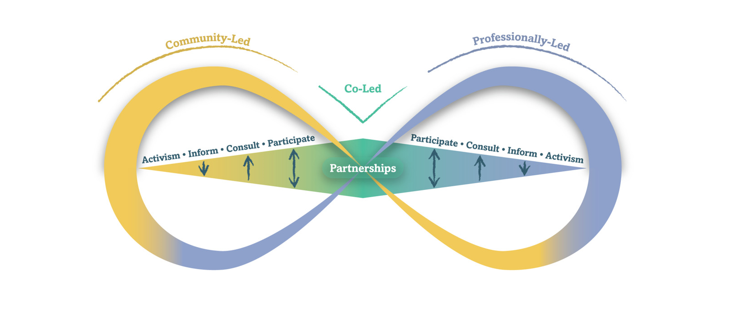
- Engagement consists in dynamic relationships oriented towards joint health-related activities being carried out together (e.g., caring for each other, doing research together, teaching together, promoting health together, and building policies together). The Engagement Loop (see image above) is:
- Reciprocal, recognising that engagement relationships can be led by professionals, community members, or both. Unlike a scale or ladder, the loop has two poles of attraction at each end (community vs. professionally-led engagement) that can be more or less powerful or balanced at different points in time.
- Dynamic, highlighting the shifting nature of engagement relationships over time. For example, a patient can take leadership of self-care activities at home, be led by professionals during hospitalisations, and engage in partnership decision-making during outpatient follow-up appointments. This shift in engagement leadership can also be observed at the collective level, where professionally led initiatives can transition to community-led programmes over time, and vice-versa.
The Engagement Loop distinguishes between different types of engagement relationships, categorising them according to the following: power and knowledge (activism, information, consultation, participation, and partnership), at what levels of health ecosystems they operate (micro-, meso-, and macrolevels), among whom (bonding, bridging, and linking), and based on its ecosystemic distribution (density, intensity, and diversity).
- Health ecosystems and engagement are interdependent (i.e., both influence health, equity, resilience, and sustainability). The engagement of patients, professionals and communities can transform its ecological context by shaping policies, social determinants of health, research, health institutions, education programmes, and direct care. In turn, several ecological factors (e.g., culture, institutions, policies) influence the process and outcomes of engagement. These influences can operate upstream (micro- to macrolevels), downstream (macro- to microlevels), or laterally (across a single level).
The paper illustrates the pragmatic application of the model using several empirical examples. For instance, a comparison of how community engagement was carried out during the Ebola epidemic and COVID-19 pandemic illustrates a contrasting approach to engagement relationships and resilience in different health ecosystems. During the 2014-2015 Ebola outbreak in West Africa, community engagement became a pillar of intervention to reduce the progression of the disease, including: designing and planning public health responses and communication strategies with communities; building public trust; and engaging communities in case detection, follow-up, and quarantine. As the literature has reported, these measures directly contributed to controlling the outbreak and supporting the resilience of the health ecosystem, with its limited professional structure. In contrast, equipped with well-resourced healthcare systems, countries in North America and Europe mostly left governance of national COVID-19 strategies in the hands of professional experts. Especially during the early phases of the pandemic, community groups were most often mobilised as delivery mechanisms, with little decision-making power over the design and planning of local pandemic response.
Having reflected on the strengths and limitations of the model, the researchers outline a research agenda for the future:
- There is a need to synthesise what is known about ecological factors influencing engagement in order to build coherent engagement policies across sectors, as opposed to fragmented and short-lived engagement support strategies.
- Adoption of an ecological perspective pushes researchers to approach engagement differently. In light of factors such as the potential for engagement to reshape the ecological context in which it is embedded by transforming organisations, communities, culture, and social norms, the model's creators note that "innovative, flexible and dynamic approaches to research and evaluation...." will be needed.
- An ecological perspective calls for long-term follow-up of the ripple effects of engagement, a gap in the existing scientific literature, which is still dominated by short-term descriptive studies of engagement initiatives.
"In conclusion, the Ecology of Engagement opens new avenues for engagement practice and science by proposing an integrated, interdependent and reciprocal model of engagement in health ecosystems....The model can serve as a common sketch to foster dialogue between system leaders, engagement practitioners and scientists to drive cooperative efforts on health system improvement, sustainability, resilience and equity."
Health Expectations https://doi.org/10.1111/hex.13571.
- Log in to post comments