










































Ensuring a Positive Practice Environment: Occupational Safety and Health for Health Worker Productivity
IntraHealth International (Deussom, Jaskiewicz, Tulenko); International Council of Nurses (Adams)
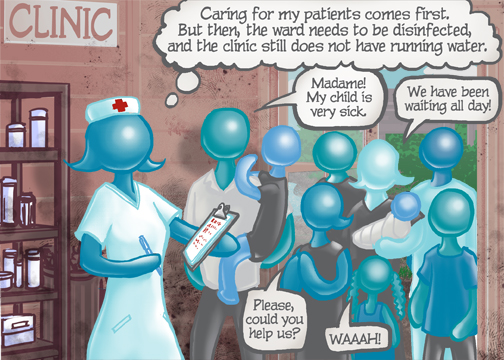
Noting that health workers are adversely affected by numerous occupational safety and health (OSH) hazards they face on the job, this CapacityPlus technical brief outlines ways to make health workers' safety a higher-level policy issue and shows how to create working environments that prioritise occupational health - in part by using comic-style illustrations. It is noted that effective OSH measures contribute to national workforce health and productivity, but only 5%-10% of workers in developing countries have adequate OSH services.
The OSH hazards described in this report that affect low-resource settings are: biological (e.g., lack of clean water to wash hands), chemical (e.g., those found in laboratories), physical (e.g., fatigue), psychosocial (stress, fear caused by violence, emotional or verbal abuse, work-related drug or alcohol consumption, depression, and intimidation in the workplace), and gender-based violence and discrimination (unwelcome advances, assaults, touching, verbal or emotional abuse, differential treatment, and marginalisation on the basis of gender from colleagues, supervisors, or patients).
"Multistakeholder initiatives that include global principles, national policy advocacy, and the involvement of professional councils, schools, and health facilities can facilitate OSH risk reduction measures and fill the gaps." Amongst the recommendations:
- Making health workers' safety a higher-level policy issue through such measures as legislation or regulatory standards for OSH. Included here are examples where OSH policy has been successfully adopted by 4 different types of policy influencers: global alliances, national governments, professional councils and associations, and health professional schools. For example, taking global standards to practice, the Positive Practice Environment (PPE) Campaign was initiated in 2008 as a multiyear, multistakeholder alliance that aims "to improve the quality of health services by raising awareness, identifying good practice and developing tools for managers and health professionals in the field, as well as carrying out concrete national and local demonstration projects to improve practice environments" (PPE 2012).
- Creating positive practice environments to prioritise occupational health. It is noted that challenges at the operational level may be due to limited knowledge or perception of risks and subsequent behaviour, as well as a limited authority to allocate resources to prevent or reduce risks. Country cases that demonstrate best practices at the organisational level include the following are provided from PPE campaigns in Morocco, Kenya, Uganda, and Zambia. For example, Uganda's health management was decentralised to empower health subdistricts to create healthy work environments, using a participatory approach and an evaluation tool to assess the probability that a hazard would result in injury and the severity of consequences if injury occurred. The evaluation tool assessed risks by location, process, job description, and gender. "As a result, facility teams had a common comprehension of the risks identified, and were better positioned to implement local improvements."
Email from Rachel Deussom to The Communication Initiative on September 25 2012.
- Log in to post comments