










































Examining Emergent Communities and Social Bots Within the Polarized Online Vaccination Debate in Twitter
George Mason University
"This research demonstrated the potential of using social media as a way to directly monitor the impact of pro-vaccine information in anti-vaccine communities."
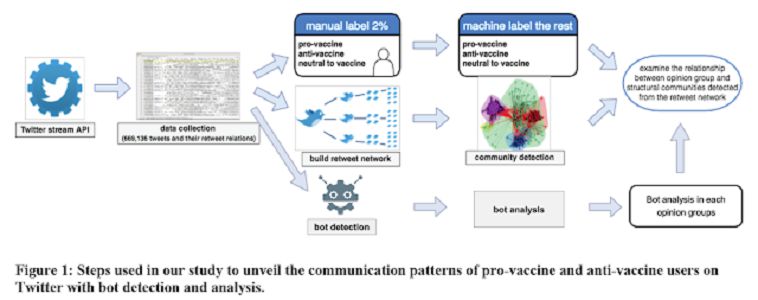
In the United States (US) and elsewhere, social media has been one of the dominant communication channels for people to express their opinions about vaccination. To that end, in the Global Vaccination Action Plan for 2011-2020, the World Health Organization (WHO) emphasises that social media should be taken advantage of to build trust with the public. Despite official efforts to disseminate information about vaccination benefits through this channel, anti-vaccine sentiment is gaining momentum. Studies have shown that social bots, computer algorithms designed to mimic human behaviour and interact with humans in an automated fashion on social media, can influence opinion trends. The research presented here investigates the communication patterns of anti- and pro-vaccine users and the role of bots in Twitter by studying a retweet network related to measles, mumps, and rubella (MMR) vaccine after the 2015 California Disneyland (US) measles outbreak.
The article provides background on refusal of the MMR vaccine, in particular. Parents who refuse to vaccinate their children are often skeptical about the safety of this vaccine and consider mandatory vaccinations to be violations of personal freedom of choice. These people often cite, or are still influenced by, Andrew Wakefield's well-known - later retracted - research published in The Lancet (incorrectly) claiming the correlation between the MMR vaccine and autism.
Specifically, the researchers ask:
- Do vaccine discussions on Twitter show a highly clustered pattern in the sense that users tend to communicate more often with those who have same opinions towards vaccination than those who do not?
- If the communication is highly clustered, to what extent do pro-vaccine users reach out to anti-vaccine users and vice versa?
- How much do social bots contribute to the conversation?
In order to answer these questions, the researchers used Twitter data collected using a geosocial system from February 1 to March 9 2015 after the Disneyland measles outbreak: 669,136 tweets published by 268,055 distinctive users. They employed a variety of machine learning techniques (i.e., "logistic regression, support vector machine (e.g., linear and non-linear kernel), k-nearest neighbors, nearest centroid, and Naïve Bayes) trained with labeled data" (which is available here) to categorise each user's vaccination stance (anti-vaccination, neutral to vaccination, or pro-vaccination groups). They discovered that:
- Pro- and anti-vaccine users retweet predominantly from their own opinion group (representing an "echo-chamber"-like communication pattern), while users with neutral opinions are distributed across communities. (One notable finding here is that, within the anti-vaxxer community, there is also a small amount of communication between anti- and pro-vaccine users. The cross-group communication is dominated by pro-vaccine users retweeting anti-vaccine users instead of vice-versa. This indicates that anti-vaccine users tend to communicate with users of same opinion group, while pro-vaccine users communicate with both in-group users and out-of-group users (anti-vaccine users).)
- 1.45% of the corpus users were identified as likely bots (per the DeBot platform for bot classification), which produced 4.59% of all tweets within the dataset.
- Although 77% bots are pro-vaccine, proportionally, these pro-vaccine bots only contribute 1.51% toward all the pro-vaccine users. It is close to the result that 1.16% anti-vaccine users are bots. Therefore, there is no obvious difference of the opinion distributions among regular users and bot users.
- Bots display hyper-social tendencies by initiating retweets at higher frequencies with users within the same opinion group. So, the "echo-chamber"-like pattern exists in the bot-initiated communication as well, with pro-leaning bots primarily connecting with pro-target nodes (both bots and regular users). The same pattern holds true for the "anti-to-anti" pairs.
One particular finding that has implications for health communicators is the fact that cross-group communication appears to be sparse for anti-vaccine users. This implies that "an effective online strategy to change anti-vaxxer's attitude might start from some 'contact.' For instance, instead of producing dry statistics of why vaccination benefits everyone, health practitioners could produce more emotionally appealing content to at least 'start the conversation'." Furthermore, they note that, situating the findings within research on the importance of healthcare workers, "mitigating against the extreme online anti-vaccine opinions still (at least partially) requires offline efforts."
In conclusion, this research has demonstrated "a way to timely measure online vaccination discussions, in comparison with indirect measurements such as vaccine hesitancy rates." It has found that that highly clustered anti-vaccine Twitter users make it difficult for health organisations to penetrate and counter opinionated information, and social bots may be deepening this trend.
Social Media + Society, July-September 2019: 1-12. https://doi.org/10.1177%2F2056305119865465 - sourced from "Communities, Bots and Vaccinations", by Andrew Crooks, GIS and Agent-Based Modeling, September 4 2019.
- Log in to post comments