










































Mapping the Dutch Vaccination Debate on Twitter: Identifying Communities, Narratives, and Interactions
Center for Media & Health (Lutkenhaus, Bouman); Erasmus Research Centre for Media, Communication and Culture, or ERMeCC (Lutkenhaus, Jansz, Bouman)
"It is important to study vaccine-related conversations across these [online] communities, because discussions can instill norms and affect perceptions that may ultimately impact the vaccine-related decisions made by individuals."
Concerned about declining vaccination rates in the Netherlands, the Dutch National Institute for Public Health and the Environment (RIVM) commissioned a Committee for Vaccine Willingness (VWC) to study the societal context of the decline. The VWC was especially interested in the role online communities play. Working for the VWC, these researchers explored the Dutch vaccination debate on Twitter in order to: identify the different communities and understand their backgrounds, identify salient vaccine-related narratives, and examine how the communities interact by exposing the ways in which narratives flow through the network.
As is explained here, 2 mechanisms have been associated with exaggerating differences about vaccination-related perceptions across online communities: (i) Online platforms tailor their content feeds to individual preferences, resulting in a filter bubble for individual end-users where they are selectively exposed to media content aligned with their interests and beliefs. (ii) The formation of echo chambers, whereby one's preexisting opinions are reinforced by like-minded peers, ultimately contributes to polarisation of communities.
Having employed a mixed-method approach, the researchers outline how they retrieved, processed, and analysed the data, which included 2,869 tweets by 1,684 unique Twitter users. The scripts to gather and process the data, which draw from Kearney's rtweet package and the igraph package, have been made available publicly via GitHub.
When the process of data retrieval began, Dutch news media reported on vaccination becoming mandatory in Italy, followed by opinion pieces and readers' letters on whether this should be the case in the Netherlands, too. A month later, the Dutch Health Council released a report in which they promoted mandatory vaccination of all children against rotavirus. This further sparked the public debate on vaccination. A substantial part of the Twitter debate (still) seemed to revolve around a public appearance of a columnist in 2016, expressing her doubts about vaccination and referring to the negative information she found online.
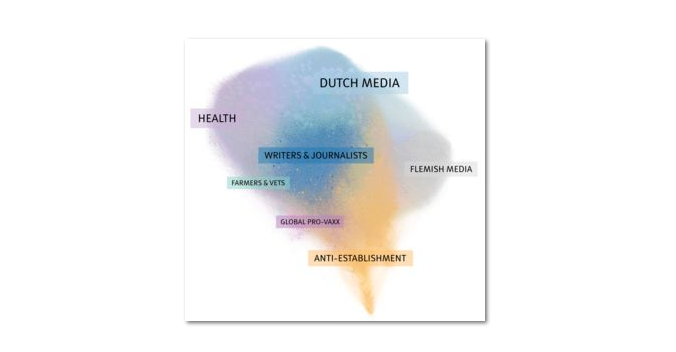
The researchers identify 7 different communities and outline their properties, comparing the number of authors with other users and distinguishing initiators (users who specifically mentioned vaccination) from sources and responders (authors of messages retrieved in the context of the debate). The communities, by order of size, include:
- Dutch media, comprising the country's main news platforms, broadcasting organisations, and public personae such as columnists, presenters, politicians, and musicians. Although this community spans 37.4% (n=45,177) of the network, just 0.3% of them were engaged in the vaccination debate, writing an average of 1.5 messages per users, the lowest of all communities.
- Health, comprising general practitioners, nurses, consultants, and other healthcare professionals working for hospitals, municipal health services, education, and mental health services. The health community spans 18.2% (21,974) of the network, with 2% of the members engaging in the vaccination debate, which is the second lowest of the communities, and writing an average number of 2.7 tweets, which is the second highest.
- Writers and journalists, including a group of (independent) journalists working for quality Dutch newspapers such as de Volkskrant and NRC. With an average number of 1.8 tweets per author, the authors in this community produce a comparatively small number of tweets, of which a substantial part is replies, possibly indicating a conversational Twitter style and an incidental kind of involvement.
- Anti-establishment, comprising homeopathy advocates, independent bloggers, alternative media, conspiracy thinkers, and users following these accounts. With 2.8% of the community engaging on vaccination, the anti-establishment community is the third-most engaged community. It is the most vocal, writing an average number of 2.8 tweets per author.
- Flemish media (Belgium), consisting of media accounts from Flanders in Belgium that are also in Dutch. With 2.2% of the community members engaging on vaccination, writing an average number of 1.9 messages, the Flemish media community is the second-least engaged, but third-most vocal community.
- Farmers and veterinarians, who are the most engaged but relatively insular (interacting relatively little with others) - probably because they are discussing vaccination from a livestock perspective.
- Global media and vaccine advocates, containing: news platforms, health and development institutions, and public personae such as researchers, correspondents, artists, and athletes mainly based outside the Netherlands. The global media and vaccine advocate community spans a mere 2.5% (n=2,971) of the network, but, with 12.2% of the community actively engaging on vaccination, this community shows the highest involvement with the topic of vaccination.
The analysis showed that the debate is spearheaded by the writers and journalists community, while the health and anti-establishment communities try to influence it. The health community circulates facts, figures, and scientific studies, while negative messages about vaccination - either from a homeopathy or conspiracy perspective - are most prevalent in the anti-establishment community.
After analysing the different profile texts of all members of the online communities, the researchers moved to the analysis of the vaccine-related tweets to determine the different narratives being circulated within and across communities. They found 9 narratives, 4 of which were negative. The themes include: scientific evidence, extremism, information, framing, natural medicine, survival of the fittest, freedom, anti-religion, and conspiracy.
Another purpose of the research was to determine how these communities interact with each other. The researchers aggregated the interactions between the communities to inspect these dynamics, as well as the circulation of community-specific narratives through the network. They detected that the health and Dutch media communities employ a classic mass media sender-approach, sharing news and evidence from a top-down perspective and hardly engaging in any one-to-one interaction. The facts and figures shared by the health community hardly reach other communities, whereas the myths introduced by the anti-establishment do spill over to other communities. The global media and vaccine advocates community is highly visible among the anti-establishment by actively responding to myths and misconceptions, and providing (retweetable) evidence to debunk these myths. The writers and journalists and anti-establishment actively interact with each other, with quotes and replies flowing between them characterised by ridicule and insults.
In conclusion: "Due to selective exposure, members of the anti-establishment community are more likely to be exposed to messages that are negative about vaccination than others. To effectively reach the group, Dutch health organizations could try to engage in an open dialogue to address questions, doubts, and worries; and by making information to debunk those myths more easily accessible and shareable."
Vaccine X. 2019 Apr 11; 1: 100019. doi: 10.1016/j.jvacx.2019.100019
- Log in to post comments