










































Expanding Access to Modern Contraception Using Advocacy to Spur Action: RESPOND's Experience in Malawi
"Use of modern contraception among married women increased from 28% to 42% during this period, translating into an additional 611,000 contraceptive users served by the public and private sector..."
This United States Agency for International Development (USAID) /RESPOND Project brief describes efforts to expand access to family planning (FP) and modern contraception in Malawi. "Nearly half of all married women and men state that they want no more children; meeting this demand will help them achieve their desired family size....The government is making concerted efforts to reach the one-quarter of married women who still have an unmet need for FP, by establishing enabling policies, investing in staff and services, and communicating the benefits and importance of FP to both health staff and communities. FP is quickly becoming an accepted national norm....Yet there is a growing need to expand information and services, especially for the large cohort of Malawi’s population nearing their reproductive years. With 49% of the household population under the age of 15..., sexual and reproductive health information and services will need to be expanded dramatically." The RESPOND Project provided the government and local partners with technical assistance for research, advocacy, and programme planning, especially for advancing long-acting reversible contraceptives (LARCs) - the intrauterine device (IUD) and the hormonal implant - and permanent methods of contraception (PMs).
In brief, the project worked with the Ministry of Health (MOH)'s Directorate of Reproductive Health (DRH) to research, advocate for increased investment in FP, and disseminate information about Malawi’s achievement using a case study based upon interviews and a secondary analysis of data to give direction to FP national planning. Through a National Leaders’ Conference on Family Planning, Population and Development in 2012, the project helped the DRH to demonstrate "to a large cross-section of influential decision makers the important relationship between FP and population dynamics, environment, education, and food security." More than 80 national decision makers participated in a stakeholders' meeting in 2013. The tool used to provide data for presentations and papers to advance understanding of the importance of providing FP was the Reality Check tool with, accompanied by training of trainers, step-down training, and testing of a revised version of Reality Check. Now accessible to the DRH and partners is a tool to assist with "quantifying the number of contraceptives and related supplies needed to meet CPR [contraceptive prevalence rate] goals; the numbers of clients to be served, by method; the number of providers needing training; and the cost of providing enough contraceptives to meet CPR goals."
District meetings were held using the EngenderHealth’s Supply-Enabling Environment-Demand (SEED™) Programming Model to frame programming and advocacy. A cadre of local champions including reproductive health staff from district hospitals, health centres, private facilities, and clinics operated by the Christian Health Association of Malawi, as well as community leaders, attended motivational workshops to help providers examine their own attitudes regarding contraceptive choice and review characteristics of specific methods. "Participants were also introduced to advocacy approaches and tools that put their local work into district, national, and international perspective."
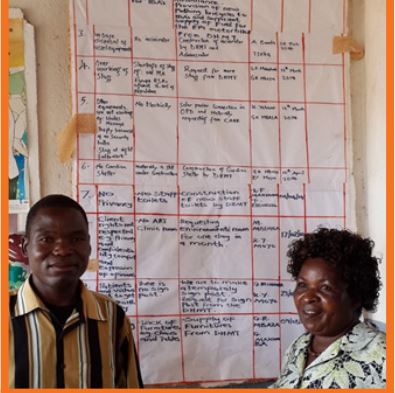
The project implemented use of COPE® for Contraceptive Security, a tool and methodology used by frontline health and logistics personnel to identify and implement low-cost local solutions to address problems related to contraceptive supply. "The tool consists of 10 self-assessment questionnaires on issues ranging from logistics to record keeping to warehousing and transport." Follow-up qualitative interviews showed gains in stock management and on-time ordering.
To meet demand for the Female Sterilization Standardization+ (FSS+) programme, master trainers were prepared with training to introduce new providers and clinical staff to FSS+ through cascading trainings.
Lessons include:
- Evidence-based advocacy is a powerful precursor to action.
- Evidence-based advocacy changed attitudes, behaviours, and commitments and motivated people to increase support of contraceptive choice.
- Reality Check is useful as both a forecasting tool and an advocacy tool.
- Replication of tools and approaches is enhanced through South-to-South exchange. A South-to-South exchange of expertise occurred among Tanzanian trainers and Malawians on the use of COPE® for Contraceptive Security and how to overcome issues through learning about improvements made in Tanzania.
- Global programmes add significant value to country programmes. The project's tools and approaches changed the way in which Malawian districts and facilities plan and respond to contraceptive needs.
The RESPOND Project. 2014, New York: EngenderHealth (The RESPOND Project), accessed September 24 2014.
- Log in to post comments