










































Father Engagement in Nutrition: A Qualitative Analysis in Muhanga and Karongi Districts in Rwanda
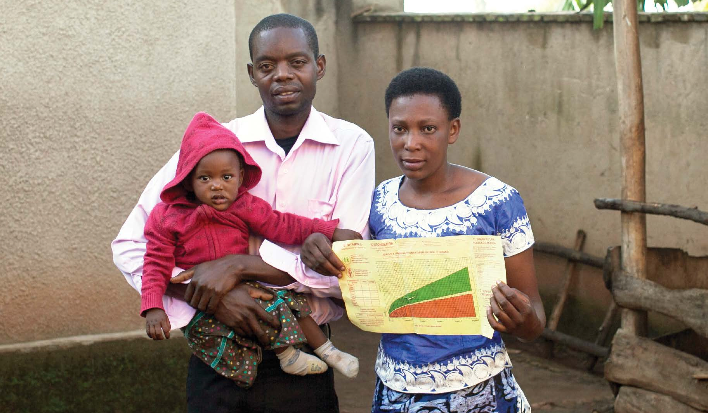
“Recent efforts to engage men in health have often centered on maternal or reproductive health and addressing the root causes of gender-based violence, but there has been less focus on involving men more in child health and child care, including in nutrition and child feeding issues.”
This report shares key findings on male engagement in child nutrition and maternal and child health from the Accelerate Reduction of Stunting of Children Under Two Years (EKN) project in the Muhanga and Karongi districts in Rwanda. The project, which is managed by the United Nations Children's Fund (UNICEF) and implemented by Catholic Relief Services (CRS) through local partners Caritas Kabgayi and Eglise Presbytérienne au Rwanda (EPR), aims to accelerate the reduction of stunting rates in under-two children across Rwanda. The programme, which is designed to reach pregnant and lactating women and children, uses an integrated three-part approach to addressing child malnutrition which includes nutrition, economic strengthening, and agricultural components. In particular, the project seeks to improve the nutrition-focused outcomes by promoting behaviour change and the adoption of optimal maternal, infant, and young child nutrition (MIYCN) practices.
As explained in the report, men are not a primary intended audience for the EKN project; however, in its third year, CRS became interested in understanding how men are in fact playing a role in their family’s nutrition around the first 1,000 days and in identifying barriers to greater engagement of fathers. The resulting study had the following objectives:
- Assess current knowledge, attitudes, and practices around male engagement in child nutrition and maternal/child health in the EKN project districts;
- Assess potential barriers and enablers to male involvement in these domains;
- Assess the degree to which men have been involved in EKN programming, and explore ways that programming may currently encourage or discourage male participation; and
- Identify existing and appropriate future avenues to better engage men with MIYCN messaging in the context of EKN.
The report outlines the rationale for the study, shares the results of a literature review on the issue of male involvement in child nutrition, and gives an overview of the methodology of the study, which involved an in-depth qualitative inquiry in eight sectors of Muhanga and Karongi Districts, utilising: focus group discussions (men, women, and mixed-gender); in-depth interviews with fathers identified by project staff or leaders as role models within their communities (“engaged fathers”); and key informant interviews with village heads and with implementing partner staff.
The findings can be summarised as follows (as taken from the Executive Summary and slightly abbreviated):
Current Knowledge, Attitudes and Practices in Male Engagement
- Men generally see themselves as engaged in their children’s nutrition, mostly via financial and resource support and in allowing wives to participate in activities around nutrition and income-generating activities such as Savings and Internal Lending Communities (SILC). They contribute less often in other domains, such as accompaniment (to the health centre, for example), emotional support, or direct caregiving/bonding with children.
- A minority of men express more open attitudes to involving themselves in tasks such as caring for children or cooking.
- Men have a good degree of basic knowledge about key nutrition messages, but often lack detailed knowledge.
- For the most part, men want to be more engaged and do not think that their current level of engagement is enough. Women perceive that the contribution of men in nutrition and childcare is not equal, but do not universally see it as a problem.
Barriers and Enablers
- Knowledge: Knowledge is still a barrier for some, but it is not the primary barrier for the men in this study, as responses reflected understanding of key nutrition and MIYCN messages.
- Couple Communication and Decision Making: Men generally reported they felt comfortable talking with their wives about their children’s well-being and reported “consulting” them in major decisions. Women reported communicating about family health issues regularly with their husbands. However, decision-making power is largely inequitable within the household, with men having the final say on how resources are allocated, including for nutrition and health-related expenses.
- Social and Peer Support: In general, men have limited social support for engagement. Although role models of active fatherhood do exist and have an influence, men who are viewed as too involved are likely to be laughed at or otherwise experience negative reactions from other men. Most commonly, these men are viewed as having been “poisoned” by the influence of their wives.
- Cultural and Social Norms around Gender: Local norms present significant barriers to male engagement. Despite Rwanda’s progressive gender equality laws, respondents still describe a traditional gendered division of roles and responsibilities, upholding a dichotomy of men as providers and women as caretakers and nurturers. Some leaders noted that there is a gradual shift taking place, and some men, particularly engaged fathers, did indeed describe taking on tasks not typically ascribed as masculine.
- Male-friendly MIYCN services: Health centres and community nutrition sites are branded largely as female spaces. Men do not tend to frequent them unless there is a reason their wives cannot attend. However, some men report occasionally accompanying children to growth monitoring sites.
- Other Influencers: Mothers-in-law were identified as particularly important influencers - both in terms of male engagement and in terms of nutrition and feeding practices more generally. Examples were cited of this influence being positive (encouraging fathers to be involved) and negative (upholding traditional social roles and incorrect ideas about child feeding).
EKN involvement
- Men perceive the EKN project as a women’s project and do not report high levels of involvement.
- Direct father involvement in any of the nutrition aspects of the project (cooking demonstrations, growth monitoring, nutrition education) is rare.
Reaching Men
- Men have been reached through broad awareness campaigns on the first 1,000 days of life, including National Family Campaigns and International Women’s Day, as well as through the radio and large-scale community campaigns around issues like gender-based violence (GBV). They have also been reached through the Umugoroba w’Ababyeyi (Parents’ Evenings), a government strategy for bringing men and women together at village level to discuss various issues related to family well-being. Local authorities have used these meetings to promote “complementarity” between husbands and wives.
- Men are interested in learning together with their wives as couples. However, they also expressed a desire for a space to learn and exchange with other men.
The report offers the following recommendations:
- "Leverage existing program activities as opportunities to increase male engagement: Project monitoring, including home visits, of activities around bio-intensive agricultural techniques (BIAT), for example, are a good opportunity to involve men in discussing their household kitchen garden.
- Utilize “father role models” and promote dialogue-focused approaches: Men want the opportunity to learn and exchange with other men, which increases social support for behavior change. Men who are already engaged (the “positive deviants”) may be able to facilitate a group dialogue focused approach which not only provides information on topics related to nutrition and family health, but also examines notions of gender norms, masculinity, and fatherhood, and encourages transformative thinking and behavior change towards greater engagement. Importantly, interventions should seek to encourage reflection and to change underlying attitudes, rather than promoting isolated behaviors as a sign that men are adequately engaged.
- Strengthen communication and the couple relationship: Although men and women report being comfortable exchanging with their spouses, unequitable decision-making is still the norm. The Umugoroba w’Ababyeyi and other, more in-depth forums should be used as opportunities to help couples reflect upon their communication dynamics and encourage collective decision-making. Events should be planned which are aimed at couples, to foster a sense of learning together and increase men’s investment in understanding how to ensure the health of their families.
- Engage other actors, particularly mothers-in-law: Mothers-in-law are key influencers with regards to household roles and responsibilities as well as nutritional practices, and are not targeted by current interventions. Training could target mothers-in-law, alongside mamans lumières, to equip the mothers-in-law with the skills and knowledge to promote positive MIYCN behaviors and to encourage father involvement at household level. Qualitative research focused on this group would help to better understand their practices and needs and to design an intervention.
- Emphasize active caregiving for both sexes: There is limited awareness of the importance of active caregiving, bonding and stimulation for children’s development. Both men and women should be provided the opportunity to learn about and practice principles of early child development. Messages should encourage both fathers and mothers to regularly play and engage with their young children. CRS’ ECD pilot must ensure that fathers as well as mothers have the opportunity to participate."
CRS website on November 10 2016.
- Log in to post comments