










































Global Health: Our Commitment to Communities
Save the Children
"Over the past fifty years, Save the Children recognized the critical role that communities play in children's development and well-being, and in their own development."
Save the Children's commitment to strengthen community systems and the social support structures and services closest to families and children is rooted in a community development and child rights orientation. Created in commemoration of the organisation's 100-year anniversary in 2019, the Community Health Legacy Brief shares strategies and impact data from efforts to improve health worldwide by addressing individual behaviours, social and gender norms and their inherent power relations, and structural issues related to the quality of, access to, and demand for care.
The brief provides a historical overview of Save the Children's commitment to communities, starting from Community-Based Integrated Rural (and later Responsive) Development (C-BIRD), an integrated approach to programming rooted in principles of community empowerment and self-determination. Two examples from the 1990s include the Community Empowerment in Nutrition Project (CENP) in Vietnam, applying a positive deviance approach, and the Bolivia WARMI Project, which featured development of a community-led process called the Community Action Cycle (CAC). Among the other endeavours discussed include Save the Children's implementation of integrated Community Case Management (iCCM) into its programmes and the development in 2003 of Partnership Defined Quality (PDQ), an approach that engages community members and service providers in collaborative quality improvement plans and action.
Key Save the Children community health strategies include:
- Community service delivery (CSD), which is "the provision of a continuum of health promotion, disease prevention, and curative services by a cadre of Community Health Workers and Volunteers (CHWs) and community groups responsive to community needs and context." Save the Children's experience includes:
- In the Maternal and Child Health Integrated Program (MCHIP), Egypt Smart Choices for Healthy Living (2011-2014), Save the Children had a 98% retention rate of CHWs, and over 149,000 mothers received maternal and child health and nutrition messages. A quasi-experimental study demonstrated the effectiveness of CHWs as change agents, with significant increases in consumption of iron-folic acid supplements during pregnancy, antenatal care (ANC) coverage, use of skilled birth attendants, and exclusive breastfeeding and children fed a diverse diet.
- Save the Children has worked in partnership with key actors, such as the World Health Organization (WHO) and the United Nations Children's Fund (UNICEF), to build consensus on the need for the iCCM approach and to influence policy; for instance, Save the Children is a member of the global iCCM Working Group, which has helped to advance operational research and policy application in multiple countries.
- Community capacity strengthening (CCS), which is "the process through which communities obtain, strengthen and maintain the capabilities to set and achieve their own development objectives over time. Community mobilization (CM) is a central approach to strengthen community capacity, through which community members, groups, or organizations plan, carry out, and evaluate activities to achieve a common goal on a participatory and sustained basis, on their own initiative or stimulated by others..."
- An inventory across multiple sectors demonstrated the effectiveness of the CAC implemented in over 40 countries, with outcomes in the areas of maternal, newborn, and child health (MNCH), adolescent sexual and reproductive health (ASRH), HIV and AIDS, nutrition, basic education, and early childhood education; evidence is shared in the brief from, for example, the Zambia LINCHPIN Project and the Access to Clinical and Community Maternal, Neonatal, and Women's Health Services (ACCESS) initiative (2006-2009) in Bangladesh, Malawi, and Nigeria. Through strategic partnerships with other non-governmental organisations (NGOs) and community-based organisations, the CAC has also been scaled in multiple countries, as can be seen in projects like Ethiopia Positive Change: Children, Communities and Care (PC3), the Zambia Health Communication Partnership Program (2005-2009), the MaMoni Integrated Safe Motherhood, Newborn Care, and Family Planning project (2009-2013), and MaMoni Health Systems Strengthening (2013-2018).
- The brief references application of the PDQ approach in more than 20 countries, with documented improvements to service quality and utilisation, including at scale in Mozambique, Zambia, Pakistan, and the Philippines. Recognising the value of this approach, the 2007 PDQ for Youth (PDQ-Y) toolkit was field tested in Nepal with research on modifying the PDQ methodology specifically for adolescents.
- Save the Children has undertaken efforts to consolidate the social science literature on CCS and adapt indicators to measure community strengthening efforts in the field.
- Community-centred social and behaviour change (SBC), which is "the systematic application of interactive, theory-based, and research-driven processes and strategies to address SBC at the individual, community, and social levels, including the cross cutting use of strategic communication. This includes interpersonal communication, group activities, community media, and social media. Community involvement at every step of the process is key (adapted from FHI360 2012: C-Modules)."
- Save the Children has developed integrated programming combining SBC strategies with CCS approaches and with large SBC campaigns integrated with community programming. Examples provided (with evidence of impact) include the "A Baby is a Gift" campaign piloted by the Malawi Ministry of Health and Save the Children's Saving Newborn Lives (SNL) project and "Grow Together", undertaken as part of the Cambodia NOURISH Program (2014-2019).
- Save the Children has used community approaches to address gender norms, notably with adolescents, to promote male engagement. Examples (with data) include the Model Husband School approach, which combines SBC with CCS in Niger and Burkina Faso, and Northern Uganda's Responsible, Engaged and Loving (REAL) Fathers Project (2014-2017). The latter involved home visits with small group sessions with young fathers and their mentors, as well as community posters purposefully sequenced and displayed over time to stimulate discussion and reflection. From baseline to long-term follow-up, there were significant declines among men in intimate partner violence, from 66% to 37%, and in use of physical punishment, from 68% to 50%.
- Save the Children's work in ASRH includes approaches that use small-group based dialogue and discussion models coupled with parent, community, and service provider engagement. Examples discussed include the Gender Roles, Equality and Transformations (GREAT) Project (2010-2016) and a Gender Norm Package for very young adolescents.
- Among the media-supported community dialogue examples cited here are the Ethiopia Empowering New Generations to Improve Nutrition and Economic Opportunities (ENGINE) Project (2011-2016) and the Strengthening Partnerships, Results and Innovations in Nutrition Globally (SPRING) Project (2011-2018). ENGINE featured development of the Enhanced Community Conversation (ECC) approach, which includes a virtual facilitator with pre-recorded audio, behavioural demonstrations, and games to promote the adoption of optimal maternal and child feeding practices, and a transformation of gender roles. A comparison of baseline to endline results found statistically significant outcomes on infant and young child feeding, maternal and child dietary diversity, and handwashing practices.
- Save the Children works to engage traditional and religious leaders as important stakeholders in SBC approaches. For example, the LAHIA project in Niger led to improvements in hygiene through training of traditional and religious leaders in community-led total sanitation (CLTS) and latrine construction, faith-based messaging at local radio stations, and involvement of religious leaders in village development committees.
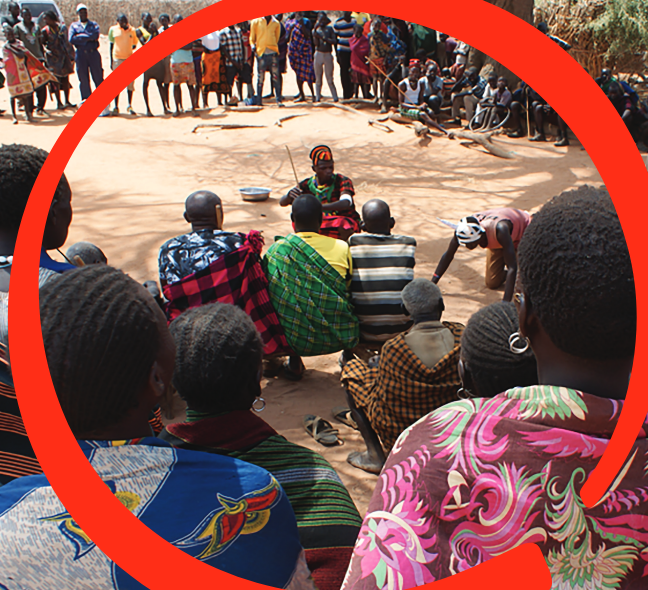
- Save the Children has reached pastoralist communities in a variety of settings, such as through the participatory learning and action processes incorporated into the Pastoral Livelihoods Initiative Phase II project (2009-2013) in the Somali Region of Ethiopia. Two lessons learned in an evaluation were: (i) multiple community-based behaviour change communication (BCC) approaches help reach large and various segments of community, and (ii) empowering and including women and girls in BCC and CM is crucial. Another example discussed is the food security project Apolou (2017-2022) in the Karamoja region of Uganda, whose Eyok Kiyan ("our discussion" in Karimojong) campaign works through experiential marketing activities (Manyatta Wagon), silent trigger videos, a radio magazine programme, and various community platforms in an effort to increase skills and collective efficacy to practice new behaviours, as well as to strengthen existing community self-organisation.
For each of these areas, the brief looks at "the unfinished agenda for community health". For example: (i) For CSD, Save the Children is working with partners to build the evidence base for effective iCCM approaches, such as in emergency settings; (ii) CCS-related opportunities include, among others, further research and documentation of the social normative changes and impact on health and development outcomes due to CCS, as well as exploration of the use of CAC, PDQ, and other CCS processes through the application of mobile technology; and (iii) Save the Children will continue applying more systematic and measurable SBC, such as in its Emergency Health and Nutrition response package; the SBC team is also mobilising urban communities for health and emerging infections and other humanitarian situations.
"Going forward and based on our integrated SBC framework, this combination of CCS, CSD and community-centered SBC can be developed and implemented more systematically, using quality standards and tools, including an online tool (FOCUS) to develop SBC strategies and plans."
Emails from Antje Becker-Benton to The Communication Initiative on October 23 2019 and October 30 2019; and Save the Children Resource Centre, October 23 2019.
- Log in to post comments