










































The Impact of Mandatory Vaccination Law in Italy on MMR Coverage Rates in Two of the Largest Italian Regions (Emilia-Romagna and Sicily): An Effective Strategy to Contrast Vaccine Hesitancy
University of Bologna (Gori, Ricci, Ialonardi, Fantini); University of Palermo (Costantino, Vitale); University Vita-Salute San Raffaele (Odone, Signorelli)
"The debate is still open on how mandatory vaccination strategies are effective in the short term, but in the long term these strategies may limit confidence in vaccination and lead to an attenuation of the positive effects of coercive measures."
In recent years, a worldwide increase in vaccine hesitancy (VH) and a reduction in vaccination coverage (VC) rates have been observed worldwide. The trivalent measles-mumps-rubella (MMR) vaccine has been one of the most targeted by hesitant parents due to possible (but never proven) adverse effects. In Italy, VC rates for MMR have been decreasing since 2012; as a result, there was a measles outbreak in 2017-2018. In this context, this study investigates infant and childhood MMR immunisation coverage rates and trends in the period 2009-2018 in the Emilia-Romagna Region (RER) and the Sicily Region (SR). The aim is to assess the effectiveness of mandatory vaccination laws as a strategy for combating VH.
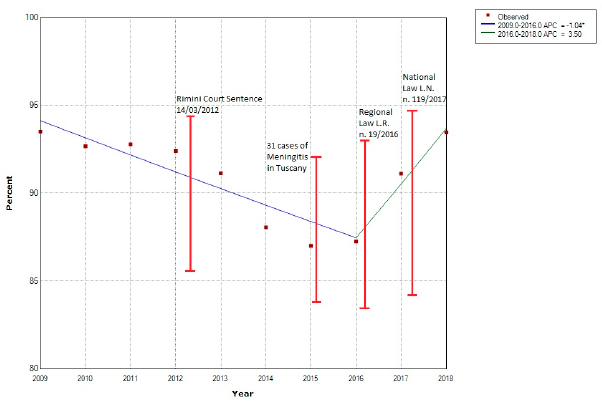
The researchers explain that VC at 24 months for the MMR vaccine in RER showed an important reduction between 2012 and 2015, leading regional and national health authorities to take urgent measures. In 2016, RER enacted the Regional Law n.19, which introduced mandatory vaccination for access to educational and recreational services for kindergarten-age children. The decision by RER was reinforced by the 2017 National Law 117/2017, which increased the number of mandatory vaccinations for primary school attendance from 4 to 10 and introduced fines for hesitant and refusing parents. In addition to the law, the Italian Ministry of Health enacted on February 18 2017 the 2017-2019 National Vaccination Prevention Plan (Piano Nazionale Prevenzione Vaccinale, or PNPV).
According to the researchers, one of the possible causes of the steep decrease in VC rates since 2012 in RER and SR is the Rimini Court sentence of March 15 2012. This sentence, which garnered widespread media coverage, supported the possible association between vaccines and autism. The event, along with other general causes like the role of social media, caused increasing fear in the population and contributed to the development of anti-vax movements in the RER and generally at a national level. In addition, due the occurrence of 2 suspected deaths within 48 hours of vaccine administration, the Italian Medicines Agency (Agenzia Italiana del Farmaco, or AIFA) decided to withdraw, as a precautionary measure, some lots of adjuvant trivalent influenza vaccine in November 2014. This event was again widely covered by media, which highlighted the potential negative consequences that the influenza vaccine could have on a population's health. These 2 events may have contributed to enhancing vaccination-related suspicion that has developed in the Italian population in recent years.
For the study, the researchers used Joinpoint (JP) regression models to identify statistically significant trends and changes in trends (increasing/decreasing) in MMR vaccination during 2009-2018 in RER and 2012-2018 in SR. The key finding is that there was a 4.1% increase in RER and a 6.4% increase in SR in VC for MMR in the year 2017 following the RER Law 19/2016, and an additional 2.5% and 5.3% in SR in the year 2018 following the PNPV 2017-19 and especially Law 117/2017 deliberation. "This confirms the effectiveness of legislative measures in favor of vaccination, together with information campaigns and political initiatives at different levels."
In conclusion: "Based on these premises, the improvement of vaccination knowledge (health literacy) remains the main target to be achieved, consistent with the current Italian National Vaccination Plan....However, the law on mandatory vaccination for the MMR vaccine in Italy has allowed a significant increase in vaccination coverage rates in both regions analyzed. In the future, a health policy goal should be the improvement of parents' trust, allowing them to make informed and responsible choices. Specifically, communication and information are essential components of strategies to counteract vaccination hesitation and ensure the success of any immunization program."
Vaccines 2020, 8(1), 57; https://doi.org/10.3390/vaccines8010057.
- Log in to post comments