










































Improving Human Papillomavirus-Related Knowledge and Attitudes Among Ethnically Diverse Young Adults
University of Texas Health Science Center at Houston School of Public Health (Preston); Robert Stempel College of Public Health and Social Work, Florida International University (Darrow)
"HPV-related knowledge and attitudes can be improved through a brief, tailored, and visually inclusive educational intervention experience in a college setting."
Human papillomavirus (HPV)-related knowledge is reportedly lower among Hispanic populations compared to non-Hispanic whites in the United States (US), as ethnic minorities are less likely to receive relevant vaccination recommendations from healthcare providers, in addition to perceiving a lower threat of HPV. In support of the Healthy People 2020 goal to reach 80% HPV vaccine coverage, the aim of this study was to develop and then test the efficacy of an educational intervention for improving HPV-related knowledge and attitudes among ethnically diverse college students enrolled in a Hispanic-serving institution (HSI) in south Florida, US, a region known to have many Cuban and other Hispanic populations and a high incidence of cervical cancer.
From April 2015 to February 2017, the researchers conducted a brief in-class intervention in English with students enrolled at a public, urban HSI in south Florida. The intervention utilised a pre-test and post-test to evaluate the efficacy of a 30-minute educational presentation and question-and-answer session designed to improve basic knowledge of HPV and HPV vaccination among 387 diverse college students attending a gender studies course. Presentation messages incorporated physical Hispanic representation in intervention materials. This was intended to develop "felt targetedness" among participants, a construct in health marketing that identifies the feeling of being the intentional recipient of the health information.
Hispanic participants had more positive attitudes toward HPV vaccination (62% vs. 44%, p=0.009) and were more willing to become vaccinated (66% vs. 46%, p=0.02) than non-Hispanic participants at baseline. Hispanic women (48%) were more likely to have initiated HPV vaccination than Hispanic men (27%, p=0.006). At baseline, only 30% of participants scored 4 or more out of 7 points in knowledge.
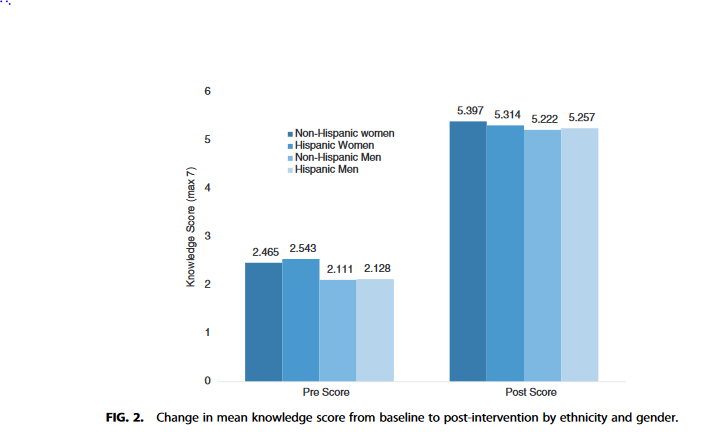
Immediately after the intervention, participants showed a statistically significant improvement in knowledge and attitudes toward HPV and vaccination. When asked again about their self-perceived knowledge of HPV, 94% of those who felt limited knowledge at baseline felt that they knew more following the intervention. Similarly, 91% felt more knowledgeable about the HPV vaccines following the intervention. Participants improved their average knowledge score from 2.4 points (standard deviation (SD)=2.0) to 5.3 (SD=1.5) out of 7 (p<0.001); this is a 41% increase. There was no difference in post-intervention knowledge score between ethnicities after means were adjusted for preintervention score.
Attitudes toward general vaccine safety and effectiveness moderately increased following the intervention (from 72% in pretest to 81%). Opinions of the HPV vaccine improved overall at follow-up, with non-Hispanic attitudes improving to 73%, yet not enough to close the significant attitude gaps seen at baseline compared to Hispanic participants (81%, p=0.04).
Consideration of HPV as a serious concern for women increased from 69% at baseline to 92% and from 47% to 86% for men. Despite this, only 63% of women and 73.6% of men felt that HPV was a threat to their own health. Hispanic participants were still more likely than non-Hispanic participants to agree that women (93% vs. 86%, respectively, p=0.05) and men (92% vs. 86%, respectively, p=0.05) should be vaccinated against HPV. Hispanic and non-Hispanic participants evaluated the components of the intervention as very positive. Nevertheless, in 10% of non-Hispanic cases (vs. 5% in Hispanic cases), participant attitudes were even more negative post-intervention than at baseline, indicating that the intervention may have reinforced existing vaccine-hesitant attitudes among some students instead of counteracting them.
Evidence points to provider recommendation as the single strongest event in the behavioural path to vaccination. However, providers are less likely to recommend the HPV vaccine to racial/ethnic minorities. The researchers indicate that medical education programmes should develop HPV and HPV vaccination educational modules to increase provider confidence in giving strong vaccination recommendations, especially in response to hesitant attitudes. Furthermore, providers should work to minimise missed opportunities for vaccination in a culturally competent and inclusive manner. Future studies that assess attitude and prejudicial predictors of HPV vaccination recommendations among healthcare providers would be useful, according to the researchers.
They also propose that future studies assessing the role of education on HPV knowledge and attitudes could consider including increased measures on ethnicity and preexisting vaccination stances. Particular care can be taken in future intervention studies to tailor HPV educational messages for Hispanic young men and women in both clinical and nonclinical settings, although this study found that simply providing the information may be sufficient among Hispanic college students.
Noting that the intervention itself was inexpensive and easy to implement, the researchers conclude that "Intervention in the college setting has the potential to close disparities in HPV knowledge between ethnicities, as well as bolster vaccine attitudes and vaccination rates. Addressing HPV knowledge outside of a traditional clinical setting takes some of the burden off health care providers, who are restricted in time and sometimes resources to thoroughly educate patients about HPV." However, as noted above, healthcare providers may benefit from increased training on inclusive education of all vaccine-eligible patients regardless of ethnicity. "As the topic of HPV vaccination advances in public scrutiny, HPV interventions should now turn their focus to populations disproportionately burdened by HPV and HPV-related outcomes and populations at risk for underutilization of the vaccine."
Health Equity. 2019 May 28;3(1):254-263. doi: 10.1089/heq.2018.0091. eCollection 2019.
- Log in to post comments