










































Love Patrol

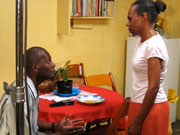
The Wan Smolbag Theatre was motivated to raise the profile of understanding of HIV in the Pacific through the television/DVD, which has a wider reach than many other mediums, particularly given the geographically isolated nature of the Pacific Island countries and low levels of literacy. In Series One of Love Patrol, the action takes place in a police station in an urban centre somewhere in the Pacific. Mark is a detective. He desperately wants his wife to have a child, but he is also caught up with Rita, a singer in a bar. A gang of boys are slipping into houses to steal money; they rob a Minister's house. The search for the boys takes us into the settlements, "the other side of Paradise" where unemployment is rampant. HIV does not become a major focus until episode 6. The central reason for this was to hook people who may be deterred by the HIV focus. Stories collected from around the Pacific through workshops and from the nurses and peer educators at Wan Smolbag's reproductive health clinic informed the series.
In order to increase the reach and effect of Love Patrol, Wan Smolbag worked with a behavioural specialist to produce a teacher's guide for series which was then pretested with teachers in rural and urban schools in Vanuatu, Fiji, and Solomons. The DVD of Love Patrol (Series 1) has been distributed widely to schools and communities in approximately 20 Pacific countries, with accompanying student and teacher workbooks. The user's guide encourages principles of critical thinking and interactive classroom practices. The guide, therefore, reinforces information in the series and raises discussion on issues including sexual health, youth crime, violence, relationships, and gender issues. Click here to download the guide in PDF format.
In August 2012, Love Patrol began filming Series 6. As they become available, the DVDs and workbooks of Love Patrol series are distributed widely to schools and communities around the Pacific. Click here in order to download the available guides, as well as to read storylines for each of the series.
Reproductive Health, HIV/AIDS, Gender Equity.
An evaluation survey and report was carried out in 2008 on the impact of Series 1 of Love Patrol in Fiji, Solomons, and Vanuatu; see the "Related Summaries" link below to access a summary and the full document. "Both the qualitative and quantitative components of the research undertaken suggested changes in knowledge and attitudes once participants had viewed the series. The research also draws out participants' intent to change risky behaviour. Love Patrol has been a huge success. People have been exposed to issues that are rarely talked about in the Pacific. The use of the soap format has brought 'tabu' topics into people's living rooms and raised discussion about HIV amongst ordinary people in many Pacific countries." One viewer explains, "It raises issues that are hard for people to talk about, but when it comes out on TV, no one blames anyone for raising those issues and it becomes a way to begin talking about important issues." Another noted that Love Patrol and the teacher support materials "help us to think and be creative on how to attract learners' attention and involvement."
Since then, research on the impact of Love Patrol has found that:
- It is creating greater openness in talking about traditionally taboo subjects and stimulates dialogue in families, schools, workplaces, churches, and communities about difficult issues.
- Many viewers report that the show has allowed them to open up discussions with their partners, children, and other family members about HIV and other sensitive issues.
- In Vanuatu, Love Patrol has inspired a range of topics on talkback radio.
- It is increasing motivation and confidence to seek advice, treatment, and support for sexual health services, including among sex workers.
- There is evidence of Love Patrol playing a role in reducing denial about sex work and increasing community dialogue on the issue.
- Health workers are noticing the influence of Love Patrol within the communities where they live and work.
Wan Smolbag Theatre is a non-governmental organisation (NGO) based in Vanuatu but operating all over the South Pacific. It has grown since 1989 from a body of 5 actors to a team of around 70 full-time staff and international volunteers, plus another 40 or so people whose main income derives from Wan Smolbag activities.
The development of the Love Patrol series was encouraged by the success of the edutainment series in South Africa called "Soul City".
The series was funded by the Australian Government (including through the Pacific Regional HIV/AIDS Project - PRHP), Nga Hoe Tuputupu-mai-tawhiti (NZAID), and the Secretariat of the Pacific Community (SPC), with additional support from the Global Fund to fight AIDS, Tuberculosis and Malaria.
Emails from Peter Walker and Joanne Dorras to The Communication Initiative on March 7 2009 and August 7 2012, respectively; and Wan Smolbag website.
- Log in to post comments