










































Mining HPV Vaccine Knowledge Structures of Young Adults From Reddit Using Distributional Semantics and Pathfinder Networks
The University of Texas Health Science Center at Houston (Amith, Savas, Smith, Cuccaro, Gabay, Tao); University of Washington (Cohen); Texas Children's Hospital (Cunningham, Boom); Arizona State University (Schvaneveldt); New Mexico State University (Schvaneveldt)
"Understanding preconceptions of this group could inform health-care professionals to better engage target vaccine audience users on social media platforms such as Reddit."
Use of social media to seek health information, facilitate social support, and promote psychological well-being is higher among young adults, making it a potential information source to understand personal determinants of health-seeking behaviours. The present study used the social media platform Reddit to examine the perceptions, concerns, and beliefs of Reddit users as they pertain to human papillomavirus (HPV) vaccination. The aim is to increase understanding of factors influencing young adults' decision-making regarding obtaining HPV vaccination, the coverage rate of which has been described as "alarmingly low for both males and females" in countries such as the United States (US).
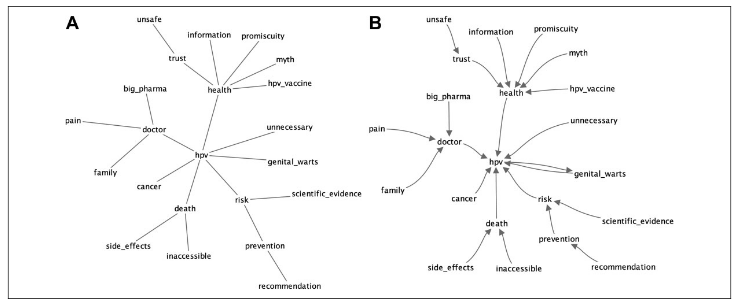
The study is grounded in distributional semantics, which is predicated on the notion that words that appear in similar contexts across large bodies of free text (corpora) may be semantically related to each other. Specifically, Random Indexing (RI) and Reflective Random Indexing (RRI), an extension of RI that aims to enhance its ability torecover meaningful implicit associations between terms from a corpus, were used. The researchers derived Pathfinder networks (PFNETs) from estimates of semantic relatedness obtained by learning word embeddings from Reddit posts and compared these to networks derived from experts' (e.g., paediatricians, health communication experts, behavioural scientists, and epidemiologists focused on HPV vaccination research) estimation of the relationship between key concepts. They interpreted the set of relationships existing between extracted keywords from submissions posted on Reddit over a duration of 10 years (2007-2017).
Results revealed that users of Reddit, predominantly comprising young adults in the vaccine catch up age-group 18 through 26 years of age, perceived the HPV vaccine domain from a virus-framed perspective: Reddit users implicitly arrange their knowledge around virus- rather than vaccine-related topics. In contrast, HPV vaccine experts abstracted their knowledge using professional understanding of the HPV vaccine and HPV. Overall, the PFNET for Reddit expresses young people's domain understanding from the perspective of sexually transmitted infection (STI) transmission and the impact of contracting this virus. Pap screening is an important preventive measure for HPV among females, yet this concept does not appear to be reflected or understood to be important by the younger and predominantly male Reddit population in the context of HPV. Awareness of the HPV vaccine for cancer prevention is also lacking.
Based on these findings, implications for future health communication initiatives are outlined. The researchers suggest that HPV vaccination messaging for young adults should focus on genital warts and prevention of HPV infection, followed by education on HPV vaccination for cancer prevention. While other studies have show that cancer prevention may be more acceptable and salient for parents considering the HPV vaccine, the risk of STIs and their prevention appeared to resonate more with the sexually active young adults in the present study. Future studies are needed to confirm these findings, particularly among young adult non-Reddit users, such as those with less educational attainment.
In conclusion: "What individuals express on social media platforms may be examined qualitatively and quantitatively to identify themes related to how a subgroup may perceive or understand health recommendations, including vaccination. This is particularly helpful for health communication and public health researchers planning e-health interventions targeting online users in specific social media domains."
Cancer Control, Volume 27: 1-16. DOI: 10.1177/1073274819891442.
- Log in to post comments