










































Using Markers for Digital Engagement and Social Change: Tracking Meaningful Narrative Exchange in Transmedia Edutainment with Text Analytics Techniques
Center for Media & Health (Lutkenhaus, Bouman); Erasmus University Rotterdam (Lutkenhaus, Jansz, Bouman); University at Buffalo, The State University of New York (Wang); The University of Texas at El Paso (Singhal); Inland University of Applied Sciences (Singhal)
"Online user engagement can significantly affect public agenda setting...and the renegotiation of norms and values."
Previous studies show that active user engagement that conveys injunctive norms on social media, such as content that generates many likes, shares, and comments, can influence attitudes and behaviours. While the rise of social media offers an opportunity for large-scale user engagement to promote such norm change, challenges exist in preserving the intentionality of campaign messages and in tracking meaningful user engagement across digital platforms and across time and space. This article shares a potential solution: "markers", or verbal expressions, visual representations, and modeled behaviours that are aligned with a project's social objectives. Markers can be introduced in entertainment programming and subsequently monitored on multiple media platforms and assessed using various textual analytics techniques. The field-based study reports on the use of markers in a transmedia edutainment initiative led by the Population Foundation of India, Main Kuch Bhi Kar Sakti Hoon (I, A Woman, Can Achieve Anything; hereafter, MKBKSH). Specifically, it looks at how, in MKBKSH Season 3, markers functioned as points of engagement that allowed the researchers to follow how social norms are shifting around issues such as sanitation, family planning, and gender equality.
As detailed at Related Summaries, below, MKBKSH leveraged the power of storytelling through a melodramatic television serial broadcast in India across three seasons (2013-2019) and 183 episodes. MKBKSH's main plot centered on its protagonist Dr Sneha, a young medical doctor who leaves her lucrative practice in Mumbai to return to her home village of Pratappur to challenge and overcome regressive social norms such as child marriage, sex-selective abortion, domestic violence, open defaecation, gender inequality, and large family size. Centring around multiple characters, intersecting plots, and social topics, the television serial was adapted on the radio in multiple regional languages and fostered audience outreach through various digital platforms, including a real-time interactive voice response system, mini-documentaries on YouTube, an artificial intelligence chatbot on Facebook Messenger, and allied promotional activities on popular social media. MKBKSH was designed to serve as a catalyst for spurring interpersonal discussion and shifting public discourse across platforms and over time.
Broadcast from January 26 2019 to April 21 2019, the first 26 episodes of MKBKSH Season 3 focused on sanitation issues and gender equality. In MKBKSH Season 3, a set of 4 markers were co-created by the MKBKSH producers and researchers to provide positive alternatives to existing beliefs and practices while turning upside down prevailing regressive social norms. These markers were then introduced in the television serial and strategically promoted on social media. The markers were presented in various compelling and playful media formats (e.g., visual imagery and dance moves) designed to invite audiences to reflect on, interact with, and endorse the prosocial messages embedded in the markers. In this way, audiences were invited to share their perspectives on the health and social issues featured in the programme.
The markers included:
- Swachhta Elaan (cleanliness pledge): Its narrative context was established through a storyline involving Panna, a young woman who is molested by several men when she goes to defaecate in the field because her home has no toilet. As the story unfolds, Panna becomes an apprentice to Dr Sneha, and they both champion the cause of hygiene and sanitation, making house visits to educate residents. They also make appearances on Pratappur Vaani (Voice of Pratappur), a local community radio station hosted by Munna and Buaji, respected and credible sources who use humour to engage and persuade their listeners. The culmination of this community mobilisation drive on MKBKSH, including the celebration of its open-defaecation-free status, occurs in the village square with the collective performance of a popular Qawwali (a genre of Sufi singing with dialogic call and response), in which community members emphasise their Swachhta Elaan (cleanliness pledge) to maintain sanitary practices.
- Mast Pitara (pleasure basket): Panna brings a pleasure basket to the Pratappur Vaani community radio station, where she has lively conversations with Munna and Buaji about the pleasures of its contents: Mast Topi (pleasure hats, i.e., male condoms), Mast Goli (pleasure pills, i.e., oral contraceptive pills), and Mastbandi (pleasure-closure, i.e., vasectomy). Later, a new character enters the stage, Condom Baba, a medical doctor turned mystic, who preaches the advantages of condom use through riddles, puzzles, and anecdotes. When Condom Baba, who opened a Condom Dhaba (roadside condom café), is brought to court for openly (if not brazenly) bringing taboo sexual issues to the public, he convinces the judge about the importance of his work, allowing viewers to move toward more open conversations about sexual topics, including viewing protected sex in a new light as "healthy passions".
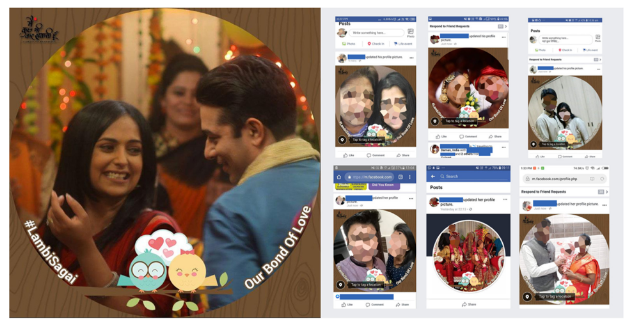
- Lambi Sagai (long engagement): This marker was introduced in a romantic storyline featuring Panna and her fiancé Sameer, a creative technology tinkerer from a high social caste. Sameer's mother stigmatises Panna (on account of her molestation) and is vehemently against Sameer marrying her. By the end of the first 26 episodes, the young couple decides not to rush into marriage, allowing them to establish their careers and a healthy and happy foundation for a life together. The purpose of Lambi Sagai was to present a counter-narrative to the predominant practice of early marriage while also emphasising the value of collective decision-making and deep understanding between would-be couples about their mutual aspirations in life.
- Laadlidin (day of the beloved woman): On television, Dr Sneha's parents celebrated their anniversary by having 4 young girls collectively cut their birthday cake. The purpose behind the marker was to portray a new gender-equitable practice: a public celebration of girls' birthdays at par with boys' birthdays.
As conversation starters and calls to action, social media posts featuring these markers invited audience members to engage in multiple ways - for instance, to post poetry to expound on their Swachhta Elaan (cleanliness pledge), to provide reasons they would choose Lambi Sagai (long engagement), and so on. Using social media in this manner can empower the audiences to shape the unfolding narrative and public discourse underlying each of the newly-introduced markers. The researchers then applied various web-based tools to systematically track marker-related engagement on Facebook, Twitter, and YouTube from January to September 2019. They also conducted semantic network analysis to better understand how marker-related social media comments evolved over time. Based on this digital tracking of markers, they were able to identify attributes of social media content formats and promotional strategies that effectively spurred enthusiastic and meaningful audience engagement.
The researchers' investigation of markers was guided by the conceptual framework of digital story circles. Social media provide platforms for narrative exchange, while their technical features as well as the users' social networks provide the infrastructures for such narrative exchange. For instance, Facebook posts can evoke certain scenes and character dialogues and ask audiences for their opinions. In implementing the social media strategy for MKBKSH Season 3, the creative team was guided by 4 key considerations: (i) Inspire: social media posts were designed to shine the light on a marker-related narrative element of the television serial that was geared to enhance knowledge, attitude, and/or behaviour change; (ii) Introduce: markers were presented to the audiences using unique and novel verbal expressions (e.g., hashtags), visual representations (e.g., Facebook frames, dance moves), and newly-modelled behaviours (e.g., toilet cleaning challenge) that represent positive alternatives to their existing reality; (iii) Invite: invitations were extended through the social media posts with specific calls for action for audiences to share their own stories in creative ways; and (iv) Inspire (again): audience members discovered their agency as storytellers by using their own voice, seeing their story connecting with other people's stories, and witnessing the collective amplification of marker-related discourses, leading to a new series of social media posts.
By late January 2019, MKBKSH had built up a community of 134,700 likers on Facebook, 52,600 followers on YouTube, and 2400 followers on Twitter. The Facebook page became the central point of digital narrative engagement and the main focus of this article. Overall, 128 marker-related Facebook posts were made by the Population Foundation of India's social media team, with 3,321 audience comments and an average of 25.9 per post, compared to 228 non-marker-related Facebook posts with 4,380 audience comments and an average of 19.2 comments per post. Table 3 shows the digital analytics for the 4 markers tracked in MKBKSH Season 3. The marker with the highest average comments per post was Lambi Sagai (long engagement), receiving more than triple the average for non-marker-related posts. The comment averages of Laadlidin (day of the beloved women), Swachhta Elaan (cleanliness pledge), and Mast Pitara (pleasure basket) were slightly lower than the average for non-marker-related posts.
To provide an account of how systematic monitoring of markers allowed the researchers to creatively adapt, experiment, and enhance their impact over time, the results are presented chronologically in the paper (e.g., see Figure 1, which visualises interactions across the television serial, audience reach, engagement, and comments on the MKBKSH Facebook page). Figures 2 to 4 show the evolution of the semantic networks through the 3 phases and how engagement with the markers changed over time. In summary:
- The results suggest that markers can be used to stimulate narrative exchange around sensitive topics while preserving the original intentionality when they are embedded in social media posts that refer to a story that the audience knows and/or follows and when social media posts specifically invite the audience to share their perspective on the topic.
- The markers that were strongly rooted in MKBKSH Season 3 proved to be the most valuable sources of conversation material, especially when the markers appeared in the television serial and social media post schedule in a coordinated fashion. The Lambi Sagai (long engagement) posts in late April provide an example of how the social media team set a story circle in motion toward the climax of the romance between Panna and Sameer: A dictionary definition introduced the marker, dramatic scenes provided context and inspiration, and specific messages invited audiences to share their views on marriage. Drawing from the same narrative context, content formats such as memes can be used to sustain engagement in the month thereafter.
- Along those lines, variety of media formats can be used to start and sustain narrative exchange: Audiences can be asked to share stories in text, as poems, or as song lyrics. Similarly, audiences can be asked to share pictures or endorse key messages by applying frames or other visual filters to their photos. Audiences can also be invited to participate in dance challenges, although the data suggest that the effort requested from the audiences should not be too high, as it can pose a barrier to participation.
- Affiliating messages with popular, knowledgeable, and inspirational characters - real or fictional (e.g., Dr Sneha) - increases audience engagement. Also recommended: connecting posts with real-world events such as World Population Day and International Friends Day and capitalising on the contemporaneous success of sports idols and role models such as the Indian women's world badminton champion, PV Sindhu.
From the 4 steps in the framework, the third one - invite - was found to be of particular importance. A strong invitation (e.g., requesting audiences to finish song lyrics, or showing a scene and asking what audiences would do in the place of Dr Sneha or Panna) often explained the difference between a handful and hundreds of comments around the featured health and social issues. These posts set social processes in motion that resulted in rich audience responses. Conversely, when posts or markers only include a strong but close-ended message, audiences seemed less likely to comment. Such posts include slogans, quotes, or statistics and were liked and shared frequently.
Thus, this study demonstrates that "markers can be used to stimulate narrative exchange around sensitive topics while harnessing their original intentionality. MKBKSH Season 3 provides an example of how communication channels such as television, radio, and social media can be strategically purposed into layered interactive communication systems that offer a continuous stream of engagement points on social topics for audience members. Markers can be used to stimulate meaningful audience engagement exchange in that they link social media content formats to a corpus of meaningful stories."
In conclusion, "markers can serve as anchors for identifying the most relevant data, showing evidence of new perspectives and desired realities embedded in unique terminologies, visualizations, or practices that can be traced back to their narrative origins and nowhere else. Program evaluators can track these meaningful digital footprints over time and across different platforms to follow how social norms in online conversations may be shifting, thus enhancing the efficacy of program monitoring and assessment....Furthermore, systematic monitoring allows practitioners to continuously find and finetune media content formats to stimulate meaningful engagement and leverage social influence on social media."
Digital Health, Volume 8: 1-18. DOI: 10.1177/20552076221107892 - sourced from emails from Arvind Singhal and Roel O Lutkenhaus to The Communication Initiative on June 15 2022 and June 20 2022, respectively.
- Log in to post comments