










































Videoconferencing and Low-cost Wireless Networks Improve Vision in Rural India
Columbia University
According to this article on the website New Media and Development Communication: Human Rights: New Challenges and Applications from graduate students of the Columbia Center for New Media Teaching and Learning, Columbia University, New York, NY, United States, the Aravind Eye Care System, located in the eastern state of Tamil Nadu, India, is working to counter blindness, largely from cataracts, and other vision problems suffered by millions of people. The author states that 90 percent of the problems are treatable, but most Indians lack access to good quality eye care. However, the Aravind system uses high-quality video conferencing and low-cost wireless technology to bring eye care to economically poor, rural communities.
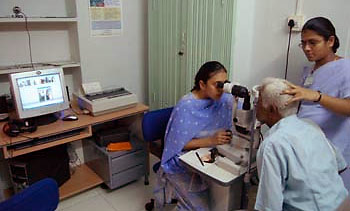
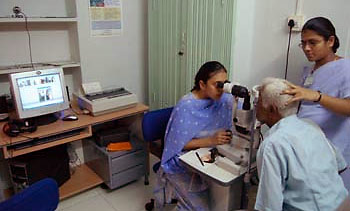
As stated here: "The Aravind Eye Care System reaches remote villages through 50 rural vision centers. The centers are equipped with basic equipment and run by an ophthalmic assistant who performs basic examinations, prescribes corrective lenses and treats minor ailments, but needs guidance for more complicated cases.
After seeing the assistant, patients undergo a five-minute video consultation with an ophthalmologist at an urban Aravind hospital via web camera and special videoconferencing software. The ophthalmologist can diagnose and give treatment advice in real-time, thereby reducing travel costs and time for patients. If the specialist deems an in-person examination or treatment at the hospital necessary, arrangements are made for a visit to one of the Aravind hospitals, where care is usually free.
To hold video consults, a little over half the vision centers use a low-cost wireless long-distance network, WiLDNet. This was designed by the Technology and Infrastructure for Emerging Regions (TIER) research group at the University of California, Berkeley, [California, United States,] for rural, developing regions.....In order to use high-quality videoconferencing, Aravind had to address having no internet connectivity or slow and expensive dial-up internet that did not support high-quality videoconferencing at the vision centers. This is a common predicament in rural areas with low user-density.
In early 2005, TIER began collaborating with Aravind to solve connectivity problems by installing WiLDNet. TIER develops low-cost hardware and software infrastructure designed specifically for the physical, political and economic real-world conditions of developing regions.... [W]hen designing technology, TIER takes into account cost, deployment, power consumption and local level of technological literacy.
Using the TIER network, Aravind vision centers have conducted 100,000 video consultations over the last two-and-a-half years, and a little over a year after TIER began installing its system, 5 to 10 percent of videoconferencing patients (about 100 a month) reported significant improvement in their vision, usually after receiving cataract surgery. Aravind also conducted an evaluative study in 2006 that found that 85 percent of men and 58 percent of women who lost their job because of eye problems regained employment after receiving treatment.
However, the relative newness of video conferencing and the demanding conditions of rural, developing areas pose challenges. Frequent power outages of 10 to 15 hours at vision centers disrupt services. Additionally, physicians need more training and familiarity with video consults, since the practice is not yet integrated into medical school curricula in India."
This material was created in the 2008 class "New Media and Development Communication" with Professor Anne Nelson, Columbia School of International and Public Affairs (SIPA).
Emails from Anne Nelson to The Communication Initiative on April 22 2009, August 12 2009, and February 12 2010.
- Log in to post comments