










































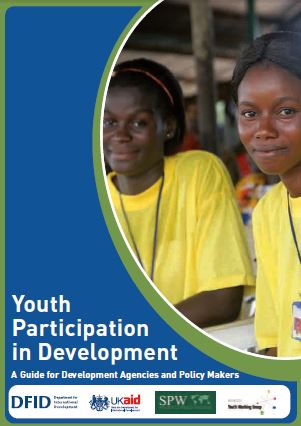
Youth Participation in Development: A Guide for Development Agencies and Policy Makers
Image
SummaryText
This guide aims to increase understanding of youth participation in development practice. It provides information on how to actually work with youth at a practical, operational level with respect to policy and programming. It does this through the provision of promising practice case studies (and their associated resources), and a number of quality standards that are designed to help organisations to get started. The guide is a creation of the Youth Working Group of the United Kingdom (UK) Department for International Development (DFID)-Civil Society Organisation (CSO) Children and Youth Network. The different aspects that form the structure of the guide were developed through consultation with key partners, including donor agencies, civil society organisations, and young people over an 18-month period.
The guide challenges negative stereotypes of youth and seeks to demonstrate how young people can positively contribute to development in 4 operational areas: organisational development, policy and planning, implementation, and monitoring and evaluation. It also draws together case studies, resources, and practical guidance from around the world. Specifically, it looks at Sharing and Learning Networks established in 2 focus countries - Nepal and Uganda - to illustrate this focus on 3 thematic areas that, according to organisers, are important to young people: governance, voice, and accountability; post-conflict transitions and livelihoods; and sexual and reproductive health and rights. An online guide and website have been created.
Central to this guide is its focus on working with excluded sub-groups of young people, and the importance of building partnerships between adults and youth in a culturally sensitive manner.
The guide challenges negative stereotypes of youth and seeks to demonstrate how young people can positively contribute to development in 4 operational areas: organisational development, policy and planning, implementation, and monitoring and evaluation. It also draws together case studies, resources, and practical guidance from around the world. Specifically, it looks at Sharing and Learning Networks established in 2 focus countries - Nepal and Uganda - to illustrate this focus on 3 thematic areas that, according to organisers, are important to young people: governance, voice, and accountability; post-conflict transitions and livelihoods; and sexual and reproductive health and rights. An online guide and website have been created.
Central to this guide is its focus on working with excluded sub-groups of young people, and the importance of building partnerships between adults and youth in a culturally sensitive manner.
Publication Date
Number of Pages
120
Source
Youth InfoNet 67, May 3 2010.
- Log in to post comments