When Communicating Really Matters: The Experience of CDAC in Haiti
Internews
"...[I]n Haiti and beyond, in other disaster-affected areas, we still face a challenging mindset that suggests providing information to those affected creates an 'added burden' on humanitarian responses. Collectively, the humanitarian community fails to realize that humanitarian responses are too often undermined precisely because people's information needs and participation are considered a low priority."
Written just over a year after the devastating earthquake in Haiti, this article describes the strategies being used by the Inter-Agency Working Group on Communicating with Disaster Communities (CDAC) in Haiti, which is hosted by the international media development organisation Internews and supported by the United Nations Office for the Coordination of Humanitarian Affairs (OCHA). As author Jacobo Quintanilla explains, CDAC brings together experts in outreach and communications and humanitarians in a collective effort to improve a two-way communication flow between the humanitarian community and affected populations. The cross-cluster service brought together a wide array of actors involved in the disaster response including humanitarian agencies, media development organisations, local media, and local authorities, in a systematic effort to disseminate lifesaving information to disaster-affected populations through a variety of media.
Quintanilla elaborates that, working from the premises of an emergency media centre created by Reports sans Frontiers (RSF) for journalists in the earliest days after the earthquake, CDAC Haiti provided a coordination platform for a collective communications effort.
- Radio was one tool used, and included: daily humanitarian radio shows like Enfomasyon Nou Dwe Konnen (ENDK - News You Can Use), produced by Internews since January and broadcast on 41 radio stations; Connexion Haiti, produced by the BBC World Service Trust and BBC's Creole Service; Chimen Lakay ("The Way Home"), produced by the International Organization of Migration (IOM); and Radio Boukman. These shows reportedly reached up to 70% of the Haitian population. CDAC also advised on the distribution of some 9,000 donated wind-up radios through Internews working under the support of United States Agency for International Development (USAID)/Office of Transition Initiatives (OTI).
- Technology providers such as Ushahidi and Noula crowdsourced information and geo-located messages from survivors. The Thomson Reuters Foundation pushed out millions of short messaging service (SMS) messages about humanitarian services. The International Federation of Red Cross and Red Crescent Societies (IFRC) also deployed mobile messaging (including, more recently, as part of a national cholera prevention strategy). In addition, International Media Support (IMS) mapped the impact of the earthquake on the local media, creating a humanitarian media centre that hosted the country's local media associations.
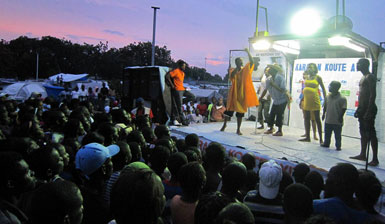
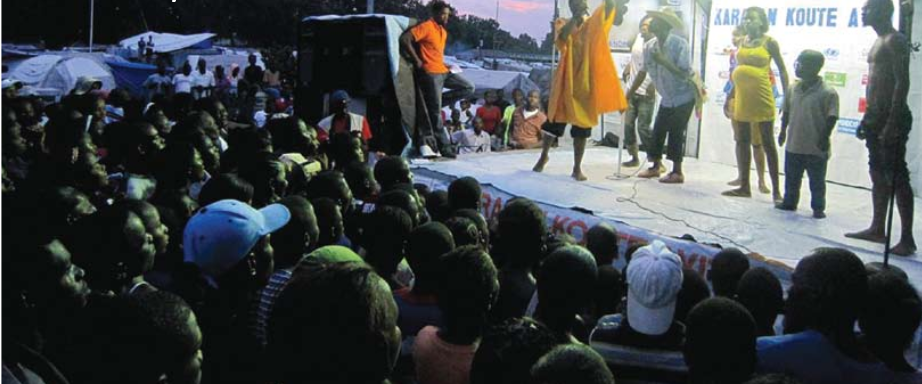
- CDAC coordinated Koute Ayiti (Listening to Haiti), a caravan with music, drama, and public debates that travelled to disaster-affected areas. Dozens of community mobilisers from agencies like the United Nations Office for Project Services (UNOPS), IOM, and Action Contra la Faim (ACF), conducted outreach and education on cholera prevention in internally displaced persons (IDP) camps.
- Working with IMS, CDAC supported local media with grants and equipment, organised get-togethers of humanitarian actors and local press in an effort to bridge the gap between humanitarians and local media and build further confidence, and coordinated communication initiatives to tackle a cholera outbreak, including ongoing audience research on information needs and access to, and use of, the media by communities most exposed to the epidemic for such information.
From Quintanilla's perspective, while strong work has been done on delivery of messages to affected populations, challenges remain - most of which focus on the importance of genuine participation of affected communities. He says that establishing systematic ways of listening to survivors in order understand their information needs has proven particularly challenging. "Furthermore, the humanitarian community needs to work harder to include those affected by disasters into the design and implementation of programs focused on communications, tap into traditional, indigenous, and often more trusted communication mechanism channels (e.g. religious leaders, farmers groups), and enhance communication with local authorities."
Email from the Internews Network to The Communication Initiative on January 12 2011. Image credit: Jacobo Quintanilla