










































Institutional Trust and Misinformation in the Response to the 2018-19 Ebola Outbreak in North Kivu, DR Congo: A Population-based Survey
Harvard Medical School, Harvard University (Vinck, Pham, Nilles); Center for Research on Democracy and Development in Arica, Free University of the Great Lakes Countries in the Democratic Republic of the Congo (Bindu); Anthrologica (Bedford)
"The findings underscore the practical implications of mistrust and misinformation for outbreak control. These factors are associated with low compliance with messages of social and behavioural change and refusal to seek formal medical care or accept vaccines, which in turn increases the risk of spread of EVD."
Responding to Ebola virus disease (EVD) outbreaks entails a multifaceted control strategy that includes, for example, risk communication and vaccination. These measures are particularly challenging in an active conflict zone, where community trust and support for the EVD response can be undermined by misinformation exploited by local politicians and the contrast between the rapid mobilisation to contain the EVD outbreak and chronic failure to protect civilians. The 2018 EVD outbreak in eastern Democratic Republic of the Congo (DR Congo) - the country's tenth - emerged in a complex and violent political and security environment. This study explored: (i) whether public trust in relevant authorities and information is associated with the adoption of preventive measures, including exposure avoidance and vaccination; and (ii) whether belief in EVD misinformation is associated with lower adoption of preventive measures.
During September 1-16 2018, 1 month after the EVD outbreak was declared (August 1 2018), the researchers surveyed 961 adults in the cities of Butembo and Beni in the province of North Kivu, eastern DR Congo.
Overall trust in how administrative authorities represent the interests of the population was low and decreased from local, to city, to provincial, to national levels. (That is, local authorities were more frequently trusted than were provincial and national levels of government, and health professionals were more frequently trusted than were authorities.) Among 961 respondents, 349 (31.9%, 95% confidence interval, or CI) trusted that local authorities represent their interest. When considering the EVD response specifically, 419 respondents trusted the government and 620 trusted health professionals to act in the best interests of the public.
The mean EVD information score was 4.7 (standard deviation (SD) 1.48) out of a maximum of 6. All respondents had heard about the EVD outbreak, and most had received information about how to protect themselves, where to seek care, and symptoms of EVD. Fewer received information about what to do if a relative was affected, cases in the province, and ongoing efforts to control the outbreak. Respondents received Ebola information from friends and family (863 [88.8%, 95% CI]), community radio stations (803 [82.4%]), national radio stations (657 [67.9%]), religious leaders (691 [73.1%]), and health professionals (562 [52.8%]). Fewer had heard about EVD from local authorities (248 [21.3%]) or national government (305 [28·7%]).
Belief in misinformation was widespread, with 230 (25.5%) respondents believing that the Ebola outbreak was not real. A higher proportion of respondents believed that the Ebola outbreak was fabricated for financial gains, or was fabricated to destabilise the region; 446 (45·9%) respondents believed at least one misinformation statement to be true, and 171 (18·2%) believed that all were true. The EVD information and government trust score, government EVD trust score, and health professionals EVD trust scores were significantly lower among those who believed in all or any misinformation statements than among those who did not believe in those statements.
Furthermore, low institutional trust and belief in misinformation were associated with a decreased likelihood of adopting preventive behaviours, including acceptance of Ebola vaccines (odds ratio (OR) 0.22, 95% CI, and 1.40) and seeking formal health care (0.06, and 1.16).
Men had higher odds of avoidance behaviour and vaccine acceptance than did women; however, they had lower odds of seeking care from formal providers if they suspected having EVD.
Confidence in vaccines in general was high, and most respondents believed that vaccines work (899 [90.7%, 95% CI) and are safe (852 [88.5%]). Fewer believed that EVD vaccines work (641 [65.7%]). 589 reported they would accept the EVD vaccine (63.3%). Reasons for not accepting the vaccine included that it was unsafe (225/313 [71.5%]), did not work (75/313 [23.4%]), or was not needed (45/313 [12.0%]).
Questions the data cannot answer but might be the focus of future investigations include: How does trust in governments and local and national institutions interact with and relate to trust in local and international non-governmental organisations, especially in conflict settings? What are the most effective tools for building trust? And should limited outbreak response resources be directed to rebuilding institutional trust?
The researchers suggest that:
- "Engaging locally trusted leaders and service providers could help to build trust with Ebola responders who are not from these communities. If those involved in the EVD response are transparent and consistent in responding to the local needs to stop this outbreak, the trust established during this response could translate into long-term general trust in institutions."
- "Until trust building is effectively translated into response strategies and communication protocols, the basic principles of intensive risk communication by trusted sources in a transparent, sincere, and consistent manner should be the cornerstone of the social mobilisation and community engagement efforts."
- "Mediation (eg, by local and international peacebuilding organisations) and interactive dialogue between communities, community leaders, and local and international Ebola responders might address misinformation about the reality and politicisation of outbreaks, reducing the tensions between EVD responders and the community at risk."
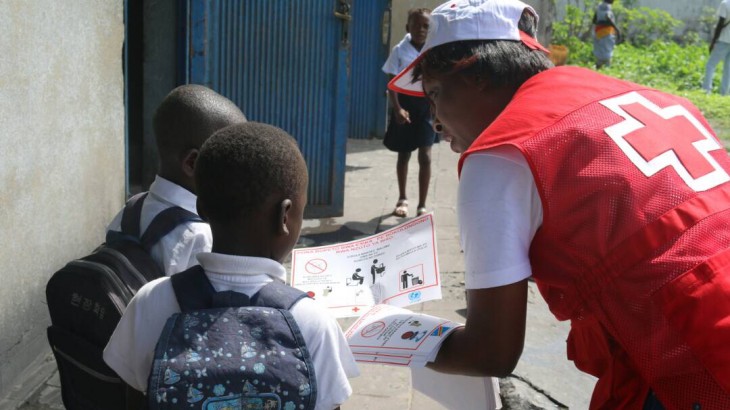
The Lancet https://doi.org/10.1016/S1473-3099(19)30063-5. Image credit: CC BY-NC-ND / ICRC
- Log in to post comments