










































Increasing Immunization Compliance among Schools and Day Care Centers: Evidence from a Randomized Controlled Trial
American University (Leight); Office of Evaluation Sciences (Safran)
"[U]p to this point, little evidence has been presented around the effectiveness of social norms in addressing compliance with vaccine guidelines in a school-based setting."
While vaccines are compulsory for school-aged children in the United States (US), vaccine hesitancy among parents and the use of non-medical vaccine exemptions has been increasing. State-, city-, and school-level variation in how school vaccination requirements are administered and communicated to school stakeholders and parents is hypothesised to be a key factor in shaping local variation in immunisation outcomes. Qualitative and quantitative evidence suggests that a perception that immunisation is a social norm is positively associated with the decision to vaccinate. This paper reports on the results of a randomised controlled trial in which researchers collaborated with a department of health (DOH) in a mid-sized US city to evaluate the effectiveness of targeted communications highlighting descriptive social norms to increase immunisation compliance across 700 schools and day care centres.
Prior to this evaluation, all educational institutions received weekly automated email updates generated by the city's Immunization Information System (IIS), reporting overall compliance for the school; these updates were sent to the immunisation point-of-contact, generally the school nurse for elementary, middle, and high schools, or the director for day care centres. The DOH uses 2 injunctive norms to motivate compliance: (i) the city has set a target of 98% immunisation compliance for every school in the city; and (ii) to signify approval of immunisation compliance, each school is assigned an immunisation star rating of 1 to 5 stars. For the purpose of this intervention, immunisation compliance rates at the school level were measured in October 2017, immediately prior to the roll-out of the intervention.
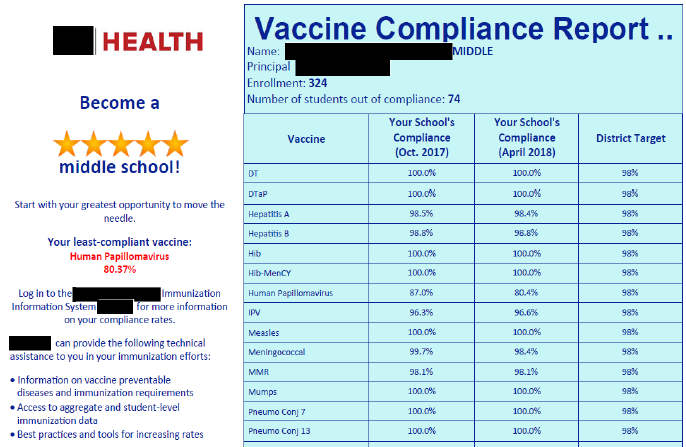
DOH and the research team collaborated to create a report card using descriptive social norms around immunisation compliance rates. It was designed to address several barriers identified by DOH: (i) Immunisation compliance may not be particularly salient to school leaders given their wide areas of responsibility; (ii) school leaders may lack information about their students' current immunisation status and appropriate steps to take to increase compliance rates; and (iii) they may not perceive that immunisation compliance is an important objective, or may assume that their school’s rates are already satisfactory.
More specifically, the report card provided information about 3 social norms: descriptive information about average compliance and average compliance among the top 10% for the school category, and injunctive information conveyed in a star rating for the school's performance. In addition, the report card provided information about action steps school leaders could take to increase compliance rates, as well as a detailed list of the school's compliance rates for each required vaccine compared to the city target of 98% compliance. Each cue was conveyed both visually and in text form to accommodate individuals with different preferences for the presentation of information.
This intervention then relied on school leaders utilising the information they were provided via the report card to take action to effectively inform parents about required immunisations and encourage them to update immunisations.
The evaluation randomised 346 of the city's schools into the treatment arm, and 354 into the intervention arm. Schools assigned to the treatment arm received the first report card in early November 2017 and the second report card in April 2018. All schools in both treatment and control groups continued to receive weekly automated updates from IIS directed to the immunisation point-of-contact. School-level immunisation compliance rates were then tracked over the year using the IIS.
The results suggest that the intervention did not lead to any statistically significant increases in immunisation compliance. There is similarly no evidence of heterogeneous effects for different school types, or different types of vaccines.
The observed null effect of the treatment suggests that the use of the report cards was not sufficient to generate significant shifts in immunisation compliance. School officials may not view immunisation compliance rates as an important or salient objective; they may be poorly incentivised to enhance immunisation rates, even if they view it as a meaningful objective; or they may lack appropriate levers to shift parental and household behaviour around immunisations.
However, the study serves as an example of embedding a behaviourally informed experiment in a government programme: It included a large sample of schools (the full universe of schools in the collaborating jurisdiction), benefited from a close collaboration with the responsible health authorities, and used an administrative registry (rather than self-reports) to track immunisation outcomes. From a broader policy perspective, the evaluation illustrates how state immunisation information systems can provide school-level data on immunisation rates to school leaders as well as comparative immunisation rates across a set of peer schools. In addition, the evaluation demonstrates the feasibility of automating the creation of personalised report cards at the school level, even for non-traditional (i.e., not strictly academic) metrics.
In conclusion: "Ultimately, the motivational effects of social comparisons may be muted in a context in which key stakeholders receive a diverse array of feedback regarding a range of educational and health goals. Regardless, schools may constitute a valuable entry point for communications with parents, including parents who have a wide range of attitudes toward vaccines and different patterns of interaction with the health system. Collaborating with school systems to share health information and health communications around vaccines may be a useful tool for policymakers."
Journal of Behavioral Public Administration, 2(2). https://doi.org/10.30636/jbpa.22.55
- Log in to post comments