










































Discourse Strategies of Fake News in the Anti-vax Campaign
University of Bergamo
Anti-vaccine controversies have been occurring for more than a century but were revived in the 1990s, when The Lancet published (and then later retracted) a study by Wakefield et al. incorrectly linking the measles, mumps, and rubella vaccine (MMR) to autism. As the #anti-vax discourse has moved onto social media, debates have been amplified. By drawing on Critical Discourse Analysis (Fairclough 1995), corpus linguistics, and socio-semiotic multimodality, this paper aims to analyse fake news discursive dynamics and strategies related to the anti-vax campaign to unveil cognitive, social, and institutional constructs of misinformation.
The paper opens with background and an overview of how misinformation is constructed and spread on online platforms. Author Stefania Maci explains that misinformation tends to spread where the information system fails - in particular, where there is not enough specialised training for professionals, especially in online contexts where updates need to be done immediately, which compromises the adequacy of the information and causes a loss of trust on the citizens' part towards the information system. In this context, people turn to online platforms, particularly social media, where viral posts are based on fictitious accounts made to look like news reports, in an intentional way, but are verifiably false. Their aim is to mislead readers for economic, psychological, political or ideological reasons, such as promoting and favouring some ideas/people and discrediting others. Fake news not only goes viral but is based on algorithms that bring people to similar news they have read before. This creates a vicious circle: Anti-vax supporters tend to always read and believe the same type of (fake) news offered by such algorithms, which confirm (in a self-predicting way) what they believe in, and which renders them unable to discern real and fake news, "as they do not realize that scientific fake news is the result of a decontextualization of the medical sources."
In order to carry out the linguistic analysis, all English tweets with the hashtags #provax, #provaxxer(s), #vaccine, #antivax, #novax, #antivaxxer(s), or #vaxxed were downloaded, regardless of the users' nationality. The investigation was carried out on a corpus of 16,768 tweets (75,960 running words) containing 3,737 pictures collected over 10 days in October 2018, when there was an upsurge of measles in New York City, United States (US).
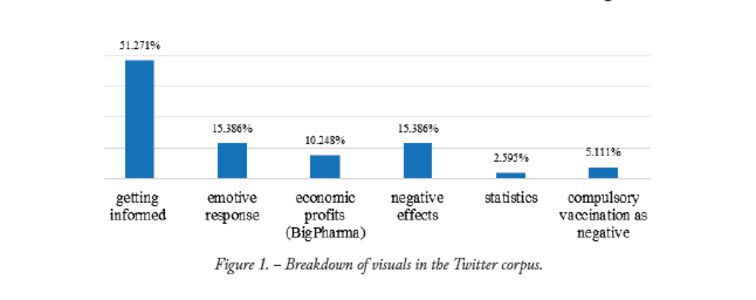
The visuals can be grouped into the categories shown in the figure above: proactively advise Twitter users about the necessity of getting informed about vaccination; aim to get an emotive responsse; underline the negative side-effects of vaccination; focus on pharmaceutical/economic profits in connection with vaccination; put a negative stress on the mandatory aspect of vaccination; and contain (negative) statistical data related to vaccination. (The categories can overlap, but the criterion by means of which one visual is categorised under one specific category rather than another is based on the type of keywords found in the visual headline.)
Maci analyses the strategies, including colour choice, of several examples of visuals from Twitter, one with the headline "The Murdering of Our Daughters". The emotion lies in the fact that more than 50% of the picture is a composition with photos of all the girls who died because, according to the post, they had a vaccination. The link between cervical cancer vaccination and the deaths of these girls is not medically and statistically demonstrated in this tweet. Yet, by posting 67 closeup pictures of dead young women, all of them looking at the camera as if demanding involvement with the audience, the parents' grief is greatly exploited by the anti-vaccine activists for their campaign. This is emphasised by the use of the possessive adjective "our" in the post-modifying phrase "the murdering of our daughter": The sentence is meant to activate the social actors involved in the anti-vaccine group by creating a "belonging together".
The sentiment analysis of the linguistic data reveals that over 45% of the tweets are neutral (in the sense that they are posts reporting academic scientific papers without any positive or negative consideration about vaccination per se), roughly 35% of the tweets convey negative feelings, and 20% convey positive ones. Maci used WMatrix (Rayson 2009), a corpus annotation tool developed by Lancaster University (United Kingdom), with the aim of detecting key parts of speech (POS) through the WMatrix's tagging system. She concluded that "what the tweets report is that vaccination is dangerous, as it can cause adverse reactions and correlates with autism, if not death. So parents should protect their children by not allowing the government to have their children injected with unnecessary vaccinations, as the government is responsible for a conspiracy with Big Pharma. Therefore, all parents are invited to get informed before it is too late."
Maci explains: "The results suggest that the #anti-vax discourse seems to be founded on moral and scientific grounds at cognitive, social and institutional levels, thus granting itself authority."
In conclusion: "The analysis of the anti-vaccine activists corpus collected from Twitter has revealed that the anti-vax discourse, based on fake news, is apparently constructed on scientific grounds in an accessible language that is supported by vivid (and visual) metaphors....The misrepresentations to which the spread of such fake news can lead over Twitter are visible to such an extent that, nowadays, social media are removing social news sites from their platforms 'on the grounds that they violate policies against misleading contents' (Alcott and Gentkow 2017, 233). This alone is not enough. There is a need for a new transdisciplinary literacy: a digital-health literacy on vaccination that can help people, even vaccine supporters who may be confused by the debate arising in social media, to develop trust in health professionals..."
Lingue Culture Mediazioni - Languages Cultures Mediation Vol 6, No 1 (2019). doi: https://dx.doi.org/10.7358/lcm-2019-001-maci
- Log in to post comments