










































Effectiveness and Parental Acceptability of Social Networking Interventions for Promoting Seasonal Influenza Vaccination Among Young Children: Randomized Controlled Trial
University of Hong Kong (Liao, Fielding, Cheung, Yuan, Lam); The Hong Kong Polytechnic University (Lian)
"Mobile social networking apps such as WhatsApp Messenger are promising tools for health interventions."
In Hong Kong, despite the fact that families of children aged 6 months to 12 years receive free seasonal influenza vaccination (SIV), SIV uptake among young children languishes around 30%. Sending vaccination reminders through mobile-phone-based short message services (SMS) has been shown in some studies to promote vaccination uptake. In Hong Kong, WhatsApp messenger, which also permits social networking functions, is used by over 80% of the population due to high penetration of smartphone use. Previous studies suggest that parental decision making for children's vaccination is modified by knowing other parents' vaccination decisions, indicating a strong social normative influence. Therefore, knowing that other parents take their child for SIV can encourage hesitant parents to do the same. This was a preliminary study to test the effectiveness and parental acceptability of a social networking intervention that sends weekly vaccination reminders and encourages exchange of SIV-related views and experiences among mothers via WhatsApp discussion groups for promoting childhood SIV.
After completing a baseline assessment, 365 participants - mothers with at least one child aged 6 to 72 months - were randomly allocated to either the control group, which received no intervention, or one of 2 social networking intervention groups that received weekly reminders to take their children for SIV via WhatsApp discussion groups. Because an objective of the study was to examine the effect of introducing time pressure on mothers' decision making for childhood SIV, there were 2 intervention groups: one with a time pressure (TP) component (SNI+TP) and without a time pressure component (SNI-TP) incorporated into the weekly vaccination reminders. The intervention lasted for the 8 weeks of the Hong Kong government SIV campaign (from October 2017 until 2 weeks before the end of December 2017). Both intervention groups were also encouraged to share their positive vaccination decisions and experiences via their respective WhatsApp group with group members and a group moderator (a health professional) during the intervention period.
More specifically:
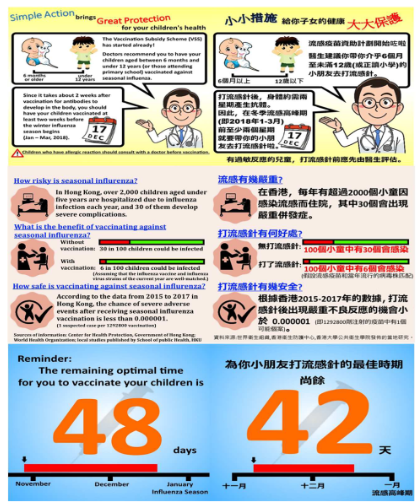
- The vaccination reminder comprised 3 messages: Message 1 introduced the subsidy and doctors' recommendations for children's SIV; message 2 addressed children's risk of seasonal influenza and benefits and safety of SIV for children, and message 3 addressed the number of days remaining for the recommended vaccination timing. While the vaccination reminders for SNI-TP and SNI+TP contained message 1 and 2, message 3 (the time pressure component) was only included in the vaccination reminders for SNI+TP participants. All messages were: pre-tested with 10 mothers, constructed using information from the official websites of the Hong Kong Centre for Health Protection and World Health Organization (WHO) and local published studies, and delivered in graphical format through WhatsApp.
- To provide positive peer support for mothers, participants allocated to the intervention groups were then randomly allocated to one of two SNI–TP and two SNI+TP WhatsApp discussion groups, each comprising approximately 40 mothers. In each WhatsApp discussion group, mothers could post their opinions and concerns about influenza and SIV and freely communicate with other mothers and the group moderator about their experiences of personal and child influenza vaccinations. In addition to delivering the weekly vaccination reminders, the moderator sent one additional message on a weekly basis to enforce exchange of positive views and experience about SIV and addressed any questions, concerns, or misunderstandings.
A total of 84.9% (174/205), 71% (57/80), and 75% (60/80) who were allocated to the control, SNI-TP, and SNI+TP groups, respectively, completed a follow-up outcome assessment (April - May 2018). The youngest target child SIV uptake rates were 37.9% (66/174), 33% (19/57), and 38% (23/60) in the control, SIN-TP, and SNI+TP groups, respectively.
The social networking intervention was found to have significantly promoted mothers' self-efficacy for taking children for SIV, with participants of the SNI-TP (odds ratio (OR) 2.69, 95% confidence interval (CI) 1.07-6.79) and SNI+TP (OR 2.50, 95% CI 1.13-5.55) groups reporting more increase in confidence in taking their children for SIV than did the control participants. However, chi-square tests indicated that the interventions did not have significant effects on either the youngest target child's SIV uptake or all target child(ren)'s SIV uptake. After adjusting for mothers' working status, introducing additional TP reduced the overall SIV uptake in children of working mothers (OR 0.27 [0.10-0.77]) but significantly increased the SIV uptake among children of mothers without a full-time job (OR 6.53 [1.87-22.82]). This indicates that TP on decision making facilitated vaccination uptake among mothers who may have more free time, but it had the opposite effect among busier working mothers.
From the 2 SNI-TP and 2 SNI+TP WhatsApp groups, 434 relevant posts from participants were retrieved over 8 weeks - 226 (52.1%) of which were coded as sharing experience or views, 119 (27.4%) as seeking information or opinions, 106 (24.4%) as sharing knowledge or information, and 66 (15.2%) as emotional exchange. Of those sharing experience or views, 44.7% (101/226) were categorised as negative or hesitant, such as sharing concerns about vaccine safety, side effects, and effectiveness. These concerns or views about SIV seem to mostly reflect beliefs that SIV could weaken immunity, distrust about how the vaccine strain was estimated every year, and a perception that vaccination is not a natural process. Although participants shared predominantly negative experience or views about SIV at the beginning of the discussion, the moderator was able to encourage the discussion of more positive experience or views and more knowledge and information.
Most intervention group participants indicated willingness to receive the same interventions (110/117, 94.0%) and recommend the interventions to other mothers (102/117, 87.2%) in the future. Post-hoc qualitative interviews with 20 participants of the intervention groups emphasised the positive attributes of the moderator's information, though a few complained that the reminders were too repetitive and that the moderator's responses lacked details. Advantages of using WhatsApp for promoting child health cited included convenience in information accessibility, better information quality, and enhanced interaction with a health professional. Few concerns over using WhatsApp for health promotion were raised, mainly regarding receiving unwanted advertising. On perceptions of the TP component, most reported feeling pressured into making a rapid decision, either a positive or negative one, but others ignored or failed to notice the shrinking optimal window of time. Reasons for not participating in the online discussion included perceived low confidence about giving information, desire to avoid arguments, and perceived low information need.
Reflecting on the findings, the researchers note that this social networking intervention did not significantly enhance children's SIV uptake. This could be due to the fact that parents have more risk-related concerns about optional vaccines. For participants who had already made the decision to take their children for SIV before joining in the discussion group, the information may have prompted vaccination planning or been used as a cue for taking action. For participants who had antivaccination attitudes or were hesitant to take SIV, the information was insufficient to change the psychological roots of the antivaccination attitudes or remove concerns over vaccine risk.
In addition, although participants perceived information from the moderator to be trustworthy, they may have deemed it less relevant to children's health care compared with information received directly from a general practitioner. This possibility indicates that health professionals' active participation and involvement in vaccination discussions could create a more positive online experience. "Active communication from health professionals may be sufficiently effective to combat vaccine hesitancy compared with attempts to control online media misinformation..."
The discrepancy found in the study between the enhanced parental self-efficacy in taking a child for SIV and the unchanged SIV uptake indicates that the direct effect of perceived self-efficacy on vaccination uptake is weak. "Because experience-based knowledge and information from peers may be more powerful and persuasive for changing parents' attitudes..., future studies should focus on how to encourage peers to share positive experience-based knowledge and information about vaccine safety, side effects, and effectiveness for promoting childhood vaccination."
The content analysis of the WhatsApp discussion identified several maternal concerns and misperceptions about SIV that might help guide health communication efforts in this area. For instance, the researchers indicate that future risk communication should give a clear explanation about the mechanism of influenza vaccination, which is a quasi-natural process. For parents intending to take their children for SIV, information about medical eligibility for SIV, vaccination clinic and costs, and how to arrange the timing of the 2 vaccinations for children's initial SIV should be provided to enhance optimal timing of SIV.
The findings also indicate that "audience segmentation, based on parents' prior beliefs about SIV, is necessary for improving the effectiveness and acceptability of social networking interventions to achieve behavioral change. Putting people with different vaccination beliefs into one group may lead to strong arguments which may negatively affect other members' participation in the discussion and the online communication environment. Finding approaches that work to bring resistant parents around to SIV requires further research."
Relatedly, the researchers advise that future social networking interventions should consider audience segmentation using mothers' working status: Placing "time pressure on decision making can significantly promote children's SIV among non-full-time working mothers, but among mothers working full-time, time pressure may reduce SIV uptake by reinforcing the influence of negative cues on SIV decision making."
In conclusion: "Online information support can effectively promote mothers’ self-efficacy for taking children for SIV but alone it may not sufficient to address maternal concerns over SIV to achieve a positive vaccination decision. However, the active involvement of health professionals in online discussions can shape positive discussions about vaccination."
Journal of Medical Internet Research 2020 (Feb 28); 22(2):e16427.
- Log in to post comments