










































Child-Centred Approaches to HIV/AIDS (CCATH)
The programme aimed to strengthen children's resilience and also to address the issue of their life situation. This included the emotional, social and practical support they received in their immediate surroundings from family, peer groups, and neighbours. It also includes supported from CBOs, faith-based organisations (FBOs), schools, and health services, which need to be accessible and welcoming to children.
The project began with an assessment of the needs of children, their families, and CBOs in communities affected by HIV/AIDS. This research was conducted in Kenya and Uganda, introducing child-centred participatory research methods to help adult researchers to listen to and learn from children. The research revealed a range of risks to children's development in these communities. It showed how deeply children are affected - psychologically, economically, and socially - by the impact of HIV/AIDS on their lives.
Collaboration was central to the CCATH project. It was coordinated by a group of non-governmental organisation (NGO) partners in Kenya, Uganda, and the United Kingdom (UK): Kenya AIDS NGO Consortium (KANCO), AIDS Care, Education and Training, Uganda (ACET), Child-to-Child Uganda, National Community of Women Living with HIV/AIDS, Uganda (NACWOLA), and Healthlink Worldwide and the Child-to-Child Trust in the UK.
The CCATH developed strategies such as these to support children and communities to cope with the impact of HIV/AIDS:
- ACET promoted life-skills-based education to develop children's communication and coping skills.
- ACET facilitated seminars for children and parents to promote open communication and mutual understanding.
- Child-to-Child Uganda worked in primary schools promoting the principle of children helping and supporting each other. Children formed clubs where they could share problems and work together to find solutions. They also learned to communicate their emotions and fears and to develop empathy for each other. Child-to-Child's hope was to give children a sense of self-esteem because they could contribute to others' well-being. In some cases, children were "twinned", that is, they were paired up for mutual support.
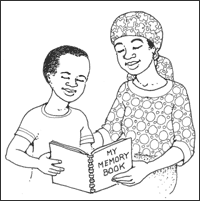
- NACWOLA worked to support women and children to cope with illness and bereavement in the family. They introduced the idea of a Memory Book, in which parents living with HIV record their own and their children's past lives, celebrating good, loving memories. The Memory Book is also designed to help parents and children to prepare for bereavement and make concrete plans for the future.
- NACWOLA established children's clubs where they learn about health, child development, and basic survival. Children can share their emotional and psychological problems with adults at these clubs. They can also get access to training and small grants for income-generating activities, such as the rearing of goats.
- KANCO supported CBOs to develop their capacities for working effectively with children through participatory processes. KANCO also operates at the national and international level, influencing policy development in relation to children and HIV/AIDS. The organisation has been instrumental in the drafting of a children's bill in Kenya.
HIV/AIDS, Children
The project focused on 5 main areas:
- enabling older children to strengthen their coping skills and resilience for their own survival and continued development through the illness or loss of a parent;
- supporting older children and parents/guardians in providing appropriate care for their younger siblings and at the same time providing them with emotional support and enjoyment through activities which are creative and rewarding for both older and younger children;
- addressing the "culture of silence" surrounding HIV/AIDS, especially how the subject of HIV/AIDS is discussed with, and by, children and young people;
- promoting the social inclusion of children affected and infected by HIV/AIDS and tackling discrimination; and
- enabling families to develop coping strategies for managing the severe economic impact of HIV/AIDS, including issues surrounding planning for the future after the death of a parent, inheritance, sexual or labour exploitation, income generation and continuing access to education.
Kenya AIDS NGO Consortium (KANCO), AIDS Care, Education and Training, Uganda (ACET), Child-to-Child Uganda, National Community of Women Living with HIV/AIDS, Uganda (NACWOLA), Healthlink Worldwide, the Child-to-Child Trust in the United Kingdom (UK).
Healthlink Worldwide website on January 15 2004 and November 29 2010.
Comments

i have read that you work with partners, am from a local CBO called Rural Efforts for Action in Davelopment in Luweero Uganda, is there a posibility of establishing partnership with you? we work with ophans, child mothers, care givers in four program areas; HIV?/AIDs,livelihood options , village savings, and loan associations, and reproduction health.
Joseph Byabazaire readuganda@yahoo.com
congratulations
i do like the way u work,lets hwelp the young children affected with aids live and buil;d their hope 4 life,i'm studying earlychildhood education n i luv kids very much.if possible i'd like 2 work with u i like volunteering.cynthia maina.cynthiamaina25@yahoo.cvom
- Log in to post comments