










































Behaviour Adoption Approaches during Public Health Emergencies: Implications for the COVID-19 Pandemic and Beyond
Centers for Disease Control and Prevention, or CDC (M.F. Jalloh, S.A. Nur, Prybylski, Namageyo-Funa, Hageman, Baker); University of Washington (A.A. Nur); Karolinska Institutet (Winters, Nordenstedt); independent consultant (Bedson); Bill and Melinda Gates Foundation (Pedi); Focus 1000 (M.B. Jalloh); University of North Carolina (Eng); CDC COVID-19 Response Team (Hakim)
"Ideally, bottom-up approaches should be one of the four main tires of the vehicle driving the response; in some instances, they may need to be the steering wheel."
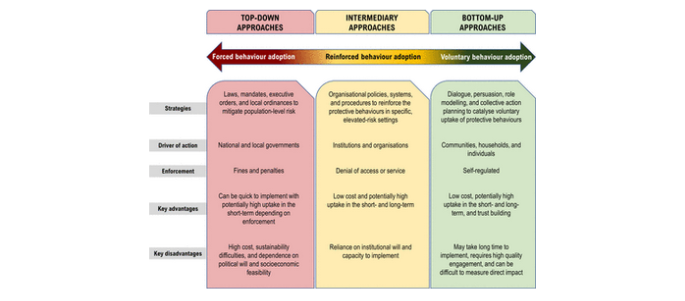
The COVID-19 pandemic has intensified global discourse around the adoption of protective behaviours and other public health and social measures (PHSMs) to slow the person-to-person spread of SARS-CoV-2. This paper develops a contextual framework that aims to facilitate a common taxonomy of behaviour adoption approaches during public health emergencies. Using the COVID-19 pandemic as a case study, it demonstrates how three approaches to accelerating and sustaining behaviours such as hand hygiene, the use of masks, and physical distancing - (i) top-down, (ii) intermediary, and (iii) bottom-up approaches - differ in terms of their implementation, underlying drivers of action, enforcement, reach, and uptake. The researchers hope that the contextual framework outlined here can inform the design, implementation, tracking, and evaluation of PHSMs during future health emergencies.
The researchers have summarised the drivers of behaviours during past health emergencies (see online supplemental material). They found that the "collective evidence demonstrates the need for clear, science-based messaging during infectious disease epidemics to help the public channel anxieties and fears into protective health behaviours, and to build trust in public health measures. This includes effective communication on the current state of knowledge regarding the outbreak, as well as the practical and actionable measures that people can take to mitigate transmission risk. The PHSMs should (1) be informed by behavioural insights data, (2) be coupled with localised two-way interpersonal communication and community engagement approaches that build on existing trusted networks and (3) address community concerns and needs."
Drawing on interventions in the COVID-19 response, coupled with other illustrative evidence in routine public health programmes or from past global health emergencies, the researchers developed a contextual framework (see above). It includes:
- Top-down approaches - include, for example, government-instituted "lockdowns" that create population-level restriction of movements or mandates for wearing masks in public spaces. Similar to the COVID-19 pandemic, behaviour adoption measures were initially focused on top-down approaches during the 2014-2016 Ebola epidemic in West Africa. Eventually, bottom-up community engagement was required to increase and sustain community acceptance of safe burial measures during the Ebola epidemic.
- Intermediary approaches - constitute efforts to "nudge" the behaviour via the provision of physical and social cues (e.g., handwashing stations (or alcohol-based hand rubs) at the entrance of restaurants and businesses) without needing to always overtly enforce the behaviour. "Given that intermediary approaches operate across important community institutions, they can be powerful in promoting key protective behaviours and providing continuity of uptake within communities. People may be more willing to calibrate how they should behave based on expectations set by local institutions that they value and trust."
- Bottom-up approaches - facilitate voluntary behaviour adoption through dialogue, persuasion, role-modelling of protective behaviours, and collective action planning that include the participation of local communities and households. For instance, during the 2014-2016 West African Ebola outbreak, large-scale community engagement interventions were implemented by faith leaders, traditional leaders, influential women leaders, and other trusted community members; they worked together to locally interpret top-down measures and ensure they were appropriate for their communities and then promoted and modelled the protective behaviours in their communities. "While bottom-up approaches such as community engagement have suffered from a lack of agreement on broad principles, there have been efforts by UNICEF [the United Nations Children's Fund] and global stakeholder to establish technical rigour for such approaches..."
Notably: "Effective communication should be a cross-cutting feature to enable behaviour adoption in all three approaches. Similarly, transparency and accountability in addressing issues of equity should also be cross-cutting features of all three approaches."
The researchers stress that each outbreak is unique, and there is no one-size-fits-all approach to encourage and support promoted behaviours during health emergencies. Thus, they argue that implementing blended strategies that draw from all three approaches outlined above might be an option. They cite the example of Taiwan's open consultation platform (vTaiwan), which brings together stakeholders (using online and offline platforms) from the government, civil society, and private sector to propose, discuss, reflect and legislate; this platform had been in use for a range of issues and could be leveraged to facilitate collective action in the context of COVID-19.
"While all three approaches may be necessary for optimal behaviour adoption, there is evidence suggesting that bottom-up approaches may be more effective in sustaining the protective behaviours over long term....Laying a solid foundation for voluntary behaviour change and community action through bottom-up approaches of community engagement may also strengthen social cohesion and build the trust needed to enhance adherence to top-down mitigation measures, especially in the context of community spread of infection during an outbreak."
In fact, the researchers suggest that "the public trust built in the process of implementing and supporting bottom-up approaches that engage communities during the COVID-19 pandemic may also provide a much-needed foundation for promoting the uptake of COVID-19 vaccines....Getting ahead of the curve in addressing misinformation and concerns regarding COVID-19 vaccines can be greatly enhanced through well planned, bottom-up engagements with communities, using online and offline platforms on an ongoing basis."
During the COVID-19 response, efforts have heavily focused on top-down approaches and some intermediary approaches, according to the researchers. They urge: "bottom-up approaches that facilitate sustained community engagement should be fostered and maintained throughout all stages of the health emergency." However, those determining how to foster behaviour adoption need to take into account the complex cultural and sociopolitical factors that influence behavioural uptake.
BMJ Global Health 2021;6:e004450. doi:10.1136/bmjgh-2020-004450.
- Log in to post comments