










































Community Interventions with Women's Groups to Improve Women's and Children's Health in India: A Mixed-methods Systematic Review of Effects, Enablers and Barriers
Population Council India (Desai, Misra, Das, Singh); International Food Policy Research Institute (Sehgal, Kumar); University College London (Gram); University College London Institute of Child Health (Prost)
"Working with women's groups can improve women's and children's health in India if the health outcomes selected are relevant to group members, multiple social and behaviour change techniques are used beyond knowledge transfer and sufficient intervention intensity is achieved."
India is home to over 6 million women's groups. Interventions to improve women's and children's health can leverage these groups to strengthen the capabilities of individuals, groups, and communities to adopt beneficial health practices and shape the social determinants of health. This systematic review sought to identify: what is the evidence on the effects of different kinds of women's groups interventions on women's and children's health in India, which social and behaviour change (SBC) strategies work best and for what, and what are the barriers and enablers to effectiveness.
The researchers conducted a mixed-methods systematic review of studies on women's groups in India by searching 10 databases for quantitative and qualitative studies published in English from 2000 to 2019 measuring health knowledge, behaviours, or outcomes. They screened 21,380 studies and included 99: 19 randomised controlled trial (RCT) reports, 25 quasi-experimental study reports, and 55 non-experimental studies (27 quantitative and 28 qualitative). (Online supplemental figure 1 describes the geographical location of studies by state. Online supplemental table 2 describes study settings, interventions and their characteristics, type of control, participant inclusion criteria, outcome measure(s), effect size, and risk of bias assessment for all RCTs. Online supplemental table 3 describes all quasi-experimental studies, and online supplemental table 4 describes all non-experimental studies.)
The article describes the effects of women's groups interventions within health domains, including these selected examples:
- Reproductive, maternal, newborn, and child health (RMNCH) - examples: A moderate-quality RCT of a community-wide behaviour change intervention with group meetings and home visits in one rural sub-district found a large reduction in neonatal mortality (adjusted risk ratio: 0.46, 95% confidence interval (CI) 0.35 to 0.60) and improvements in maternal care-seeking behaviours. Two moderate-quality to high-quality RCTs and a moderate-quality quasi-experimental study tested community mobilisation through women's groups practising participatory learning and action to identify and address problems in the perinatal period with support from the wider community. This approach, including one implemented by Accredited Social Health Activists (ASHAs) in 5 districts, led to reductions in neonatal mortality of around 30% (adjusted odds ration (aOR) 0.68, 95% CI 0.59 to 0.78; aOR 0.69, 95% CI 0.53 to 0.89; aOR: 0.69, 95% CI 0.57 to 0.83), with greater reductions among more marginalised families (aOR: 0.41, 95% CI 0.28 to 0.59). One moderate-quality quasi-experimental study tested the impact of community-based women's groups engaging in collective action based on identified needs in 3 rural districts, leading to improvements in child immunisation rates.
- Nutrition - example: One high-quality RCT found that giving information about key practices for maternal and child nutrition to SHG members had a small effect on child dietary diversity (mean number of food groups consumed) for the youngest child in the family.
- Vector-borne diseases - examples: A moderate-quality RCT of an urban intervention to educate group members to control dengue found significant reductions in pupae per household and pupae per person indexes (difference in difference in % reduction from baseline: -14.7, p=0.01 and -0.35, p=0.02). A moderate-quality RCT of a rural community mobilisation intervention engaging group and community members for malaria control reported increases in the proportion of people sleeping under bed nets and receiving prompt diagnosis from a trained provider for a fever (aOR: 1.27, 95% CI 1.14 to 1.42 and aOR 1.45, 95% CI 1.09 to 1.94, respectively).
- Sexual health and HIV - examples: A moderate-quality quasi-experimental study evaluated a community mobilisation intervention and reported improved knowledge of sexually transmitted infections (STIs)/HIV (know at least one STI: aOR: 48.5, 95% CI 14.4 to 163) and an overall effect on summary measures of empowerment and health (parameter estimate 4.81 (SE: 0.34), p<0.001). A moderate-quality evaluation of community mobilisation and peer groups reported reductions in gonorrhoea and/or chlamydia (aOR: 0.60, 95% CI 0.47 to 0.78) but no change in syphilis (aOR: 0.74, 95% CI 0.58 to 0.94) or HIV infection (aOR: 0.89, 95% CI 0.74 to 1.07).
In short, experimental studies provided moderate-quality evidence that health interventions with women's groups can improve perinatal practices, neonatal survival, immunisation rates, and women's and children's dietary diversity, and can help control vector-borne diseases.
With regard to effects by level of community participation, scope of capability strengthening, and group type, the researchers found more studies with positive effects: (i) as the level of community participation increased from informing community members (n=2/7) or consulting them (n=1/2) to building a partnership (9/12); (ii) when interventions aimed to increase community capabilities (n=7/9) rather than focusing only on building individual (n=1/2) or group capabilities (2/7); and (iii) through open or community-based groups (n=7/10) compared with self-help groups - SHGs (4/9). In short, evidence of positive effects was strongest for community mobilisation interventions that built communities' capabilities and went beyond sharing information.
A heat map of SBC techniques used in group interventions indicates that, on average:
- Interventions that succeeded in improving health outcomes used more SBC techniques (mean: 25.5, standard deviation (SD): 2.9) than those that did not succeed in improving health outcomes (mean: 19.2, SD: 6.9), with only a few exceptions.
- Successful interventions tended to use a combination of: (i) individual techniques aiming to increase knowledge and risk perception and (ii) techniques to foster wider social and environmental change, including techniques to change social norms, and participatory problem posing and solving.
Interventions that employed fewer, or mainly individual-level, techniques reported positive effects on self-reported behaviours but not on objectively measured health outcomes (e.g., mortality or anthropometry). In short, "using more and more diverse techniques mattered..."
Table 1 summarises enablers and barriers related to context, intervention design and implementation, and outcome characteristics. Communication-centred highlights:
- Groups that improved health outcomes did not aim to "nudge" new behaviours. Rather, they encouraged participation, problem solving, and the development of locally relevant solutions to address direct and underlying determinants of health behaviour.
- Motivated, trusted facilitators enabled effective meetings, ensured inclusion of the most vulnerable and prioritised health. Training local women or recruiting existing community health workers emerged as the two most promising models to ensure quality facilitation that capitalised on local trust, knowledge, and health systems links.
- Effective group interventions attained sufficient intervention intensity: meetings held at least monthly, ranging from 1 to 2 hours per meeting, and over 1 year or more.
- Intergenerational participation in groups was noted as important to address culturally rooted practices or household dynamics where mothers-in-law and family play an important role, such as birthing practices or domestic violence.
- Women and community members participated in group activities when topics discussed were relevant to them, such as neonatal practices in high-mortality settings or condom use among sex workers.
- Effective interventions addressed outcomes with mechanisms that were in women's control or addressed supply-side factors.
In short, key enablers were inclusion of vulnerable community members, outcomes that could be reasonably expected to change through community interventions, and intensity proportionate to ambition. Barriers included limited time or focus on health, outcomes not relevant to group members, and health system constraints.
In reflecting on the findings, the researchers note that "SHGs are widely viewed as a useful platform to improve health in India, but our synthesis suggests that adding a health education component to meetings is unlikely to change population-level outcomes without opening health interventions up to non-SHG members, using both individual-level and community-level social and behaviour change techniques, and addressing common barriers to intervention intensity, such as giving too little time to discussions about health....[The] review does however suggest promise for SHGs as community mobilisation partners in broader population health interventions, as illustrated by effective interventions for vector-borne disease control..."
Looking ahead, the researchers call for research that estimates population-level coverage of groups and effects, rather than focusing solely on group members. In addition, they say, more robust evaluations are needed from urban contexts and for key areas including family planning, water, sanitation and hygiene, non-communicable diseases, and violence against women. Studies should aim to include objectively measured health outcomes and measures to address social desirability bias with self-reported behaviours. Finally, systematic reporting of behaviour change approach, group and intervention implementation processes, and costs could help inform policy and practice.
Box 2 in the paper summarises this review's recommendations for future interventions with women's groups in India. For example: Group-based interventions should aim to involve the wider community through specific, intentional mechanisms (e.g., community meetings or outreach), given that most groups will not attain sufficient population coverage and there is limited evidence of diffusion. According to the researchers, these principles have potential relevance for other countries that have community engagement programmes with women's groups, such as Bangladesh, Nepal, Thailand, Bolivia, Haiti, Ethiopia, Nigeria, and South Africa.
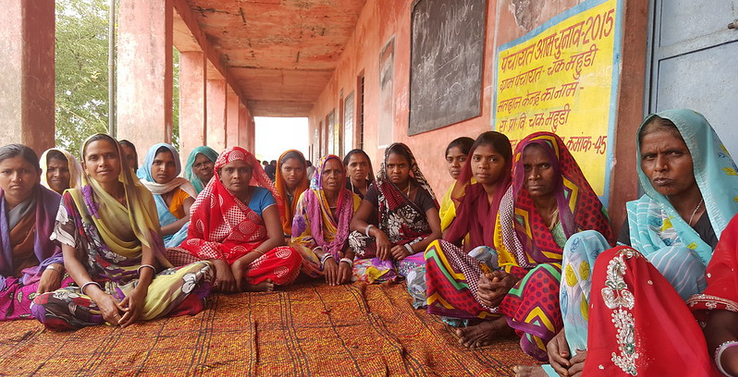
BMJ Global Health 2020;5:e003304. doi:10.1136/bmjgh-2020-003304. Image caption/credit: A Women Peer Support group in Chak mahudi village in Dungapur District, Rajastan - UN Women/Nuntana Tangwinit via Flickr (CC BY-NC-ND 2.0)
- Log in to post comments