










































COVID-19 and Health Inequities: Insights from Communication Research and Practice
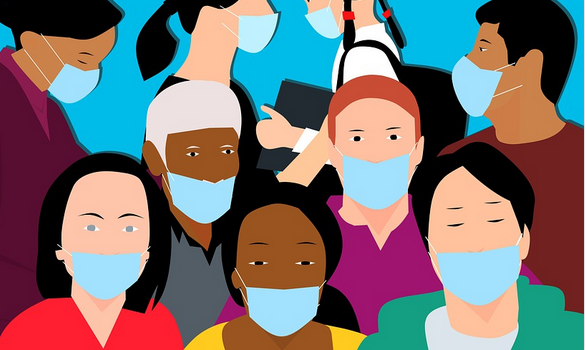
"Encouragingly, examples of addressing inequities during the response to the COVID-19 pandemic are described in this issue. However, much more must be done." - Renata Schiavo, Gretchen Van Wye, and Erma Manoncourt
The articles in this special issue of the Journal of Communication in Healthcare (JCIH) offer insights on the role on communication research and practice in addressing health inequities that existed and/or emerged during the COVID-19 pandemic. They also highlight perspectives and/or implications of relevant findings - not only as related to COVID-19 response and recovery but also future public health and healthcare emergencies in both national and global settings.
The opening editorial provides context for the selections that follow, with Renata Schiavo, Gretchen Van Wye, and Erma Manoncourt offering a brief overview of existing models for social and behaviour change communication (SBCC) and risk communication and community engagement (RCCE) - noting that, within many of these models, there are 3 social and behavioural change principles that undergird the role of communication in responding to disease outbreaks and other public health emergencies: (i) understanding human behaviour and its context; (ii) evidence-based communication programming; and (iii) community ownership and buy-in. (Additional principles are reflected in the articles in this special issue of the JCIH.) Schiavo, Van Wye, and Manoncourt make a case for investing in communication capacity and preparedness to address inequities not only during public health emergencies but also in other community and population health settings.
Contents include:
- "COVID-19 and Health Inequities: The Case for Embracing Complexity and Investing in Equity- and Community-Driven Approaches to Communication" [Editorial by Renata Schiavo, Gretchen Van Wye, and Erma Manoncourt, pages 1-6] - Introducing the special issue of the JCIH, this editorial explains why social, policy, and behaviour change at the system level is communication and suggests that the pandemic has presented "an opportunity for system change, for starting anew, investing in health systems, and integrating communication systems and preparedness with other essential functions of regional, national and global health systems." (See also paragraph above.)
- "Policy and Communication for Equity - Joyful Levelling Up During and Beyond the Pandemic" [Letter by Evelyne de Leeuw, pages 7-10] - This piece highlights some of the tensions and amalgamates between health equity policy and communication during the COVID-19 pandemic.
- "Identifying Better Communication Practices for Older Adults during the Next Pandemic: Recommendations from the COVID-19 Experience" [Letter by M. Aaron Guest and Allie Peckham, pages 11-14] - While early pandemic messaging emphasised the role of social distancing for all populations, messaging devolved into generalisable claims regarding large swaths of the population, including older adults. This piece discusses the implications of this messaging and its delivery, the ageist undertones, and recommendations for moving forward.
- "Meeting the Education Needs of a Diverse Healthcare Workforce: Bringing Equity to the Knowledge and Understanding of Infection Prevention and Control" [Letter by Nicole Coffin, pages 15-18] - This commentary describes innovations that evolved in communicating about infection control for long-term care facilities, specifically nursing homes, and the need to address health equity in those communications that became especially clear during the COVID-19 pandemic.
- "COVID-19 in North Macedonia: Implementing Community-Driven Communication Strategies to Advance Health Equity" [Interview by the JCIH Editorial Team, pages 19-21] - This interview with Patrizia Di Giovanni, Representative to the Republic of North Macedonia, United Nations Children's Fund (UNICEF) focuses on the impact of COVID-19 on groups experiencing marginalisation or other kinds of vulnerability and disadvantages, as well as lessons learned from the UNICEF countrywide and community-specific response, including local communication interventions.
- "Covid-19 Rural Health Inequities: Insights from a Real-World Scenario" [Brief Report by Teresa Wagner, Clara Ramirez, and Brenda Godoy, pages 22-26] - This brief report demonstrates the importance of effective and sustained patient- and community-centred care that includes culturally and linguistically congruent health communication to abate this pandemic and future threats to public health.
- "Pause, Pivot and Proceed: A Before-After Study to Examine the Impact of the COVID-19 Pandemic on a Community-Based Peer-Recovery Program for Substance Use Disorder" [Article by Mechelle Sanders, Teraisa Mullaney, Holly Ann Russell, Kara Izzo, and Brian Smith, pages 27-33] - During the COVID-19 pandemic, most peer recovery programmes had to end face-to-face services and move to an online and or phone-based format. The goal of this study was to explore the impact of the COVID-19 pandemic on one community-based peer-recovery programme.
- "Sharing Black Trauma as COVID-19 Crisis Communication Tactic: Assessing Communications from a Regional Hospital System in Albany, Georgia" [Article by Monica L. Ponder, Khadijah Ameen, and Natalie T. J. Tindall, pages 34-43] - In the midst of the first wave of COVID-19, a local hospital produced a video of a Black man dying from COVID-19 as a part of its crisis communication strategy. The purpose of this study is to critically interrogate this tactic.
- "Psychological and Situational Profiles of Social Distance Compliance during COVID-19" [Article by Michael Robert Haupt, Staci Meredith Weiss, Michelle Chiu, Raphael Cuomo, Jason M. Chein, and Tim Mackey, pages 44-53] - This article applies a profile approach of 482 US residents in order to facilitate personalised communications tailored to the psychological and situational circumstances of each profile, with the goal of promoting compliance with public health guidelines and guiding policy decisions.
- "'Other Patients Become a Secondary Priority:' Perceptions of Estonian Frontline Healthcare Professionals on the Influence of COVID-19 on Health (In)Equality and Ethical Decision-Making" [Article by Kadi Lubi, Kadri Simm, Kaja Lempu, Jay Zameska, and Angela Eensalu-Lind, pages 54-63] - The aim of this article is to analyse the perceptions of frontline healthcare professionals regarding the potential impact of COVID-19 on the provision of other healthcare services and the ethical challenges it may entail.
- "Experiences with Public Health Recommendations for COVID-19: A Qualitative Study of Diverse Mothers with Young Children in the United States" [Article by Katherine R. Arlinghaus, Derek Hersch, Dianne Neumark-Sztainer, and Katie A. Loth, pages 64-73] - This qualitative study aimed to understand experiences navigating public health recommendations to slow the spread of COVID-19 among economically and ethnically diverse mothers with young children.
A concluding thought from the special issue's editors: "Of greatest importance is to make sure that communication has a seat at the table early on during pandemics and always. When communication is an afterthought and not an essential function of our health systems, it is often relegated just to messaging and media...and we know that this...approach is not likely to...be effective in addressing health inequities."
Publishers
73
Journal of Communication in Healthcare: Strategies, Media and Engagement in Global Health Volume 15, Issue 1 (2022) - sourced from: "COVID-19 and Health Inequities: The Case for Embracing Complexity and Investing in Equity- and Community-Driven Approaches to Communication", by Renata Schiavo, Gretchen Van Wye, and Erma Manoncourt. Journal of Communication in Healthcare, 15:1, 1-6, DOI: 10.1080/17538068.2022.2037349; and email from Renata Schiavo to The Communication Initiative on March 31 2022. Image credit: Pixabay
- Log in to post comments