










































Ghana Early Childhood Development End-of-Project Report
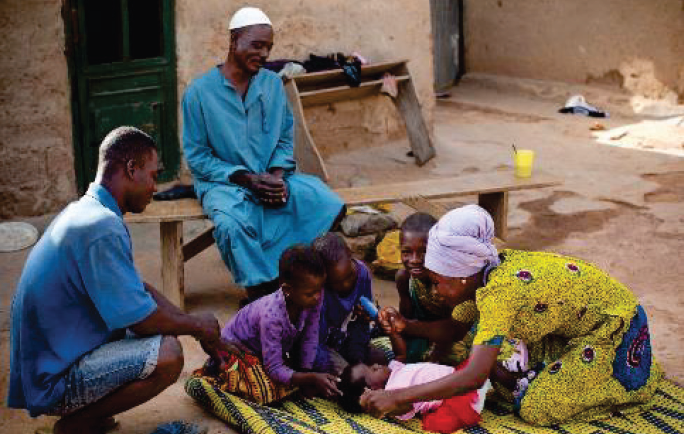
"The MCSP Ghana ECD 0-3 Program demonstrated that frontline health workers can be effectively mobilized to deliver ECD sessions as part of their routine activities to provide holistic care for improved child health outcomes."
Research shared by the global early childhood development (ECD) community indicates that children who receive appropriate health, nutrition, psychosocial stimulation, and responsive care are most likely to achieve optimal development. In that context, from December 2016 through June 2019, the Maternal and Child Survival Program (MCSP), in collaboration with the Ghana Health Service (GHS)'s Family Health Division (FHD), implemented ECD across Ghana with United States Agency for International Development (USAID) support. This report shares the results of MCSP's assessments of project implementation and impact.
The MCSP Ghana ECD 0-3 Program aimed to improve caregiver capacity and child development outcomes through:
- Development, in partnership with the GHS, of a global-level, evidence-based ECD toolkit for children ages 0-3 adapted to fit the Ghana-specific context, along with eLearning modules.
- Capacity-building of Community-Based Health Planning and Services (CHPS) staff, community health volunteers (CHVs), and social welfare officers (SWOs) to implement ECD materials through routine, community-level services and to effectively teach caregivers with children ages 0-3 about early stimulation and responsive parenting. The sessions engage caregivers to be responsive to their children's cognitive, language, emotional, and physical needs from birth onward by playing, talking, and singing, even before children can verbally respond, and exposing them to words, numbers, and simple concepts while carrying out their daily routines. The sessions also guide caregivers through use of positive discipline techniques to ensure that children are protected from physical and emotional harm. MCSP:
- Built the capacity of 2,268 national-, regional-, and district-level health staff to deliver sessions about early stimulation and responsive parenting to caregivers. These health workers implemented their new skill set to train caregivers across 21 districts within 4 regions of Ghana, ultimately reaching 5,715 caregivers and 5,006 children.
- Supported continued performance improvement among health staff via ongoing supervision and mentorship visits, documenting facilitation and utilisation of the toolkit and retention of ECD messages.
- Assessment of the ability of CHPS staff, CHVs, and SWOs to integrate ECD activities into their routine services and documentation of changes in caregiver behaviours and child development. Highlights:
- In total, 191 health workers (132 CHOs and 59 CHVs) were included in 51 focus group discussions (FGDs), and 158 caregivers participated in 22 FGDs. One finding: Health workers and caregivers report decreases in harsh discipline practices and increases in play, yet multiple exposures are necessary to drive sustainable behaviour change.
- MCSP interviewed 253 caregiver-child dyads at baseline and endline, finding significant increases in use of learning materials and play-based caregiving practices in both regions. Multivariate regression analyses that include variables from the caregiver questionnaire find that age, number of reading materials, number of caregiving practices, and an acceptable dietary diversity were significantly positively related to child development scores.
- Utilising different platforms (e.g., in urban vs. rural communities) empowered multiple community groups to deliver messages about the importance of psychosocial support and playful parenting, which can enable behaviour change. The platforms identified can be leveraged during future sensitisation activities for ECD or other health and nutrition topics. (See Appendix E.)
- Creation of an enabling environment at the national and regional levels to promote institutionalisation of ECD activities into partner and government programming, particularly for children ages 0-3, a cohort not specifically addressed in previous Ghana ECD policy. For example, MCSP:
- Leveraged learnings from the MCSP ECD programme to make technical inputs into key strategic technical documents, including the National ECD 0-3 Standards, Newborn Health Strategy, and ECD Call to Action.
- Collaborated with the GHS, United Nations (UN) agencies, and other partners to revitalise cross-sectoral working groups on 0-3 ECD and spearheaded an ECD stakeholder meeting for the upcoming Nurturing Care Strategy.
- Supported the revitalised national ECCD technical working group (led by the Ministry of Gender, Children, and Social Protection) and national stakeholder and media sensitisation meetings to educate key stakeholders on the importance of nurturing care and to build consensus toward the development of a nurturing care strategy for the health sector in Ghana.
- Organised a media workshop in January 2019 under the theme Investing in the Future, with the overarching goal of orienting media practitioners on the science, significance, policy, and practice of ECD. The event served as an opportunity to reinforce media practitioners' capacity to research, report on, and advocate for widespread adoption/practice of responsive parenting, brain stimulation, and interaction among parents or caregivers and their young children.
In short, the endline results compared to the baseline demonstrated clear changes in all targeted groups under the study and could be attributed to the MCSP ECD intervention. MCSP offers recommendations for future ECD programming undertaken by the Government of Ghana, the GHS, and partners in various areas. Some examples follow:
- Platforms and attendance - e.g., Certificates of completion or recognition at community events can be used to motivate and encourage mothers who attend all sessions and as a form of encouragement for others to attend more frequently. There is also potential to train mothers to serve a "co-facilitator" role to encourage even greater buy-in.
- Behaviour change - e.g., In light of the fact that some of the more nuanced messages about different kinds of play and stimulation activities were not yet internalised by caregivers, ECD promotion should be conceptualised as ongoing.
- Training - e.g., Future programmes could initiate a community of practice where CHVs and field implementers can share their experience, such as through WhatsApp groups.
- Materials - e.g., Toy-making activities meet a need within communities and were greatly appreciated by caregivers and health workers, so this practice should continue.
- Engaging male caregivers - e.g., Because male participation and contribution are critical, future programmes could include mass sensitisation and campaigns geared at changing attitudes of fathers. If male participation is low in group settings, finding other ways to reach fathers will be important (e.g., with home visits or through social media outlets).
- Research and evidence - e.g., Future programmes should incorporate causal research, such as a randomised control trial, and could explore questions such as: how much input is needed to make significant improvements in caregiving behaviours and child development?
- National-level advocacy and engagement - e.g., It will be important for future programmes to support cross-sectoral collaboration, putting in place: (i) a robust learning agenda to explore what can be learned to inform ECD programming at the national level, and (ii) a communications strategy that builds the capacity of regional media to accurately report on and promote ECD services and that sensitises the public at large for demand creation and scale-up.
MCSP website, October 24 2019. Image credit: Kate Holt, MCSP
- Log in to post comments