










































How Evolutionary Behavioural Sciences Can Help Us Understand Behaviour in a Pandemic
University College London (Arnot, Brandl, Campbell, Dyble, Emmott, Kretschmer, Mace, Nila, Peacey, Salali, Zhang); Lanzhou University (Chen, Du, Ge); Université Toulouse 1 Capitole (Micheletti)
"The evolutionary basis of our preferences and the cultural evolutionary dynamics of our beliefs drive behavioural change, so understanding these evolutionary processes can help inform individual and government decision-making in the face of a pandemic."
Before a vaccine for COVID-19 had been developed, and until it is widely available, stopping the spread of the virus must rely on behaviour change by limiting contact between people. In practice, being told to limit in-person contact with other people is challenging. This paper outlines how an evolutionary perspective on behaviour change - one that acknowledges that individuals are expected to act to maximise their inclusive fitness (i.e., spreading our genes), rather than to act for the good of the group - can provide insights not only around issues with physical/social distancing but with other elements of the COVID-19 response.
As is explained here, decisions in terms of maximising fitness involve trade-offs. For example, an individual living through a pandemic may have to decide whether to go out to work and risk infection in order to earn money for immediate and future needs, or to stay at home and avoid infection. Evolutionary models highlight that avoiding disease by social distancing reduces the likelihood of meeting a reproductive partner, and any associated loss of income/employment may hinder the opportunity to reproduce or invest in the well-being of (even future) offspring. When governments make policy decisions, the trade-offs are usually evaluated at the population level. Such decisions are social dilemmas: there is a collective benefit from widespread cooperation across the population, but individuals have an incentive to "free ride" on the cooperation of others. Evolutionary models can also explain why individuals may opt to cooperate in line with the public good.
Based on such thinking, the paper examines the underlying causes of behaviour and decision-making and argues that doing so can help develop more effective strategies for tackling issues such as:
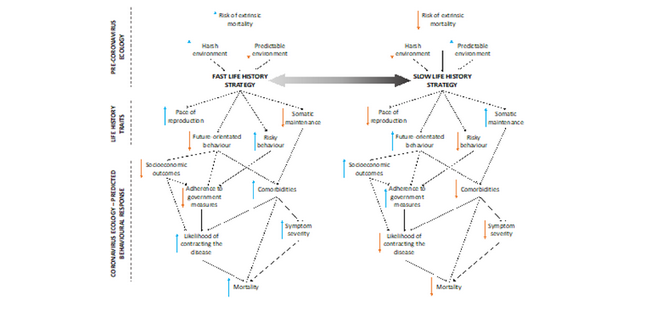
- Compliance with health-promoting rules - The paper describes a life history framework to help understand people's response to competing risks. The figure above illustrates a range of ways in which a greater risk of extrinsic mortality might promote a faster life history strategy, resulting in more risky behaviour and a decreased likelihood of compliance. "It is possible that the government and media strategies of constantly drawing attention to mortality resulting from the pandemic could have perverse effects through enhancing risk-taking, as the salience of mortality has been shown to cause people to prioritize speeding up reproduction, as recently observed in Indonesia in response to COVID-19....Alternatively, those with longer time-horizons may perceive the risk of COVID-19 as short-term and thus delay child-bearing until it is over, as recently predicted in the USA [United States]..."
- Social distancing - Like most primates, humans are highly social animals who rely on social interactions within large and complex groups for cultural learning, support in raising children, and other key functions. For many reasons, including negative impacts on children's development, social distancing rules pose dilemmas for families, as it is unclear whether the benefits of social distancing and avoiding the virus outweigh the immediate and long-term costs (e.g., lower mating opportunities for young adults). "The magnitude of these costs may be missed by policy makers who, in Western contexts at least, typically view intensive parenting as the 'normal' form of childrearing and significantly underestimate the costs of severing a family's social ties."
- Domestic violence - Lockdowns can inhibit female escape strategies and reduce their bargaining power, thus increasing instances of domestic violence. An evolutionary approach suggests that a tendency to control a mate has a strategic function: increased reproductive success in ancestral environments, through either securing more mates or more mating. The authors "suggest that policy should focus on demographic groups that an evolutionary approach would highlight as being at a heightened risk of abuse, such as younger women and women whose partners are under economic stress or risk of job loss."
- Contact tracing - Research shows that how people respond to government guidelines may be influenced strongly by the people they are surrounded by and the culture they are a part of. In Western, Educated, Industrialized, Rich, and Democratic (WEIRD) societies, there is a rising scepticism and resistance against contact-tracing measures, which stems from norms around privacy, political freedom, and moral autonomy. "One way to tackle non-compliance to contact tracing is to obtain a consensus from the public that we are now in a different social context from pre-pandemic times, so a new moral norm (i.e. more neutral attitudes towards personal data disclosure for contact tracing) is required....Understanding which cultures would be more receptive to different technologies may help governments market them to the public."
- Misinformation, conspiracy theories, and vaccine uptake - Vaccines are central in many conspiracy theories, with some believers, for example, attributing unseen causes of important events to a powerful coalition secretly working to cause harm. "When the error costs of not perceiving a threat are potentially more catastrophic than its over-detection, selection favours a bias towards over-detection..., meaning people adopt vaccine-avoidant behaviours....[B]elievers perceive themselves as participating in a common cause...and form 'echo chambers', in which they only encounter perspectives that reinforce their own." Notably, as people are more likely to trust information and conform to behaviours they observe in their in-group, appeals by peers - e.g., through engagement of social media users, from similar cultural groups, who share their own positive experiences with COVID-19 vaccination - may be effective. In short: "Cultural evolutionary theory can help us understand who is most vulnerable in regard to believing untruths about factors relating to COVID-19, and what we can do to minimize the spread of such misinformation."
- International cooperation - "Evolutionary behavioural sciences are being applied to investigating the evolution of societal organization and the drivers of intergroup cooperation, employing historical data analysis, experimental studies, and mathematical modelling....An evolutionary approach suggests reasons behind suboptimal responses to the COVID-19 pandemic from states and communities are likely to be found in these conflicts of interest and their 'ecological' drivers....Given how easily the virus is spread, countries working together to share vaccine developments, including subsidizing those countries that cannot afford it, is likely to be essential to eradicating this disease globally."
Three main guiding suggestions are offered; in short:
- "Good of the group" arguments will not go far.
- Behaviour is heterogenous.
- Behaviour change is linked to a change in ecology.
In conclusion: "Sustained behaviour change to keep pandemics at bay is much more likely to emerge from environmental change, so governments and policy makers may need to facilitate significant social change - such as improving life experiences for disadvantaged groups."
Evolution, Medicine, and Public Health [2020] pp. 264-78. doi:10.1093/emph/eoaa038.
- Log in to post comments