










































Integrating Behaviour Change and Hygiene in Public Policy: Four Key Dimensions
Word Bank’s Water and Sanitation Programme
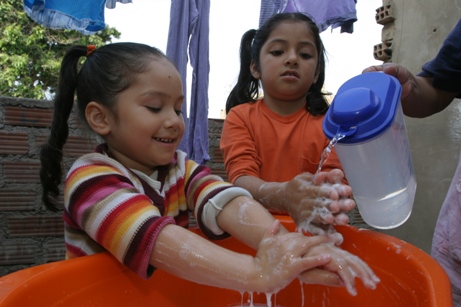
This guidance note explains the findings of policymakers, scholars, and practitioners from nine countries in Latin America and the Caribbean working in water and sanitation projects at a meeting held in the Dominican Republic in January 2012. The purpose of the meeting was to discuss the opportunities and challenges faced in water- and sanitation-related projects and explore "systemic and sustainable way(s)" of integrating hygiene and sanitation behavioural change into water and sanitation investments. The Water and Sanitation Programme, a multi-donor partnership administered by the World Bank to “support poor people in obtaining affordable, safe, and sustainable access to water and sanitation services”, sponsored the conference. During the conference,a common understanding emerged - "the sense that infrastructure by itself will not solve the global problem of inadequate access to improved sanitation and potable water unless people adopt new behaviours."
Fundamental challenge: "how to integrate a continual process of behavioural change vis-à-vis the limited time frame of water and sanitation infrastructure programmes, which start and end with the building process."
Key Dimensions:
1) Behaviour change: triggering and sustaining
- Align communication-based behaviour change interventions with the overall cultural context, and do adequate research about those contexts so as to ground communication strategies in the findings. Research and follow-up are key to determining what motivates change in a particular audience.
- Expect great variation from culture to culture: In some places, children are subordinate and therefore not able to transmit messages to their elders (Vietnam), whereas in others (Peru), children do bring new ideas home and discuss them (often with mothers). In some cultures, the "collective identity" or what everyone else is doing can be relevant, whereas some are motivated by their own increased social standing. A people who eat with their hands (Uganda) might like a mild soap without a strong smell, whereas another that eats a lot of fish (Kenya) might prefer perfumed soaps after they eat.
- The Water and Sanitation Programme developed the FOAM framework (Focus, Opportunity, Ability, and Motivation) to guide the drafting of communication strategies for its Hand Washing Initiative that allows for monitoring during implementation and corrections as needed regarding:
Who the focus audience is and what the desired behavioural change is;
The available individual resources for a behavioural change;
The individual capacities to perform a certain desired behaviour; and
The individual will to perform a certain behaviour.
- Identify clusters of behaviours.
- Clusters of behaviours are those that often occur together. For example, families who invest in sanitation systems are motivated to keep their facilities clean, leading to adopting other personal hygiene behaviours such as hand washing with soap.
- United Nations (UN)-HABITAT developed simple messages organised and communicated in a manner relevant to improvement of the water and sanitation facilities throughout the project cycle.
- Include community-level activities with information. the United Nations Children's Fund (UNICEF)'s WASH programme in Central American schools focuses the message on a specific audience (children) based on their motives for adopting new behaviours.
2) A systemic approach: multi-sectoral and integrated
- Participants suggested that it is necessary to bring "diverse sectors to the water and sanitation table especially as they are important actors to enhance and sustain complex changes of behaviour over time" and should come together at local, subnational, and national levels. Sectors might include health, water and sanitation, environment, and education. For example, in Ethiopia, multiple sectors, capacity building, and investment in health provision to reduce defecation in the open successfully used an approach "From household to the globe" - the process of behaviour change that starts in the private sphere of home and sprouts into the community as a grassroots, holistic approach that improves sustainability, links behaviours that strengthen each other, and has potential to expand horizons beyond the family into the community. This type of programme seeks to promote several home-based behaviours but also "engages authorities, promoters, and community leaders to endorse and sustain the process of change."
3) The private sector becomes a strong ally
- This section suggests that it behoves the public sector to work with businesses, especially those with a local presence, to galvanise their financial and technical support to improve the "sustainability of water, sanitation and hygiene investments."
4) Public policy and the enabling environment for sustainable change
- Decentralisation in Latin America brings about a need to "support authorities at national and local level(s) to design sound policy that will translate into operational level budget allocation to reach audiences and bring about change." In several countries such as Mexico, Dominican Republic, Colombia, Ecuador, and Peru, hygiene methodologies have been integrated into nutrition, education, and/or water and sanitation and environmental policy after being validated through fieldwork.
Conclusions:
Field experience is showing that one change can lead to another if the environment is auspicious for change; it is important to think of "sets of behaviours" when prioritising. For example, US$3.00 worth of hand washing with soap promotion can increase life by one year, the same as a US$2,750 investment in cholera immunisations. Local experiences, often small, provide most success stories with regards to hygiene, water, and sanitation. One challenge is how to scale up these experiences. "The power of municipalities rests on their proximity to the population."
The Water and Sanitation Programme website on January 23 2014, and email from Juan Chong to The Communication Initiative on January 29 2014. Image credit: The World Bank
The Water and Sanitation Programme social network contacts:
Twitter @worldbankwater
- Log in to post comments