










































Meningococcal Disease in Italy: Public Concern, Media Coverage and Policy Change
University of Brescia (Covolo, Croce, Moneda, Zanardini, Gelatti, Ceretti); University of Lugano (Schulz)
"...it takes only a few stories with an emotional impact to contribute to risk perception, as extensively shown in online vaccination debate..."
Between 2015 and 2017, six deaths due to meningitis in the Lombardy Region, Northern Italy, caught the attention of media and increased concern among the population, with a consequent increase in demand for vaccination. Considering the evidence about the impact of media coverage of health issues on public behaviour, this paper investigates the trend of media coverage and internet searches regarding meningitis in the Lombardy Region.
The context of the research is a new health protection service, reflecting a change in public health care policy. On December 29 2016, the Regional Committee of Lombardy approved a new vaccination campaign against meningitis with a co-payment system (savings of 50%) for adults. This change was precipitated, in part, by the fact that a girl died of meningitis during World Youth Day in August 2016. This event triggered mass media coverage. There are two main models to explain how policy changes can be influenced:
- The "outside initiative model" holds that society has to exert pressure on political decision makers to make them attend to problems. If this model were true, public interest and media attention towards a problem should rise and remain elevated for some time, which would be essential to trigger and observe a policymaking response. After policy changes were implemented, public interest and media attention would either subside, if the public and media are satisfied with that policy change, or remain elevated, if they are not.
- The "mobilisation model" holds that policymakers take the initiative to put an issue on the political agenda and then attempt to gain support for the issue by raising public attention and involving the media.
This study aimed to describe the dynamics of the decision made by the Regional Committee of Lombardy on December 29 2016, regarding co-payment meningococcal vaccination for adults and to try to understand if the outside initiative model mobilisation model or better fit the data.
Covering the period from January 2015 until May 2017, the study:
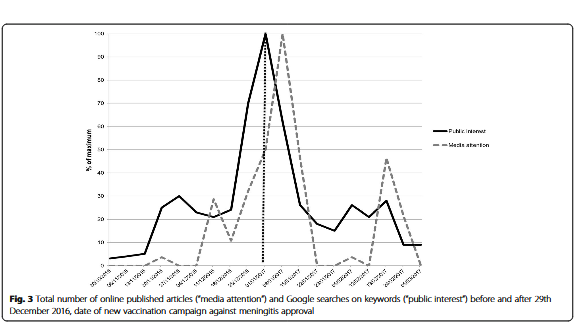
- assessed public interest using Google Trends - a peak was considered as an increase of more than 25% of searches of the Italian equivalents of the terms meningitis, meningococcal vaccine, and neck stiffness in less than 2?months; and
- measured media attention through an analysis of 132 articles featured in the online version of three main local newspapers from Brescia, using the Italian equivalent to meningitis as keyword in each. A quantitative content analysis of the articles was performed, split into two: the 5 months before and the 5 months after the policy change.
Both public interest towards meningitis and newspaper attention had briefly risen in August 2016 (one case of death due to meningitis). A peak occurred in December 2016 and January 2017, when three cases of meningitis were recorded in Lombardy, which resulted in the aforementioned changes to regional policy to offer co-payment to adults. Media attention on the subject endured into February 2017 but without a corresponding peak in public interest.
The frequency of meningitis coverage decreased after the announcement of policy change. For example, articles containing new information on meningitis or meningococcal vaccine (76% to 48%, p=0.01) and preventive recommendations (31% down to 10%, p=0.006) decreased significantly. At the same time, information on the meningococcal vaccine increased, particularly on information about access to vaccination services. This may reflect an interest to inform the public on vaccines, their costs, and availability rather than on the disease characteristics, as if media attention shifted from problem to solution.
An alarmist tone (e.g., using words such as 'anxiety', 'terror', 'scare', or 'panic') appeared in 21% of pre-policy articles that decreased to 5% post-policy (p=0.03). According to the researchers, this observed decrease in an alarmist tone could be due to the reduction in death announcements or the policy change itself.
When considering the public interest sourced from Google Trends, the findings of this study seem to support the idea of the outside initiative model: Prior to the policy change, there was an increase in public interest that might suggest public opinion was pressuring policymakers for some time until they took action. When considering media attention, a mobilisation model seem to fit the results more appropriately: The new regulation may have created some echo with newspapers that lasted for a few weeks, suggesting some sort of support from the media to policymakers; about two weeks after the policy change, a decrease both in public interest and media attention was observed.
As noted here, public concern has translated into high demand of vaccinations. Particularly in Brescia, as reported by a local online newspaper, demand from citizens developed so fast that, in June 2017, the earliest available appointment to perform a meningitis vaccination was June 2019. "This is an example of what happens when fear of disease predominates. In fact, the high demand of vaccinations observed in this scenario sounds unusual at a time when, also at international level, health professionals are questioning how to deal with the vaccine hesitancy..."
In conclusion: "This study has confirmed the important role of a media echo when dealing with public health issues. For this reason, as clearly stated by other studies...a collaboration between journalists and public health institutions would be strategic in order to improve communication with a population."
BMC Public Health (2019) 19:1061 https://doi.org/10.1186/s12889-019-7426-5.
- Log in to post comments