










































Involving Men in Handwashing Behavior Change Interventions in Senegal
World Bank
This 4-page "Learning Note" brief shares the experience of the Global Scaling Up Handwashing programme, a World Bank Water and Sanitation Programme (WSP) project focused on applying behaviour change approaches to improve handwashing with soap, to involve men in Senegal in the campaign. According to the brief, men have a central role to play in handwashing behaviour change. As gatekeepers, men allow access to their household and provide funds for soap. As protectors, men can play a follow-up role to the outreach session and ensure that household members wash their hands with soap. As role models, men wash their hands with soap while encouraging others to do the same.
Early on in project planning, women were identified as the key audience because of their central role in caring for the family, especially children. However, WSP found that in Senegal men are typically heads of household, and in this role they exert influence on many levels. Men also expressed frustration at not being included in the handwashing promotion discussion. Thus, while the Global Scaling Up Handwashing Project had initially focused on Senegalese women for mass media, direct consumer contact, and interpersonal communications, an emerging lesson was that the project team needed to consider the role of Senegalese men as heads of household, with the potential for adding men as a key audience for project implementation.
The project team organised a half-day learning event in December 2009 in Dakar, to validate the hypothesis regarding the role of men and to formulate strategies to more effectively involve men. The Dakar event produced several key learnings:
- As heads of household, Senegalese men play several key roles. Based on field observations and discussion, three key roles were identified - gatekeepers, protectors, and role models - and ways to leverage these roles were discussed.
- In these roles, men can allow or deny access to new information and necessary resources (i.e. soap, handwashing station). They can enable, reinforce, and sustain behaviour change.
- When men are engaged early on in the discussion, they are more likely to take an active role to mobilise family members, reinforce messages, and make the household available to receive handwashing with soap messages.
- Though women remain a critically important key audience for handwashing promotion, men should also be included as a key audience for mass media, direct consumer contact, and interpersonal communications.
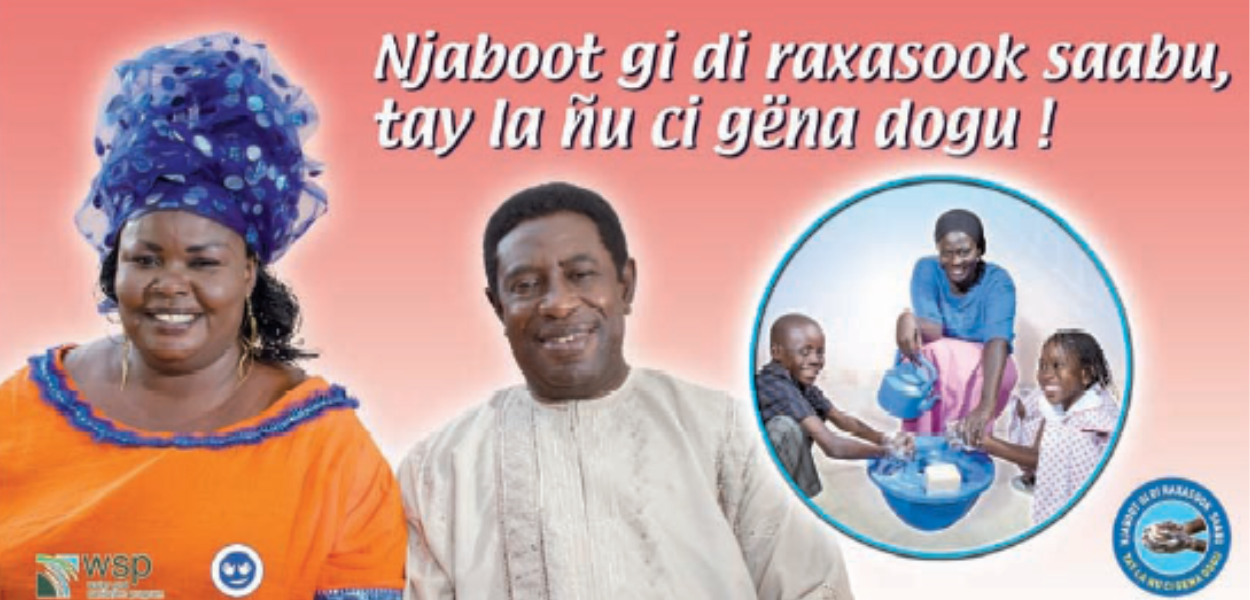
Based on outcomes of the learning event, the team modified training materials and approaches, and adjusted communication materials (i.e.logo, billboards, television, and radio spots) to increase the visibility of men's role and strengthen their commitment to support handwashing with soap in the household. Focus group and monitoring approaches were also adjusted to capture the participation and motivations of men.
The brief concludes by mentioning that as the team worked to adjust the intervention by modifying training and communication materials and adjusting monitoring tools, several questions emerged, including: What is the most powerful motivator to engage men to support handwashing behaviour change in their household? Does the inclusion of men have a catalysing, neutral, or negative impact on women’s attitudes towards handwashing behaviour change? Programme managers should consider these questions and others as they develop current and future handwashing programmes.
Water and Sanitation Programme website on February 12 2012.
- Log in to post comments