










































Behavior Change without Behavior Change Communication: Nudging Handwashing among Primary School Students in Bangladesh
University of Oklahoma (Dreibelbis, Kroeger); Save the Children—Bangladesh (Hossain); Save the Children-USA (Venkatesh); University at Buffalo, The State University of New York (Ram)
"Nudges may present a viable alternative to traditional messaging and behavior change communication programs when handwashing knowledge already exists."
Improving hand hygiene behaviours, particularly in low-income, resource-poor settings, has proven difficult. "Nudging" has been one strategy for triggering desired behavioural outcomes through environmental cues engaging unconscious decision-making processes. This proof-of-concept study centred around an inexpensive set of nudges to encourage handwashing with soap after toilet use in 2 primary schools in rural Bangladesh.
Both of the schools, with 220 and 514 students each, had on-site water connections (handpumps) and latrines. Prior to the intervention, soap was reportedly placed at the handpump in a small bowl, although head teachers reported that this was implemented inconsistently. A common set of handwashing (HW) infrastructure improvements and nudges were developed to facilitate handwashing with soap after using the latrine. In addition to the construction of a dedicated location for handwashing (raised cement platform) with a 60 L water container, 2 nudges were used at both schools: (1) connecting latrines to the handwashing station via paved pathways that were painted bright colours; and (2) painting footprints on footpaths guiding students to the handwashing stations and handprints on stations. Each phase of construction - infrastructure, footpaths, and painting - was completed on a single day.
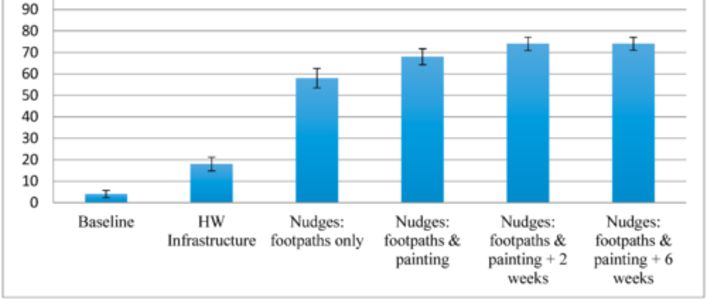
Observations were completed at baseline (prior to construction), 1 day after each infrastructure and nudge installation (HW infrastructure, brick paths, and painting) and 2 and 6 weeks after the intervention was completed. Each observation period consisted of one full school day. No additional handwashing education or motivational messages were completed. Handwashing with soap among school children was low at baseline (4%), increasing to 68% the day after nudges were completed and 74% at both 2 weeks and 6 weeks post intervention.
The researchers observe that the nudges were simple to install and used local labour and locally available materials without additional training or capacity building. The total intervention costs, US$161 per school, are significantly less than the cost for educational interventions, estimated at US$206 for the first month and US$53 for each subsequent month. However, education-based interventions are typically intended to promote improved handwashing beyond the immediate school environment and thus can have a broader impact on behaviours. The question of if and how nudges inform the creation of new habits that extend beyond the school environment requires further exploration. Furthermore, external nudges may require pre-existing knowledge or behavioural intention to successfully trigger desired behavioural outcomes.
They conclude that trials with a larger number of participating schools - perhaps some with schools struggling with issues of water availability and inconsistent provision of materials - and over prolonged durations are needed in order to fully document the potential and limitations of environmental nudges. Such future studies could also compare the behavioural impact of nudges against and in combination with motivational and/or educational messaging.
International Journal of Environmental Research and Public Health 2016, 13(1), 129; https://doi.org/10.3390/ijerph13010129
- Log in to post comments