










































Leveraging the Power of Knowledge Management to Transform Global Health and Development
Johns Hopkins Center for Communication Programs (Sullivan, Limaye, Mitchell), United States Agency for International Development (USAID) (D’Adamo), Bureau for Global Health (Baquet)
"Good knowledge is essential to prevent disease and improve health. Knowledge management (KM) provides a systematic process and tools to promote access to and use of knowledge among health and development practitioners to improve health and development outcomes."
This document discuses the meaning of "KM" - knowledge management - and examines its role in social and behaviour change communication (SBCC) for health. It offers the Knowledge Management for Global Health Logic Model (See related summary below.), describes how KM has evolved as a discipline, and offers a case study from Bangladesh. A part of the evolution of thinking about the discipline of KM is: "Scholars have recognized that information is explicit and factual, while knowledge results from the integration of information with belief and context. This implies that while information can flow easily, knowledge is embedded in people and must be extracted to bridge the gap between knowledge and its application in policy and practice."
From evaluations of KM practices, the following are suggested global-health-related practices and possible outcomes:
- eLearning - "users are able to learn at their own pace, use customized training tools, and save both time and costs of travel to attend a class, increasing the potential for knowledge gain."
- "Knowledge exchange portals create platforms for exchanging evidence-based information through online libraries, accessing epidemiological and demographic data, and creating or maintaining communities of practice."
- "[K]nowledge exchange portals, combined with tailored messaging services, can be effective at encouraging evidence-based policy and program design."
- A community of practice can "indeed become the central platform for knowledge sharing."
The case study describes the use of KM of SBCC for health, "an evidence- and theory-based process designed to improve health behavior and outcomes", within the Bangladesh Ministry of Health and Family Welfare (MoHFW). In that ministry, SBCC is used for health activities, including those focused on maternal and child health; population activities, largely focused on family planning; and nutrition activities. In early 2011, the Knowledge for Health (K4Health) Project, funded by the United States Agency for International Development (USAID), "was invited... to undertake a scoping visit to identify issues that could be resolved by applying KM solutions to their SBCC work." The Bangladesh Knowledge Management Initiative (BKMI) project focused on coordination of SBCC programmes and materials, learning and application of an integrated package of SBCC materials, and strengthening the SBCC capacity of the health, population, and nutrition units of the MoHFW.
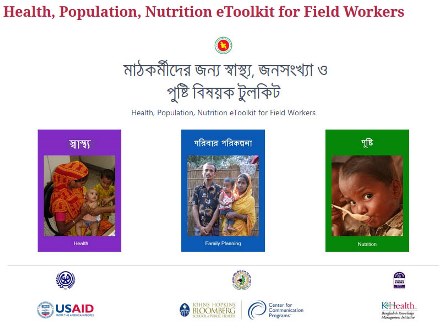
The Bangladesh SBCC Working Group was established by the BKMI for coordination, convening stakeholders, organising a workshop, developing a framework and strategic plan, and establishing a website to store and share key documents and disseminate information. Working with field workers - family welfare assistants (FWAs), who counsel and educate community members specifically about family planning, and health assistants (HAs), who counsel and communicate about general health issues such as maternal and child health, immunisations, and nutrition - BKMI conducted an eHealth pilot to improve field workers’ knowledge and skills in the use of information and communication technologies (ICT) and their ability to integrate messages on knowledge for counselling clients. The training used netbooks with a toolkit that contained 116 HPN SBCC materials, including TV spots, flip charts, brochures, posters, and job aids, vetted by both the MoHFW and the field workers themselves. "The eLearning package, designed to address the training needs of the field workers, included 2 family planning courses; 2 maternal, newborn, and child health courses; 2 nutrition courses; a course on interpersonal communication and counseling; and a course on integrated messaging. Courses contained 15- to 20-minute self-paced videos designed for low-literacy audiences. The project periodically assessed the field workers’ knowledge to measure learning from topics covered in the courses. These KM tools (digital Toolkits and eLearning courses) connected field workers to the knowledge and materials they needed to act effectively in their work."
BMKI provided hands-on coaching and mentorship to MoHFW staff of the 3 units participating, based upon an assessment of individual SBCC capacity needs and KM efforts being used to support SBCC within the units, including SBCC capacity to: conduct a situation analysis; develop a communication strategy; develop tested materials; implement programmes; and monitor, evaluate, and replan, as well as KM capacity to: create and use KM processes in support of SBCC; manage and lead SBCC programmes; nurture support for KM; and monitor, evaluate, and replan SBCC programs using KM.
"The endline post-assessments found that staff knowledge of how to design and implement SBCC activities had improved, and they increasingly used a strategic process for developing messages and materials. Staff also demonstrated greater ability to manage data, more appreciation for monitoring and evaluation, and improved leadership skills. However, BKMI staff did not successfully put KM processes in place."
Lessons learned include:
- Coordination of HPN SBCC activities and materials should allow SBCC stakeholders "opportunities to collaborate, share, and validate good practices and lessons learned, pool resources, avoid duplication of effort, and create and implement activities according to common quality standards. KM benefits from a multisector approach from the outset", involving government ministries of health along with other stakeholders to improve sustainability and coordination.
- The use of ICT offered by netbook access in the eHealth pilot gave access to eLearning courses and digital resources that empowered staff and offered credibility in the community. However, more in-person training and training in interpersonal communication for counselling was requested by staff in this initiative, and ongoing information technology (IT) support and monitoring was needed.
- A high turnover of individuals means that organisation strengthening, rather than individual training, is more likely to build capacity that is sustainable. Institutionalisation of a KM team within a ministry may be needed for ensuring cultural change over time related to SBCC and KM
- The high cost of IT (in this case, the netbooks), may prohibit scaling up. The Bangladesh project is "exploring how it can scale-up use of the Toolkit and the eLearning courses to more health service providers in Bangladesh through the existing infrastructure, which includes mostly desktop computers in clinics and tablets among the health assistants."
The study concludes that:
- "KM can improve coordination by creating and implementing a systematic process to exchange knowledge on a particular technical topic - in this case, SBCC programs and materials - as well as institutionalizing such a process to ensure sustainability."
- "Further research would be beneficial in understanding the application of KM within the health sector. At a minimum, more rigorous studies that isolate KM activities and compare them to the absence of KM activities would provide stronger evidence of its effectiveness on health outcomes."
- Systematic processes, including better defining the terms used to describe KM tools and processes, are needed, as well as critical examination of how to better integrate relevant theories into KM design, implementation, and research.
- Application to global public health of KM tools and processes from other fields should be studied.
Global Health Science and Practice, April 27 2015, accessed April 29 2015.
- Log in to post comments