










































Micro-planning in Peer Led Outreach Programs: A Handbook Based on the Experience of the Avahan India AIDS Initiative
"'Micro-planning' is a process that decentralizes outreach management and planning to grassroots-level workers - outreach workers and peer educators - and allows them to make decisions on how to best reach the maximum number of community members."
Based on the experience of the Avahan India AIDS Initiative (see Related Summaries, below), this handbook presents basic information on what peer-led micro-planning is and how it can improve peer-led outreach. It also includes detailed descriptions of various micro-planning tools, including how to use them with a variety of key populations.
Implemented across 6 states in India, since 2003, Avahan has used peer-led outreach with people at high risk of HIV infection (male and female sex workers, injecting drug users, high-risk men who have sex with men, and transgender persons), as well as bridge populations (long-distance truck drivers and clients of sex workers) to prevent the spread of HIV. These experiences may be useful for other peer-led outreach programmes - whether government programmes, non-governmental organisations (NGOs), or communities - working with marginalised groups, particularly women and youth, to improve health.
- Section 1 explains what micro-planning is. Basically, it employs a set of tools that allow peer educators (PEs, who are members of a particular community recruited and trained by an NGO to provide HIV prevention outreach to other members of the same group) and outreach workers (ORWs, who are NGO staff managing a group of peer educators) to collect and use data on the groups receiving their services (referred to in this handbook as "key populations" or KPs, or as "community members"). The tools include the following:
- Hotspot mapping: a simple pictorial representation of an area where there is a concentration of high-risk behaviour
- Social network mapping: a non-topographical map that lists the names of a PE's friends and acquaintances in the key population. These maps use symbols or colours to mark their typologies and baseline risk characteristics (e.g., number of clients per month) and the connections between them)
- PE daily diary: a small-format book in which a PE can record the details of his or her daily interactions with KPs, such as one-on-one interactions, referrals to clinics, and number of condoms distributed
- Individual KP tracking form: a written or pictorial form recording the name or ID of each KP and listing all services the KP has received each week
- PE weekly outreach planner: a simple form designed to help educators determine which KPs are a priority to contact and which KPs are due for services
- Monthly summary form: a tool that includes several outreach indicators, including communication-related indicators such as number of one-on-one interactions and number of KPs who attended community-based organisation (CBO) meetings
- Individual KP risk and vulnerability assessment: a tool that provides a quantifiable method for PEs to determine which KPs are at highest risk for acquiring HIV or other sexually transmitted infections (STIs) so that they can prioritise their outreach activities
- Condom gap analysis: a tool determining how many condoms each KP requires so that condoms are available for every sex act and whether the KP is receiving that many condoms each month
- Preference ranking: a process through which PEs list pictorially, or in writing, the reasons they are unable to contact KPs or why KPs do not access clinical services and why clinic attendance is low
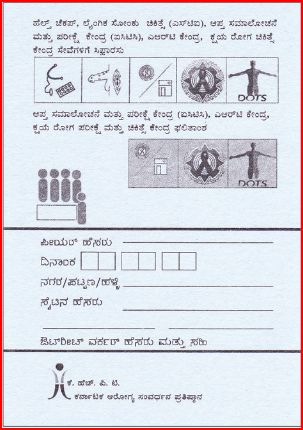
- Section 2 provides a description of each tool, including detailed information for each tool on who uses it, the frequency with which it is used, the materials needed, and how to use it, as well as an example of each tool. It includes strategies such as how to work with low-literacy PEs. This approach "requires special tools that rely on pictures or symbols instead of the written word. With training to recognize the symbols used in the tools, PEs usually have little trouble adapting and using the symbols to record data about their activities. Some programs use removable stickers, but having the PEs draw simple symbols or check off pictures on the forms works just as well." (The image above is that of a peer card.)
- Section 3 presents a sample plan that a peer-led outreach programme could use when adding micro-planning to an existing outreach programme.
- Section 4 includes information on further issues to consider.
- Appendix 1 provides more examples of the tools presented in Section 3.
- Appendix 2 presents a sample registration form.
- Appendix 3 contains a list of resources for peer-led outreach and micro-planning.
Editor's note, September 28 2017: Our apologies, but this document is no longer available online.
124
Email from Sarah McNabb to The Communication Initiative on August 12 2013. Image credit: Karnataka Health Promotion Trust (KHPT), Karnataka, India
- Log in to post comments