










































Shared Decision-Making Interventions: An Overview and a Meta-Analysis of Their Impact on Vaccine Uptake
Dartmouth College (Scalia, Durand, Elwyn); Université de Toulouse (Durand); Université Paul Sabatier Toulouse III (Durand); Unisanté, Centre universitaire de médecine générale et santé publique (Durand)
"...[This] focussed review of the effect of SDM interventions on vaccine hesitancy showed significantly increased vaccination uptake in comparison to control groups."
Shared decision-making (SDM) is viewed as the pinnacle of patient-centred care, supported by an ethical imperative and by empirical evidence of benefits. SDM interventions, which facilitate communication between those who are collaboratively engaged in making a decision in a healthcare setting, have been associated increased knowledge and awareness of, and satisfaction with, healthcare decisions and other positive patient outcomes. To provide a specific example of how SDM can be a valuable approach, this article focuses on vaccine hesitancy, which the World Health Organization (WHO) considers a significant threat to global health. It offers a systematic review and meta-analysis of randomised controlled trials (RCTs) that have assessed the impact of SDM interventions on vaccine uptake.
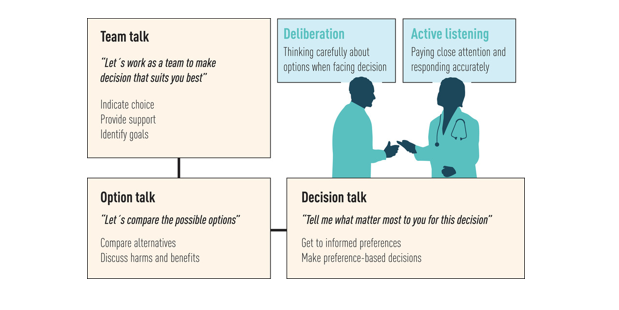
SDM interventions are designed to provide evidence-based, trustworthy information in accessible formats about a set of options so that patients can make decisions that align with their preferences. As Elwyn et al. (2017) explain, SDM recognises the role of the concerns, personal circumstances, and contexts of patients and their families in healthcare decisions. The SDM process may include the use of interventions such as clinician skills training and/or decision support tools. SDM interventions are designed to engage patients in medical decision making, with an eye toward patient activation.
An electronic search strategy adapted for the Google Scholar and PubMed search engines in March 2021 found 10 RCTs that met inclusion criteria. The RCTs were conducted in 7 different countries. Two studies employed a patient decision aid in combination with communication training, or in one case, a 2-hour parent meeting where researchers gave vaccination information and facilitated a discussion. Another study used conversation training as the SDM intervention. Other RCTs presented information using more traditional formats such as leaflets and pamphlets. See Table 1 in the paper for details.
In short, the review found that SDM interventions significantly increased vaccine uptake compared to control groups (odds ratio (OR) = 1.45; 95% confidence interval (CI) 1.17-1.80; p < 0.01). Some RCTs also reported significantly decreased decisional conflict and increased decision confidence. For example, one RCT determined that a web-based patient decision aid for the influenza vaccine significantly increased confidence in the vaccine decision and decreased uncertainty about the decision to get vaccinated. Another found that a web-based decision aid for the human papillomavirus (HPV) vaccine significantly decreased risk perception and increased positive beliefs about the safety and efficacy of the vaccine.
While noting that more work is needed to ensure that SDM interventions are accessible and usable among patients with lower health literacy skills, the researchers conclude that interventions designed to facilitate this approach "can represent a helpful, ethically defensible, strategy to increase vaccination rates."
Journal of Internal Medicine, vol. 291, issue 4, April 2022, pps. 408-25. https://doi.org/10.1111/joim.13405
- Log in to post comments