










































Vx Data Insights
"We believe that by engaging with system actors as individuals and examining the program from their unique viewpoints, we will be able to offer fresh perspectives on decades-old challenges."
Vx Data Insights is a human-centred design (HCD) study aiming to understand and overcome challenges to collecting and using data for decision-making in delivering immunisation services. A joint effort between Sonder Collective and John Snow Inc. (JSI), Vx Data Insights is being conducted in Kenya, the Democratic Republic of Congo (DRC), and Mozambique. The aim is to generate insights to support national immunisation programmes in designing interventions to address behavioural and systemic challenges to effective data collection, management, and use - ultimately, improving service delivery and health outcomes.
With participatory HCD research at its core, Vx Data Insights is understood as a first step in developing interventions (technical, behavioural, and organisational) that address and support the motivations and behavioural drivers of critical actors in the immunisation system. It is focusing on health systems and actors at the national, subnational, and facility levels in Kenya, Mozambique, and the DRC, exploring both context-specific elements and commonalities across countries. The project consists of 4 phases:
- Planning - The project team engages key stakeholders and aligns on study objectives.
- Discovery - The team carries out literature and landscape reviews to uncover, synthesise, and document the existing body of knowledge around immunisation programme data usage and collection, with a special emphasis on how data is being used for decision-making. In addition, they conduct interviews with decision-makers, data collectors, and data users, including health system leaders, managers, and service providers linked to the national immunisation programme, to better understand and prioritise knowledge gaps. In order to validate the findings from the interviews, they shadow and observe participants within their work environment for several hours to half day at a time.
- Field research and documentation - Guided by HCD, the research team uses a set of tools and methods that focus on understanding the unique needs of the individual actors of the system and help uncover behaviours, motivations, and attitudes that may be missed using more traditional research methods. From this analysis emerges patterns and themes, including:
- Day-to-day experiences of healthcare workers and managers;
- Decision-making - what information (both reported data as well as other, less formal information sources) is being used to make immunisation decisions; what information might be inaccessible, not available at the right time, or missing entirely; and what information is being collected but not being used?;
- Motivation - intrinsic and extrinsic drivers of behaviour inherent in managing, reporting, and using data for immunisation programmes;
- Data culture and value - participants' perceptions of and attitudes towards data collection and use; and
- Moments of exchange - how actors at various levels are interacting with each other, what information is being exchanged and under what circumstances, and how these interactions positively and negatively impact data collection and use.
- Synthesis and dissemination - In Kenya, the team held an in-country synthesis workshop with key stakeholders. Once the field work has been completed in the DRC and Mozambique, they will hold a regional synthesis workshop to identify overarching themes and global-level insights. These insights will then be broadly disseminated.
According to organisers, HCD can help uncover root causes behind systemic problems and translate them into actionable insights that can inform future products, services, and interventions. The idea is that, by engaging with individuals and by taking time to understand their experiences, motivations, and daily struggles, researchers can examine the system anew from the system-user perspective.
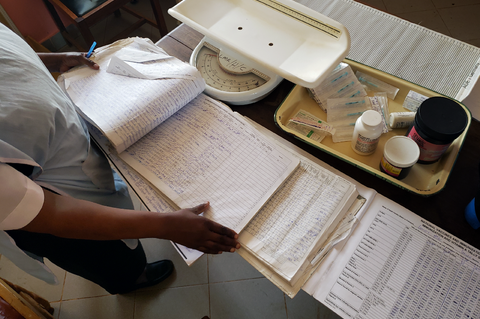
Vx Data Insights' strategic use of HCD is grounded in the assumption that understanding perceptions and mental models around decision-making can support a strong data culture. Furthermore, the ability to understand the context in which decisions are made is seen as important for thinking about the channels and formats in which data can be accessed and incorporated into the process. For instance, many of the working groups Kenya research participants described relied on a single individual, most frequently the records officer, to provide relevant data for meetings. Designing interventions specific to those individuals can have an impact on how data is used throughout the system.
One output to date of the Kenya field research is a report [PDF] summarising initial findings from the team's conversations (in January and February 2020) with nurses, Expanded Programme on Immunization (EPI) managers, and other decision-makers at all levels of the healthcare system in Kenya. The report features, among other elements, 14 profiles across all levels of the system - e.g., at the community level, where the focus is on engaging community members, collecting relevant data, and coordinating with the facilities to implement outreach activities. For each profile, the report outlines key challenges, decisions, and interactions. For instance, the profile of an immunisation nurse explains that she understands the importance of good data but does not have the proper training or passion for numbers.
Immunisation and Vaccines
According to Vx Data Insights organisers, high-quality and timely immunisation data are vital to inform decisions at local, national, and global levels. This includes decisions about how to reach all children, introduce new vaccines, document impact, monitor and improve immunisation programme performance, and prioritise resources and activities (IDEA, 2019; SAGE, 2019). Global stakeholders and national governments have acknowledged challenges related to collecting and using quality data on routine immunisation and new vaccine introductions for planning, management, and performance improvement, yet few can identify which barriers matter most, or the scope of the problem within a particular country (Akhlaq et al., 2016; Doughtery et al., 2014). Vx Data Insights organisers argue that, in order to devise strategies to improve data management and use in immunisation programmes, there is a need to document and explore the experience of health managers and workers and understand their perspective on key data-related practices.
To learn more about the project:
- Participate in a series of 30-minute webinars on initial findings from the Vx Data Insights research. For example, the first, TechNet-21 Webinar: Reframing How We Think About Decision-Making, took place on June 18 2020. The team discussed 3 insights about decision-making in the Kenya health system, covering perceptions of who is a decision-maker, the context in which decisions are made, and how information is accessed to inform these decisions. Click here for information about upcoming webinars.
- Click here to download "VxDel Data Research: Kenya Initial Insights" [PDF, 72 pages, May 2020 v 4.1]. A few takeaways from the report:
- The health system prioritises client care, not data collection and use; healthcare workers struggle to keep up with all the data they are required to collect.
- Formal tools and protocols often fall short; healthcare workers tend to rely more on informal workarounds (e.g., use of WhatsApp to access real-time data and information) and quick judgments based on personal experience.
- Actors feel they have little agency or control over their work or decisions; decision-making tends to be seen as a collective rather than an individual action.
- Click here to read blogs created as part of the project, in which the team shares/will share reflections and key takeaways around decision-making attitudes and behaviours, COVID-19-related insights, the tensions between formal protocoled planning activities versus reactive problem-solving, and the ad hoc tools and approaches used in facilities.
"TechNet-21 Webinar: Reframing How We Think About Decision-Making", JSI, June 10 2020; "New Blog Series: Using Human-Centered Design to understand how data is used in delivering immunization services in Sub-Saharan Africa", JSI, May 26 2020; "VxDel Data Research: Kenya Initial Insights" [PDF], May 2020 v 4.1; "Using Human-Centered Design to understand how data is used in delivering immunization services in Sub-Saharan Africa", Medium, May 20 2020; and "Re-framing how we think about decision-making", by Sarah Hassanen, Emilia Klimiuk, Wendy Prosser, and Chloé Roubert, Medium, June 5 2020 - all accessed on June 12 2020; emails from Wendy Prosser and Emilia Klimiuk to The Communication Initiative on June 15 2020 and June 30 2020, respectively; and Vx Data Insights project page on the JSI website, June 22 2020. Image credit: JSI
- Log in to post comments