










































Woman, Mother, Life
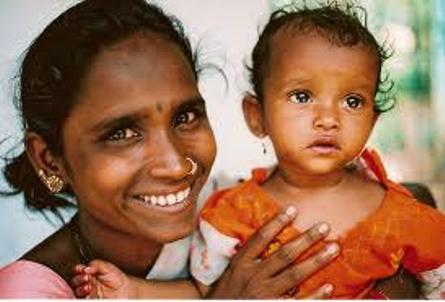
1 woman dies every 7 minutes giving birth in India
It was a dusty and drowsy afternoon. Nothing moved at the primary healthcare centre in Karra block, 60 miles away from Ranchi. Three pregnant mothers sat still on their beds, staring at the compound outside. Dry leaves swirled, as the wind grew strong. Was a storm brewing?
The day had started on a difficult note. I was in Jharkhand to film a documentary on childbirth. Divakar, who was filming it, and I had visited several remote villages in search of an expecting mother who had no access to healthcare. We wanted to understand the challenges she faced during her pregnancy.
So far, we had hit blank.
By noon, the sun was sharp and relentless. We had already traveled deep into the interiors of Khunti district. These parts, densely forested and rich in mineral resources, are marked as Maoist territory. Driving through the serenely silent and beautiful landscape, we reach Arki. Beneath an azure blue sky, the village was picturesque. Surrounded by hooded hills, the village was empty of facilities. It was here that we finally met a couple of women who were pregnant. It wasn’t easy to get them to speak. Adivasis are by nature reticent, especially when outsiders parachute in with strange queries. But soon the ice broke. Most of them did not know when they were due. Maybe during the mahua plucking season? Or when the crop is ready? Probably when the rains come. I kept thinking, was it just ignorance? Then I realised that it had more to do with stoicism. In these parts, totally cut off and isolated, mothers and their infants are expendable. Families learn to live with the reality that their daughters could die during childbirth. And often the baby too. It has become the norm.
The primary health care centre, meant to ensure safe deliveries, is miles away. It’s a small room with a thatched roof and a broken lock. It lies unused. The cobwebs tell their own story. The dai is the only one to turn to but if there are complications, there’s no one to help.
Ask officials and they shrug off their responsibility. They say no one wants to take the risk of working in these remote areas. The “dadas”, as the Maoists are called, prevent government officials from working in their territory. But while filming, we met some of the cadre who inquired about what we were doing. When we told them it was about maternal and child mortality in adivasi communities, they said adivasis don't exist for the state. They never have and never will. It is their resources they want. No one cares if women or their newborns die. And then they left.
Sitting under a massive banyan tree and a spectacular sapphire sky, we heard stories that were heart wrenching. A first time mother, just 17, gave birth to a macerated baby who had died in the womb. His tiny shape had disintegrated at the time of delivery. She didn't know when the baby had stopped moving. She barely speaks, her trauma still raw.
I ask the dai if ante natal check ups (ANCs) had been done. She looked at me puzzled. She had never heard of an ANC. She said she would check the girl once in a while to see if the baby was fine but even she couldn’t tell that the foetus had died.
Her neighbour lost his wife during childbirth. She had a prolonged labour and was bleeding profusely. By the time he arranged for transport to take her to the district hospital about 80 kilometres away, she was gone. He, too, doesn’t speak much. There isn’t anything to say. He has learnt to live with his loss. His three children play in the mud, malnourished, their eyes empty of promise. Every house in the village resonated with similar stories.
We made our way back to town through the dense forests angry and despondent.
Finally, we arrived at Karra. There were two auxillary nurse midwives or ANMs overseeing all deliveries. The pressure was enormous and the situation didn't look too good. One of three women, Shamina, had gone into early labour. Shakuntala, the supervisor, looked a trifle worried, fearing complications. Shamina's blood pressure was shooting up but the centre had run out of magnesium sulfate used to control blood pressure. Her brother was sent to buy the tablets. For the moment she was stable but anything could happen.
The ANM continued to monitor her. Since the delivery would take a while, we left to meet another woman living in a village close by. By the time we tracked Dulali, light was fading. It’s hard to tell the age of an adivasi girl but I guessed Dulali couldn’t be more than 16. Though young, she was firm. She didn't want to go to hospital or take iron and folic pills. In her eighth month, she was alone at home. We walked with her as she carried a large pitcher of water on her head. I could read the concern in the Sahiya's (frontline health worker) eyes. Would she and the baby be safe? I prodded her a little bit. Why have a baby at home and not at a hospital? She said there was no hospital close by. And how good was a hospital any way? Women die there as well because there is no one to take care. Pointing to the village she said the whole community would be there in case of an emergency.
Un-enumerated, vote-less, primitive tribal groups are India's invisible people. They have learnt not to expect anything from the government.
As darkness began to consume us, we dashed back to the PHC. The shift had changed and instead of Shakuntala, another ANM, Sangeeta, had taken over. Meanwhile, Shamina's condition has worsened. Her blood pressure showed no signs of dipping. She was delirious, her speech slurred. Medicines were not working either. It was decided that she would be referred to the district hospital. We offered to take her in our car since the ambulance would take some time to reach. The doctor stationed at the centre, a new recruit, had retired for the day. Intense fear of naxals sat like a cloak on the health centre. Karra usually shuts down by nightfall. But tonight was going to be different.
All this while, Divakar and his camera were capturing the madness that had erupted around us. Its presence drew the doctor out of his hole. Straight out of medical school, he looked terrified. He was unwilling to take any chances. He rattled off a number of possibilities. Eclampsia, severe haemorrhage, and even death.
But Shamina didn't give us a chance. Before we could shift her, she went into full labour. For the first time in my own experience, a motley group like ours helped bring a newborn to this world. Sangeeta, incredibly confident and capable, took care of the delivery. There was the possibility of heavy bleeding but her skilled handling saved Shamina. Despite my ignorance, I checked her blood pressure holding Shamina down as she turned even more delirious while Divakar handled the medications and counseled family members who were worried sick. The doctor, initially in a panic, helped resuscitate the baby, who was born blue and had stopped breathing. In the end, everything turned out fine – a story that finds resonance across rural India. Childbirth is nothing short of a miracle.
Shamina was shifted to the ward along with her newborn son. The family prayed for the well being of the child and the mother.
Exhausted but relieved, team Karra, sat down for some tea. The happiness of the family replaced the fear that had engulfed us all. The nightmare had ended. As the sun rose, Divakar and I left for Ranchi.
In rural India, every woman, who is about to be a mother lives in the hope that her pregnancy will end in celebration and not doom. But very often, that hope is a mirage, an illusion.
By Mohuya Chaudhuri
- Log in to post comments