










































Building Capacity for Creating Demand in Support of Malaria Prevention and Control
"In the context of the Support to National Malaria Control Programme (SuNMaP), demand creation is the strategic combination of advocacy, communication, and mobilisation approaches that seek to achieve increased community awareness of, and demand for, effective malaria prevention and treatment services."
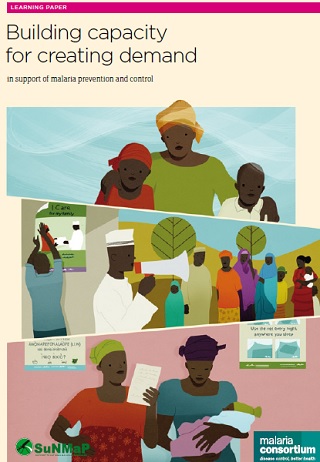
This 40-page learning paper, published by the Malaria Consortium, discusses knowledge gained through the SuNMaP programme in Nigeria in planning and implementing demand creation for malaria prevention and treatment, including SuNMaP's development of a comprehensive malaria communications plan. It presents what worked well and the challenges that remain to scale up demand creation activities. The demand creation strategy focused on long lasting insecticidal nets (LLINs), as well as intermittent preventive therapy (IPT), improved testing, and prompt and proper use of artemisinin combination therapy (ACT) treatment.
The strategy included socio-political interventions such as policy advocacy and media advocacy, service delivery interventions such as capacity building on client-centred counselling and provider-promoted risk awareness, and interventions at community and individual levels, such as community mobilisation, entertainment-education, multimedia, and public relations. SuNMaP worked with national and state governments and other partners to develop a comprehensive malaria communications plan using a mix of media. Radio is the lead medium, complemented by interpersonal communication such as health talks, treatment at service delivery points, and dialogues in community settings.
To guide the advocacy and communications strategy, the Pathways for Malaria Prevention and Control in Nigeria framework was created, with the overall goal to "reduce malaria burden to pre-elimination levels and bring malaria-related mortality to zero by the end of 2020." This framework is presented in the report, and outlines pathways comprising domains of communication, initial outcomes, behavioural outcomes, and sustainable health outcomes. The framework guides the development of the implementation plan, as well as selection of audiences, strategies, and activities. A range of stakeholders across the Roll Back Malaria (RBM) Partnership are involved in the implementation to ensure that demand creation is matched with strengthening supplies so that malaria products such as LLINs, intermittent preventive treatments (IPTs), and ACTs are available to meet the demand being generated.
As stated in the report, in 2009, the LLIN distribution campaign was initiated as an entry point to malaria prevention control. Following an initial pilot phase, relevant communication approaches and tools were identified for roll-out. The focus was on:
- "1. Where and when to access the nets
- 2. Benefits of LLINs for malaria prevention and control
- 3. Addressing the myths and misconceptions about LLINs that had discouraged their use
- 4. Demonstration on how to hang and sleep under the net
- 5. Advocacy to policy makers and community leaders to provide needed support and enabling environment for the campaign."
"By March 2013, the LLIN mass distribution campaign had covered all 36 states, and the federal capital territory, Abuja, at the rate of two nets per household. "
A subsequent "keep-up phase of demand creation" involved communication activities designed to sustain levels of information, education, and communication (IEC) that led to a change in, and maintenance of, behaviour. "The demand creation activities in support of routine malaria services include demonstrations on hanging, use and care for LLINs and community discussion groups on malaria awareness. Through service providers and radio formats, information is disseminated on the prevention of malaria in pregnancy, testing before treatment, and treatment of malaria in children under five and in the adult population."
The report outlines what worked well in the programme; radio jingles are cited as working particularly well. "Over the month prior to February 2012, 47 percent of respondents in the areas surveyed heard messages about nets, 53 percent heard messages about preventing malaria in pregnancy, and 38 percent heard messages about ACTs." At the same time, health workers, caregivers, pregnant women, and community members all reported print materials as good sources of information. Discussions at health centres and hospitals, as well as facilitated community dialogues, served to reach communities at a deeper level. The report also cites the development of the malaria brand as a key contribution to the campaign. "The logo and tagline were used as the national slogan to support World Malaria Day in 2011 and 2012. Each state adapted the tagline for their own area. For instance, in Ogun State, it read: For a malaria-free Ogun state, play your part."
Overall, monitoring data has suggested that the combination of multimedia, especially use of radio and community mobilisation, "contributed immensely to the increase in knowledge of the benefits of LLINs and IPTs and effective home management of fever. In SuNMaP focal states, the use of LLIN increased from 35 percent in 2010 to 47 percent in 2012."
The report offers suggestions for moving forward, such as improving monitoring and evaluation and using evidence to inform communication interventions. It also outlines activities to be incorporated, including involving schools in community mobilisation, continuing radio dissemination while adding net care and repair to the messages, and integrating malaria into the broader health system. Demand creation will continue to be key, and the use of text messages should be considered.
Malaria Consortium website on February 5 2015.
- Log in to post comments