










































Participatory Visual Methodologies in Global Public Health
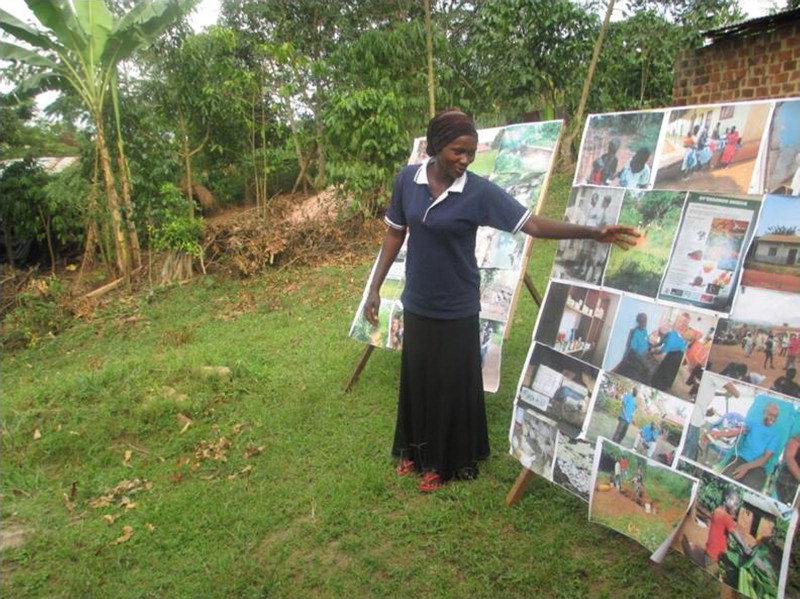
"The power of the visual to represent what is not easily put into words, especially by marginalised populations, is a key aspect of visual research. The idea of participant-generated data, and the power of participants to be in a position to create images, is also a significant feature of such approaches."
This Special Issue of Global Public Health: An International Journal for Research, Policy and Practice focuses on the use of participatory visual methodologies such as photovoice, participatory video (including cellphilming or the use of cell phones to make videos), drawing, and mapping in public health research. In the introductory chapter, Claudia Mitchell and Marni Sommer offer both an overview of participatory visual methodologies in global health and a consideration of some of the key questions that researchers might ask themselves in design and implementation.
Mitchell and Sommer explain that these approaches are, in a sense, modes of inquiry that can engage participants and communities, eliciting evidence about their own health and well-being. At the same time, they are also modes of representation and modes of production in the co-creation of knowledge, as well as modes of dissemination in relation to knowledge translation and mobilisation. Thus, the production by a group of girls or young women of a set of photos or videos from their own visual perspective can offer new evidence on how, for example, they see sexual violence. The images they have produced not only inform the empirical evidence, but also do not need to remain in a laboratory or the office of a researcher. They can, through exhibitions and screenings, reach various audiences: school or health personnel, parents and community members, and perhaps also policymakers.
With a variety of questions in mind, they say that, "[a]lthough there is a great deal of enthusiasm for participatory visual methodologies when it comes to recognising the significance of shifting power imbalances between the researcher and the researched, and in relation to the meaningful engagement of various populations and patient groups, these methodologies remain contested with regard to their authority as 'evidence', as does their use in quantitative studies, particularly in relation to their relevance to randomised control trials. How might the evidence produced in participatory visual research complement other data? What would count as compelling evidence? At the same time, participatory visual research brings its own complexities and sometimes unresolved issues. What counts as meaningful participation, and when is participation tokenistic? What new ethical challenges arise when we work with visual data in relation to anonymity and confidentiality? Who owns the visual productions (photos, videos, drawings, and maps) in participatory visual research and how are issues of ethics and ownership negotiated? Many of these concerns are not unique to participatory visual research and, indeed, they are issues that are closely linked to patient rights, access to knowledge and other important aspects of global health research. Indeed, perhaps one of the greatest contributions of the use of participatory visual methodologies within research more broadly is the very visible reminder they provide of the significance of the participants and their rights in the research process."
Articles in Part 1 of the Special Issue focus on participatory visual methodologies in work with children and young people. Part 2 shifts to the use of participatory visual methodologies in work conducted with adult populations. The issue ends with 3 book reviews. Specifically, contents include (some articles are available for free, as indicated below; others are by subscription or purchase only):
- Participatory visual methodologies in global public health [introduction to the edition] [open access], by Claudia Mitchell & Marni Sommer
- Research as intervention? Exploring the health and well-being of children and youth facing global adversity through participatory visual methods, by Miranda D'Amico, Myriam Denov, Fatima Khan, Warren Linds & Bree Akesson
- 'Closer to my world': Children with autism spectrum disorder tell their stories through photovoice, by Vu Song Ha & Andrea Whittaker
- Growing healthy children and communities: Children's insights in Lao People's Democratic Republic, by Mónica Ruiz-Casares
- Participatory mapping in low-resource settings: Three novel methods used to engage Kenyan youth and other community members in community-based HIV prevention research, by Eric P. Green, Virginia Rieck Warren, Sherryl Broverman, Benson Ogwang & Eve S. Puffer
- Exploring social inclusion strategies for public health research and practice: The use of participatory visual methods to counter stigmas surrounding street-based substance abuse in Colombia, by Amy E. Ritterbusch
- Bodies as evidence: Mapping new terrain for teen pregnancy and parenting [open access], by Aline C. Gubrium, Alice Fiddian-Green, Kasey Jernigan & Elizabeth L. Krause
- From informed consent to dissemination: Using participatory visual methods with young people with long-term conditions at different stages of research [open access], by Cecilia Vindrola-Padros, Ana Martins, Imelda Coyne, Gemma Bryan & Faith Gibson
- Beyond engagement in working with children in eight Nairobi slums to address safety, security, and housing: Digital tools for policy and community dialogue, by Claudia Mitchell, Fatuma Chege, Lucy Maina & Margot Rothman
- 'People like me don't make things like that': Participatory video as a method for reducing leprosy-related stigma, by R. M. H. Peters, M. B. M. Zweekhorst, W. H. van Brakel, J. F. G. Bunders & Irwanto
- Supporting youth and community capacity through photovoice: Reflections on participatory research on maternal health in Wakiso district, Uganda [open access], by David Musoke, Rawlance Ndejjo, Elizabeth Ekirapa-Kiracho & Asha S. George
- Using participant-empowered visual relationship timelines in a qualitative study of sexual behaviour, by Tamar Goldenberg, Catherine Finneran, Karen L. Andes & Rob Stephenson
- Regarding realities: Using photo-based projective techniques to elicit normative and alternative discourses on gender, relationships, and sexuality in Mozambique, by Emily S. Holman, Catherine K. Harbour, Rosa Valéria Azevedo Said & Maria Elena Figueroa
- Visual methodologies and participatory action research: Performing women's community-based health promotion in post-Katrina New Orleans, by M. Brinton Lykes & Holly Scheib
- The heroines of their own stories: Insights from the use of life history drawings in research with a transnational migrant community, by Jennifer S. Hirsch & Morgan M. Philbin
- Community health workers as cultural producers in addressing gender-based violence in rural South Africa, by Naydene de Lange & Claudia Mitchell
- Champions for social change: Photovoice ethics in practice and 'false hopes' for policy and social change, by Gloria Johnston
- Urban youth and photovoice: Visual ethnography in action [book review], by Jennifer A. Thompson
- Participatory visual and digital research in action [book review], by Maureen Kendrick
- What's a Cellphilm? Integrating mobile phone technology into participatory visual research and activism [book review], by Vanessa Oliver
Mitchell and Sommer reflect on some of the cross-cutting themes of these papers. They note that photovoice and the use of photographs in photo-elicitation, photo documentation, and photo-based projection are the tools most frequently referenced. One point to emerge related to the various tools and methods is the significance of triangulation in many of the articles by research teams who reported on the use of several methods in one study (e.g., photovoice and drawing; photovoice and poster production; photo-elicitation and mapping). In addition, several contributors refer to the triangulation of participatory visual methodologies with more traditional qualitative or quantitative methods. The call for papers for this Special Issue requested submissions that would not simply offer examples of these methods in action, but instead would approach these methods critically. Consequently, they articles focus on method and methodology and should be read as such; authors present only briefly their empirical findings, focusing their attention instead on extended discussions of a broader set of theoretical and ethical implications these various tools bring to the fore.
The health themes in the papers are varied, ranging from work with hospitalised children, to work on sexual and reproductive health, HIV, food security, substance abuse, teen pregnancy, and maternal health. Several of the articles taking up work with adults address issues of sexual health: men having sex with men, HIV communication with multiple partners, and addressing gender-based violence. Other health issues include leprosy and related stigma and disaster relief.
At the heart of much of this work is the notion of participation, which in itself can be interrogated. What counts as participation? What does it mean to participate, and why is it critical that citizens at whatever age have a say in the health and social conditions around them? There is one article in each section that looks more at the use of participatory visual methodologies in terms of helping to frame the actual design of the research, highlighting the significance of participation-driven research more broadly.
A second thematic area relates to ethics. Indeed, this Special Issue as a whole, Mitchell and Sommer think, can be read as a primer on visual ethics, with contributors taking up a range of topics: how to assure a determined researcher or practitioner does not display the work of a child or youth who does not understand the concept of making artwork "public" or does not have the power to say no, to determining who considers what "good" visual research and artistic representation is. A number of the papers also offer practical solutions for negotiating application of these methods in the field of global public health, where ethical review boards may be less familiar with the use of such approaches than they are in other fields.
Another cross-cutting issue that arose was that of policy dialogue and social change - speaking to the topic of social change more broadly and especially the idea of "why participatory visual methodologies, anyway?". Articles range from a consideration of the use of visual productions such as posters that could be repurposed beyond the life of a project, to how the use of participatory videos to diminish stigma around a specific disease, and how engagement by youth with the process of videotaping, editing, and screening can be a tool for social change, or how participatory processes can promote social inclusion.
Looking forward, Mitchell and Sommer recognise the issue of acceptance of these research frameworks into the range of methodologies and approaches utilised in health research. "This is no small task and may require a re-thinking of not only what counts as evidence, but the significance of participant-driven agendas. With greater acceptance of these methodologies, there is likely to be a need to expand the discourse community in ways that facilitate discussions of codes of conduct and standards of practices for tools and methods." There is also, they say, increasing acknowledgement of the need for various professional organisations and academic bodies to develop guidelines, as well as the need for more support and resources for training for researchers in such areas as participatory analysis, visual ethics, and community-based research more broadly. "Finally, we think that this Special Issue points to the question 'who are participatory visual methodologies for?' Many of the contributors have highlighted populations who are described as marginalised. Perhaps this suggests that we need to think more about what global public health would look like if we took seriously the place of all voices to drive health research."
Global Public Health: An International Journal for Research, Policy and Practice, Volume 11, Issue 5-6, 2016. Image credit:Supporting youth and community capacity through photovoice: Reflections on participatory research on maternal health in Wakiso district, Uganda, by David Musoke, Rawlance Ndejjo, Elizabeth Ekirapa-Kiracho & Asha S. George
- Log in to post comments