










































Strengthening International Health Security by Embedding the Role of Civil Society Organizations in National Health Systems: Lessons from the 2014-2016 West Africa Ebola Response
University for Development Studies (Hushie); Health and Development Solutions Network (Salifu); Centre for Development and Policy Advocacy (Seidu)
"...directs attention to specific areas at the backbone of any response to public health emergency, and where CSO-health system intersections can be particularly leveraged and better strengthened in LMICs."
In the wake of global health crises such as the 2020 COVID-19 pandemic, the role of civil society organisations (CSOs) in effective responses has been recognised. Such participation is often premised on the assumption that CSOs' grassroots linkages and close proximity to the communities most affected by specific health challenges give them comparative advantage in providing interventions that reflect local contexts, needs, and realities and that help promote democratic and accountable governance processes in global health. This book chapter examines CSOs' roles and responsibilities during the 2014-2016 West Africa Ebola virus disease (EVD) outbreak and how they can be further empowered to perform these functions. It draws conclusions about the opportunities and challenges CSOs represent for strengthening international health security (IHS) and national health systems during public health emergencies in low- and middle-income countries (LMICs).
As the authors outline, strong, well-funded, and well-staffed health systems are fundamental in the fight against diseases such as Ebola. However, the three most affected countries, Guinea, Liberia, and Sierra Leone, had suffered years of civil wars that led to widespread poverty, weak infrastructure, and a lack of health professionals, especially in rural areas. Consequently, the Ebola containment efforts were severely hampered by already weak and fragile health systems, including poor surveillance preparedness and weak governance systems.
The chapter provides a review of the terms CSOs, IHS, and health systems strengthening and their inter-relatedness to provide a conceptual framework for the study. This framework is grounded in the World Health Organization (WHO)'s health systems "building blocks", and the study looks at articles published from 2013 to 2019 on the roles played by CSOs during the 2014-2016 West Africa EVD outbreak through the lens of each of them:
- Leadership/governance: The study found this "block" to be the major entry point through which CSOs' distinctive roles become critical in responding to public health threats. For example, non-governmental organisations (NGOs) helped to establish ownership and accountability mechanisms, which are often non-existent in the public sector of LMICs.
- Health information systems: The complex nature of the response to the 2014-2016 outbreak required coordinated, bottom-up approaches to EVD surveillance (involving local communities, districts, and health facilities) to quickly detect and report new cases; NGOs were the first to champion the establishment of such systems.
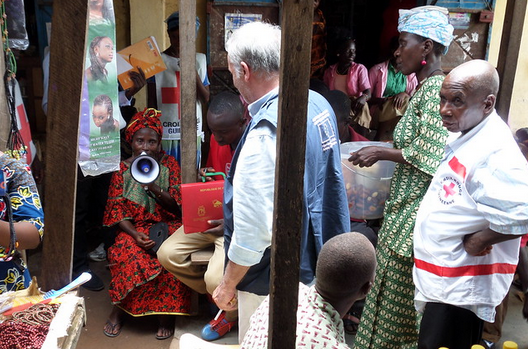
- Service delivery: Some NGOs engaged in social mobilisation, community empowerment, and public awareness activities to educate community members on how to recognise EVD signs and symptoms and refer potentially infected individuals to the nearest health facility. In addition, NGOs supported the establishment of post-epidemic survivor programmes and associations that have enrolled survivors in vocational and literacy training, employed them to lead community mobilisation and empowerment initiatives in Ebola-affected communities, and provided critical healthcare services.
- Medical products, vaccines, and technologies: For example, local laboratory technicians and other health professionals were trained in the use of laboratory testing tools for diagnosing Ebola.
- Health workforce: Working in close collaboration with international actors and the health system, CSOs supported the West Africa outbreak with a mix of health workforce, such as risk communication professionals. Other CSOs provided training to community health workers and community leaders in, for example, provision of psycho-social support and counseling for affected individuals and households. This way, CSOs mobilised the local knowledge and skills, trust, and bonds of solidarity that help staff to rapidly detect and effectively respond to Ebola.
- Health financing: Funding through varied mechanisms was deployed to strengthen the health systems of the affected countries while responding to the epidemic, such as by running mass media public health information campaigns to boost media awareness of preventative measures and building the capacity of governmental public health organisations in the development of novel vaccines.
Discussion follows about the contributions and challenges to CSOs' engagement in the EVD response. Here are just a few examples:
- Failure to take cognisance of the local socio-cultural and political contexts in implementing seemingly technical EVD interventions. Recommendation: CSOs should make their technical programme activities politically and culturally sensitive to local contexts and needs.
- Poor response coordination among CSOs themselves or with national governments. Recommendation: CSOs should support established national government response coordination structures, rather than setting up parallel structures of their own.
- The slowness with which CSOs already working in the affected countries shifted from a development approach to an emergency humanitarian method for fighting the epidemic. Recommendation: CSOs should prioritise disease prevention, outbreak spread, and saving lives over developmental activities during such health crises.
Another communication-related recommendation is that efforts should be made to engage CSOs and communities in rebuilding health systems and trust and in limiting stigma. As noted here, primary psychosocial and mental health impacts of Ebola (and other epidemics) potentially affect a wide group of people at the individual, community, and international levels. For example, at the community level, a recurring pattern of anxiety may ensue, with a loss of trust in health services, stigma and/or isolation, and loss of support or coping resources resulting in disruptions of community and cultural life. In order to address some of these primary humanitarian problems and impacts, it has been suggested that CSOs have a role to play.
In conclusion: "this review finds that CSOs have played supplemental albeit critically important roles in filling health systems gaps in a manner that enabled national governments and global actors to contain the West Africa EVD outbreak....What is needed is more in-depth understanding of the respective roles played by these varied global health actors working in collaboration with CSOs during public health emergencies. Moreover,...systematic collection of primary data on the full range of global health actors responding to public health emergencies with CSOs as implementing partners is needed to provide a clearer understanding of how profitably CSOs might be better engaged in health crises that cross national boundaries."
In Contemporary Developments and Perspectives in International Health Security - Volume 1, edited by Stanislaw P. Stawicki. DOI: 10.5772/intechopen.84766. Image credit: ©EC/ECHO/Jean-Louis Mosser via Flickr (creative commons licence)
- Log in to post comments