










































A Bird Flu Over the Commie Nest
Massachusetts Institute of Technology
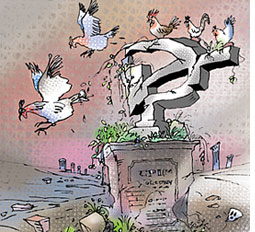
Using the avian flu epidemic of West Bengal, India, as an example, Abhijit Banerjee comments on people's belief or disbelief in government crisis warnings and how disbelief stems from already-undermined state authority. In this case, lack of trust has resulted in hiding birds and driving them across state borders to sell them and has necessitated on-the-spot government compensation, rather than promise of payment, for the culling of poultry. He traces the public reaction to their perception of government credibility - or lack of credibility - in representing the public interest in the kind of crisis which allows no time for public debate or popular mandate. He states that years of compromises and favouritism have left the government without an automatic claim to authority because people treat "any declaration of government policy, mostly correctly, not as a necessary, decisive move, but as the opening gambit in a long political game."
The author then reviews the recent political history related to decisions based on government authority in this state, particularly decisions on large-scale land use (development, and compensation for the taking of private land) and how politicising the agency of the state undermines its ability to manage crises. "...[W]inning an election does [not] guarantee being able to govern, and nor does losing absolve one of all responsibility towards making governance possible. Victory transfers to the winning party the presumption of authority, of being able to act on its judgement, but its ability to actually do so depends on the credibility it carries with it — especially among those who did not vote for it — and the willingness of the opposition to let it govern." He states that the problem in Indian politics is that as it becomes more competitive and focused on winning, it becomes "harder and harder for the parties to rise above their partisan commitments and to acknowledge the authority of the state." Hence, he sees local non-cooperation in bird flu prevention as a result: "[W]e seem to be flirting with what might be the first great public health crisis of this millennium."
Email from Nalaka Gunawardene to The Communication Initiative on March 23 2008 and Down to Earth Magazine, February 29 2008 issue.
Comments

- Log in to post comments