










































Bangladesh Knowledge Management Initiative: Effects of a Digital Health Training Package on Client Family Planning Behaviors
Johns Hopkins Center for Communication Programs (CCP)
"Knowledge management methods such as eLearning courses and Toolkits provide curated and synthesized collections of selected health information that fieldworkers can easily access and apply in their daily work, and then diffuse this knowledge and learning to their clients."
This research brief describes a cross-sectional study designed by K4Health to test the effects of a digital health training package on family planning behaviours in Bangladesh. It was carried out as part of the Bangladesh Knowledge Management Initiative (BKMI), which was an effort to strengthen the capacity of the Government of Bangladesh (GoB), United States Agency for International Development (USAID) implementing partners, and other stakeholders to develop strong, consistent, and effective social and behaviour change communication (SBCC) campaigns and interventions to improve the health and well-being of the people of Bangladesh. In brief, the research found that the knowledge a fieldworker gains through a digital health training package can be diffused to clients, positively affecting client knowledge and behaviours. Furthermore, digital health training packages can empower fieldworkers by providing them with relevant information at the point of care, which can enhance their credibility among the communities they serve.
As noted here, the diffusion of innovations theory suggests that, although external influences are generally responsible for making individuals aware of an innovation, such as a practice or idea, it is interpersonal influence (the interaction with friends and neighbours) that leads to adopting that idea or practice (Rogers, 1995; Valente, 1996). The K4Health Project hypothesised that fieldworkers would obtain knowledge through a digital health training package and then pass on the information to their clients.
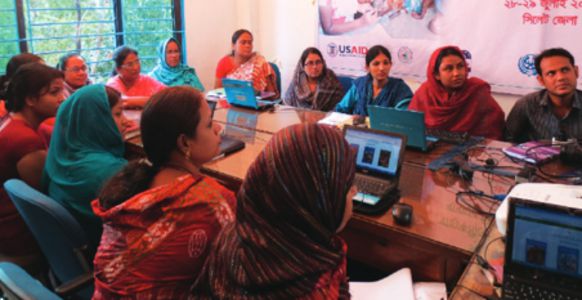
The study, consisting of a household survey, was conducted in 2 low-performing districts, Sylhet and Chittagong; 6 upazilas (subdistricts) were randomly selected from each of the 2 districts. Within each upazilla, 2 unions were randomly selected, yielding a total of 12 unions per district. A household mapping exercise was undertaken in 12 unions in each district to prepare a sampling frame of mothers with children under age 2. Netbooks were issued to fieldworkers and contained 2 distinct offline digital health training resources: (1) 8 video-based eLearning courses on topics related to maternal health, family planning, nutrition, interpersonal communication, and integrated messaging; and (2) an eToolkit containing more than 100 printed and audio-visual materials for fieldworkers to use as counseling tools on health, family planning, and nutrition topics during their regular counseling activities. The eToolkit was also designed to supplement and refresh fieldworker knowledge.
There were 3 exposure group categories: mothers who reported no home visit from a fieldworker (no exposure); mothers who reported receiving a home visit from a fieldworker who had a netbook with the digital health training package (low exposure); and mothers who reported receiving a home visit from a fieldworker who had a netbook with the digital health training package and were shown a digital resource during the visit (high exposure).
With regard to fieldworkers' behaviours: Using logistic regression modeling, K4Health found that both low and high levels of exposure to the digital health training package were associated with higher odds of mothers reporting that the fieldworker discussed various contraceptive method options, side effects of methods, and what action to take with regard to side effects. For example, mothers in the high-exposure group were 2.73, 3.29, and 3.23 times more likely to report that the fieldworker discussed contraceptive choice, discussed side effects, and provided information regarding actions the mother could take if she experienced side effects related to contraceptive use, respectively, compared with mothers in the no-exposure group. With regard to mothers' current contraceptive use: A high level of exposure was associated with higher odds of mothers reporting current contraceptive use. For example, mothers in the high-exposure group were 1.85 times more likely to currently use contraceptives compared with mothers in the no-exposure group.
"This study provides evidence for the differential effects of a digital health training package. Even low exposure to the package was associated with an increased likelihood of fieldworkers offering a choice of contraceptives, discussing side effects, and discussing possible actions to take after experiencing side effects. However, higher odds of contraceptive use was associated only with high exposure - those mothers who reported receiving a home visit from a fieldworker who had a netbook with the digital health training package and were shown a digital family planning resource on the netbook. This finding indicates that digital resources, an effective and appropriate tool for facilitating counseling, must be supplemented with interpersonal communication for successful client behavior change."
K4Health on March 3 2017, sourced from the K4Health Newsletter, February 2017. Image credit: BKMI
- Log in to post comments