










































Conventional or Interpersonal Communication: Which Works Best in Disseminating Malaria Information in an Endemic Rural Bangladeshi Community?
Centre for Equity and Health Systems, International Centre for Diarrhoeal Disease Research, Bangladesh (Ahmed); BRAC (Ahmed, Hossain, Kabir)
"This study reiterates the fact that conventional media may not be user-friendly or culture-sensitive for this semi-literate/illiterate community where dissemination through 'words of mouth' is more common, and as such, interpersonal communication is more effective. This is especially important for initiating informed action by the community in managing malaria-like illnesses."
Since 2007, BRAC - an indigenous non-governmental organisation (NGO) in Bangladesh - has been implementing a malaria prevention and control programme in 13 malaria-endemic districts under the National Malaria Control Programme. This study was conducted to examine the role of different communication media in bringing about changes in knowledge and awareness.
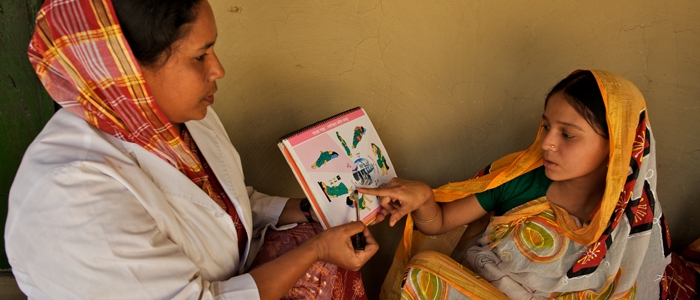
BRAC's malaria control and prevention programme has both preventive (insecticidal bed net distribution and information, education, and communication (IEC) activities) and curative (presumptive case management, early diagnosis and prompt treatment, and referral of complicated cases to higher facilities) components. Various IEC materials such as posters, leaflets, billboards, radio and television spots, etc. are used for dissemination of relevant information and building awareness for affirmative action. The community health workers use flip charts in interpersonal communication (IPC) with women and other household members during home visits. Furthermore, other means such as folk songs, popular theatre, loudspeaker miking, etc. are used to mobilise the community for informed action regarding malaria control and prevention.
A baseline survey in 2007 before inception of the programme and a follow-up survey in 2012 were done to study changes in different aspects of programme interventions, including the communication component. Both the surveys used the same sampling technique to select 25 households at random from each of the 30 mauza/villages in a district. A pre-tested, semi-structured questionnaire was used to collect relevant information from respondents in face-to-face interview. Analysis was done comparing the study areas at two different times. Statistical tests were done as necessary to examine the differences.
It was found that the intervention succeeded in improving knowledge in some trivial areas (e.g., most frequent symptom suggestive of malaria, importance of using insecticidal bed nets) but not in critical domains necessary for taking informed action (e.g., mode of malaria transmission, awareness about facilities providing free malaria treatment). Inequity in knowledge and practice was quite common depending upon sex (more if male), household wealth status (improved if affluent), schooling (better if had schooling), etc. Of the different media used in IEC campaigns during the study period, IPC with community health workers/relatives/neighbours/friends was found to be more effective in improving knowledge and practice than conventional print and audio-visual media. "This is not surprising in a largely illiterate/semi-literate society, where the contents and forms of print and audio-visual materials may not be user-friendly or culture-sensitive."
Looking forward, "the programme needs to revisit its IEC strategy to improve the depth of knowledge of the community and give attention where it is due i.e., interpersonal communication. In this regard, programme may also think of innovative means of information dissemination in this largely semi-literate community such as using folk songs, popular theatre, peer group discussion, etc."
PLoS ONE 9(3): e90711; March 6 2014 - sourced from: Malaria Monitoring and Evaluation (M&E) listserv, March 12 2014. Image credit: BRAC
- Log in to post comments