










































Global Survey on COVID-19 Beliefs, Behaviours and Norms
The University of Texas at Austin (Collis); Rutgers University (Garimella); Massachusetts Institute of Technology (Moehring, Aral, Eckles); University of Pittsburgh (Rahimian); Johns Hopkins Center for Communication Programs (Babalola, Shattuck); Johns Hopkins University (Babalola); University of Oxford (Gobat); Global Outbreak Alert and Response Network (Stolow) - note: The first 4 authors contributed equally.
"This resource can open new areas of enquiry in public health, communication and economic policy by leveraging large-scale, rich survey datasets on beliefs, behaviours and norms during a global pandemic."
There is growing evidence that people's COVID-19 prevention behaviours are dramatically influenced by many social and cultural factors. For instance, vaccine uptake is not entirely in the control of experts and policymakers. These observations are consistent with the recognition that health communication is a core part of effective response to epidemics. However, developing and deploying effective policies and communication strategies requires data about people's beliefs and how they have been affected by prior exposure to information from governments, peers, and the media. Thus, this report introduces a COVID-19 survey with data from 67 countries to help policymakers and researchers monitor and understand people's knowledge, beliefs, behaviours, norms, and risk perceptions across the world. It was carried out through a collaboration with Facebook and Johns Hopkins University, with input from experts at the World Health Organization and the Global Outbreak Alert and Response Network.
The survey ran from July 2020 until March 2021. It was translated into 51 languages and fielded in 67 countries, yielding over 2 million responses. It consistently sampled (except the wave starting on September 14 2020) around 3,000 users every wave. However, the effective sample size varies more widely among the countries and within each country. (Further information on research design is available in the Nature Research Reporting Summary linked to from the article.)
In constructing the survey instrument, the researchers drew on input from a wide set of domain experts. The survey consisted of questions related to COVID-19 information exposure and trust in information sources, knowledge about the virus, community norms, prevention behaviours, beliefs about efficacy of measures, vaccine acceptance, risk perceptions, and locus of control, in addition to demographics. The survey data include weights that are based on the information Facebook has about its users to reduce bias.
The paper presents three examples of potential use cases for the dataset:
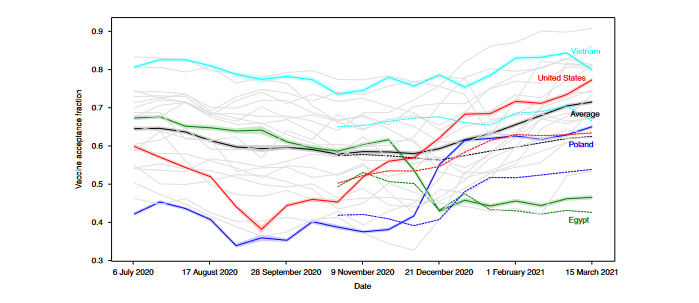
- Vaccine acceptance over time: First, the researchers computed the fraction of respondents who say they would take a vaccine or have taken the vaccine. They found huge heterogeneity across countries, with Vietnam having a consistent vaccine acceptance of over 80% throughout the time period, and countries like the United States (US) and Poland experiencing an initial dip but improving in terms of acceptance later. On average, across the 23 wave countries, vaccine acceptance has varied in the range of 57% to 71%, with slight improvements since late 2020. Starting in wave 9 (end of October 2020), the researchers also asked the following question about perceived vaccine norms: "Out of 100 people in your community, how many do you think would take a COVID-19 vaccine if it were made available?" There is a significant difference between individual beliefs ("acceptance") and beliefs about others ("norms"), with at least a 10% gap between them consistently. In other words, respondents think that at least an additional 10% of the population would not take the vaccine.
- Mismatch in COVID-19 perceptions: The researchers asked: (i) "How important is it for you to take actions to prevent the spread of COVID-19 in your community?"; and "How important do other people in your community think it is to take actions to prevent the spread of COVID-19?" If respondents themselves think taking action against COVID-19 to be extremely important, but think others do not take it seriously (or vice versa), they might adapt their behaviour to take steps that would not be necessary. Figure 7 in the paper shows the mismatch in beliefs for two countries: the US and Japan.
- News sources and medium - consumption versus trust: Some of the trends that emerged: politicians are the least trusted, and in most countries the least used, source of information. Television has high consumption, but trust in television varies widely among the countries in the sample. Local health workers are typically well trusted but they are not a source of information for most countries.
As reported here, these types of survey data have already been used in research that may inform policies on the national and global stage. For example, a study of political messaging and attitudes towards vaccination in Latin America has used the surveys to assess the relationship between vaccine acceptance, political vaccination campaigns, and political trust. Furthermore, the significant country-level heterogeneity of the survey measures - in particular, the vaccine trends - has reportedly served as motivation or explanatory factors in other research studies that seek to understand and/or reach local populations (e.g., in Spain or Australia). Others have analysed the survey responses to construct various measures of vaccine intention, perceived invincibility, and prosocial concerns at the individual level and to study their relationships, controlling for perceived personal health and demographic attributes measured in the survey. These studies have revealed that perceived invincibility has an overall negative effect on both prosocial concerns and vaccine intentions, particularly in counties with low cultural collectivism. "This ability to investigate individual health-related behaviours by controlling for country-level variables, such as cultural collectivism, shows the unique contribution of the present resource to the research community. Such investigations would not have been possible without the global COVID-19 beliefs, behaviours and norms survey data."
In conclusion: "Some of the trends observed here, particularly at a global scale and including countries in the global south, are valuable for understanding behavioural and social drivers of vaccination...and would not have been made available to the research community otherwise. Identifying what people think and feel and the social processes, such as norms..., that influence their thinking will help researchers identify motivations behind critical health behaviours....Overall, this paper provides a valuable resource which should serve as a foundation for future research and give rise to new questions in understanding the COVID-19 pandemic and developing policy solutions around it."
Nature Human Behaviour (2022). https://doi.org/10.1038/s41562-022-01347-1
- Log in to post comments